


When Google first announced the Google Search Generative Experience (SGE), many marketers and SEO professionals immediately recognised that search as we know it was about to change. Unlike the familiar list of blue links we’ve seen for decades, SGE uses generative AI to create detailed summaries, context-rich answers, and personalised results—all within the search interface.
This shift is revolutionary. But what does it really mean for users and businesses? And how can Australian brands prepare for a reality where Google itself becomes both the guide and the gateway to information? Let’s look closer at how SGE (now known as AI Overviews) works, why it matters, and what it means for the future of search.
What is Google Search Generative Experience?
Google’s Search Generative Experience is a feature powered by Google Generative AI that transforms how results appear. Instead of presenting a static index of ten web pages, SGE uses AI to generate concise, information-rich summaries that answer search queries directly.
For instance, instead of typing “best ways to fix a slow laptop” and scrolling through dozens of pages, SGE might produce a summary explaining common causes, practical steps, and product recommendations—all in a single snapshot. Beneath this summary (and on the sidebar), it still provides source links, giving users a path to explore further.
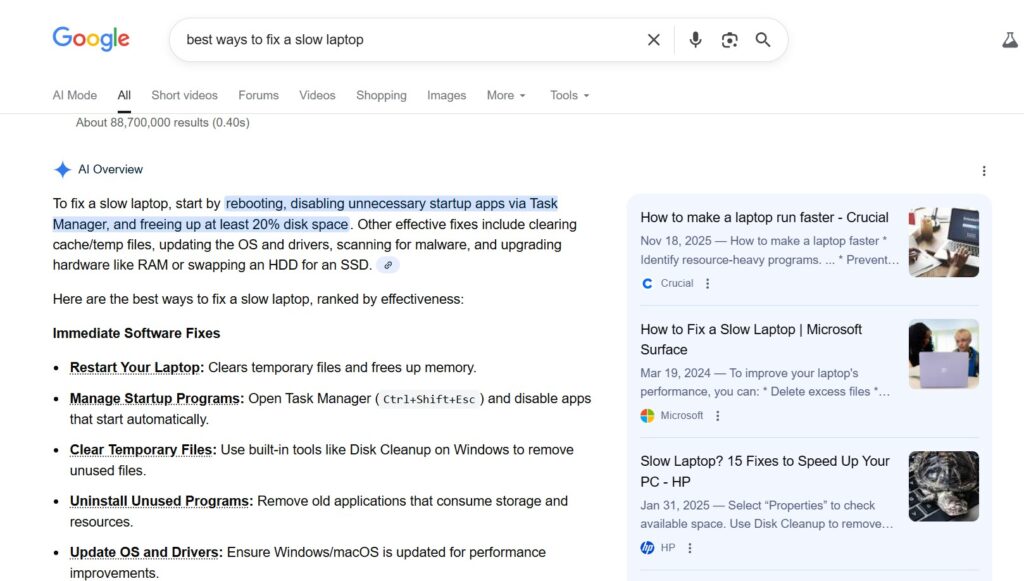
Essentially, SGE blends traditional search results with conversational AI responses. It’s powered by large language models similar to those behind tools like Gemini (Google’s own AI system), designed to interpret complex queries and generate natural, context-aware answers.
The appearance of this feature is remarkably widespread. Current research suggests that AI Overviews currently affect a massive portion of the market. Experts have tracked SGE-like elements appearing across an estimated 84 per cent of search queries.
Generative AI vs Search Engine: A Fundamental Shift
Google combines its core search engine with generative-AI capabilities (its Gemini model and others) to deliver these overviews.
Key steps:
- User enters a query.
- Google’s system interprets intent (not just keywords).
- A generative model synthesises content from multiple web pages, facts, and snippets.
- The search results page (SERP) presents an overview at the top, followed by supporting links and related content.
Users can then ask follow-up questions directly within the search interface, allowing for a more interactive and conversational experience.
Because of its placement (above usual organic results) and functionality (providing an answer within the SERP), SGE is already influencing how users behave and how content is accessed.
Why SGE Marks a Shift in Search Behaviour
Historically, Google’s algorithm has rewarded clear keyword structure and authority-building signals, such as backlinks, content quality, and site speed. SGE changes the visual and behavioural side of that equation. Users are now more likely to satisfy their query instantaneously, often without leaving the search environment.
This is the essence of the shift towards generative search. Sites ranking below the AI summary may experience significantly lower click-through rates (CTRs), with reports indicating drops of 15–30% or more, especially for informational queries. However, Google still displays cited links within SGE summaries—often featuring reputable sources.
That means while total clicks might decline, the value of appearing as a cited source increases significantly. Being part of those AI-generated overviews could become the new top position in search visibility.
What This Means for SEO
SEO is far from obsolete—it’s simply evolving. Traditional keyword tactics remain useful, but the focus is shifting towards topic authority, trust signals, and clarity.
Here are several emerging priorities for businesses and marketers:
- Content that answers intent, not just keywords.
SGE’s AI models favour content written in natural, explanatory language. Articles that anticipate user questions and provide comprehensive, factual answers stand a better chance of being featured in summaries. - Credibility and experience matter.
Google’s E-E-A-T framework (Experience, Expertise, Authoritativeness, Trustworthiness) carries even more weight under SGE. Pages that demonstrate authentic, expert-level knowledge are more likely to be cited. - Structured data and clear formatting.
Schema markup helps SGE understand content faster. Using FAQ, HowTo, and Review schemas increases visibility potential in AI-generated summaries. - Multimedia and conversational cues.
Google’s own data shows that searchers engage more with summaries that include visuals or interactive snippets. Embedding concise images, explainer videos, or bullet points may enhance content readability for AI systems.

Opportunities for Australian Businesses
Operating in Australia, you already see AI Overviews as a standard feature. While some businesses worry about losing direct traffic, SGE also opens new doors. For instance:
- Higher trust and credibility.
If your brand’s content appears within an AI overview, it signals authority to both users and algorithms. It’s a modern form of social proof—your information has been verified by Google’s own systems. - Better-qualified traffic.
Visitors who click through from AI summaries often come with stronger intent. They’ve already consumed an overview and want to dive deeper into your expertise, products, or services. - Voice and conversational optimisation.
Because SGE integrates conversational follow-ups, content written in a natural, Q&A-friendly style will perform better. This mirrors trends seen in voice search, where long-tail queries and question-based phrasing dominate.
How to Make Your Website Adapt to SGE
Google Search Generative Experience or AI Overviews have become mainstream across Australia. Consider the following steps:
- Audit your content for intent.
Review top-performing pages and determine whether they clearly answer user needs. Rewrite vague introductions into concise, information-dense summaries that reflect what people actually search for. - Use structured markup.
Help Google identify key information by implementing schema. Pages that are easy for AI to interpret are more likely to be surfaced in SGE answers. - Update and expand expertise signals.
Add author bios, cite credible sources, and display trust elements such as certifications or awards. Google’s AI models evaluate these details when assessing authority. - Leverage visuals intelligently.
Use descriptive image filenames, alt texts, and captions that align with search intent. SGE frequently integrates visuals when constructing overviews. - Test your site’s readability.
AI summaries rely on a clear structure. Short paragraphs, direct subheadings, and clean formatting help algorithms extract meaning quickly.
What About Ads and Analytics?
Ads are now actively integrated into the AI Overview layout in Australia. That could make ad placements more valuable but also more competitive.
Tracking performance under SGE may require new metrics as well. Traditional impressions and click counts might not tell the full story. Thankfully, Google Search Console now provides data on AI Overview performance.
The Road Ahead
As Google continues to refine AI Overviews or SGE, expect to see integration across more search types—from local and shopping results to travel and reviews. The company has hinted that personalisation will deepen. That means search results could adapt to user behaviour, location, and even tone preferences.
- More multi-modal search: SGE will increasingly handle images, videos, and visual queries (for example, seeing a product or object and asking what it is).
- Greater “in-search” actions: In some cases, you’ll be able to do things directly from the search results without visiting a site (booking, linking, purchasing).
- New ad formats: As SGE blocks dominate the top of pages, Google is testing ad placements that integrate more naturally with generative results.
In short, staying aware and adaptive is the name of the game.
For Australian businesses, this change presents both a challenge and a chance to lead. Those who treat SGE as an opportunity to strengthen their authority, improve user experience, and write content that genuinely informs will likely thrive in the new search environment.
The essence of SEO remains: create valuable, trustworthy content that meets real user needs. The tools and presentation might evolve, but that principle stays the same—and with SGE, Google is simply making it more visible to those who do it best.
Securing Your Place in the Generative Era
Businesses must accept that the old standard of chasing the top organic placement has given way to a sophisticated, AI-driven gateway where information is synthesised, not merely listed. The challenge lies in transitioning from being merely ranked highly to becoming an authoritative source trusted enough to be cited by the world’s most powerful answer engine.
Success in this generative future hinges entirely on a commitment to supreme content quality, technical precision, and genuine authority. The companies that thrive will be those that invest now in reinforcing their E-E-A-T signals, structuring their data impeccably, and crafting comprehensive answers that satisfy the user’s needs.
For Australian organisations, preparing for this massive undertaking requires more than just internal adjustments; it demands specialised expertise. And that’s exactly where Canty Digital comes in. We can help conduct an AI visibility audit for your website, implement advanced structured data protocols, and develop a comprehensive GSO strategy to secure your citation within the new, valuable generative summaries.
If you’re interested in dominating the AI Overview landscape, contact Canty Digital today and start securing your success.


