


The fastest route to topical authority for an Australian local business is this: build a focused topical map around your core services, create a pillar page for each service backed by several supporting cluster articles, align every signal (your Google Business Profile, LocalBusiness schema, NAP citations and reviews) to match that content, and document real community activity as published proof. Do that consistently for 90 days and you can realistically expect to appear in the local pack for a broader set of service queries, attract AI citations from tools like Perplexity and ChatGPT, and see measurable lifts in GBP calls and direction requests.
The essential elements, in order of priority:
- Topical map: group your services into seed topics, then expand each into informational, commercial and local-intent subtopics
- Pillar + cluster pages: one comprehensive pillar per service, supported by specific how-to, cost and FAQ cluster pages
- Location and service page alignment: each page targets one location-service combination with matching schema
- GBP + LocalBusiness schema: both must reflect the same services, hours and address as your site
- Reviews and local links: service-specific review text and citations from local directories, chambers and press
“AI models favour businesses that provide direct, structured answers and have corroborating signals across GBP, reviews and local citations.” — Surferstack, 2026
Table of Contents
- What is topical authority and why should Australian local businesses care?
- How do you build a topical map for your local market?
- How do you execute a content cluster for local SEO?
- Which content types build topical authority in Australia?
- What local technical signals do search engines actually check?
- How does E-E-A-T apply to local business content?
- How do you measure topical authority progress?
- How do you maintain and scale topical authority over time?
- What mistakes do local businesses make when building topical authority?
- CantyDigital: anonymised examples of building topical authority for Australian local businesses
- How do social proof and local influencer endorsements strengthen your content strategy?
- Key takeaways
- Why community-centred authority beats template SEO every time
- CantyDigital can build your topical authority without the DIY grind
- Useful sources and further reading for Australian local businesses
What is topical authority and why should Australian local businesses care?
Topical authority is the degree to which search engines and AI models recognise your site as the most complete, trustworthy source on a specific subject within a defined area. It is not the same as domain authority, which is a measure of link quantity and age. A plumber in Wollongong with 40 pages of thin service content and a high domain authority score will still lose local pack rankings to a competitor with 15 well-structured pages that cover every angle of residential plumbing in the Illawarra.
The distinction matters because Google’s local ranking logic centres on three factors: proximity, relevance and prominence. Topical authority directly influences relevance and prominence. When your site answers every question a local customer might ask about your service category, and those answers are corroborated by your GBP, your reviews and your citations, Google and AI platforms treat your business as the definitive local resource.
Moz explains that building local authority requires both online optimisation and real-world community engagement. Neither alone is sufficient. A landscaper who publishes detailed seasonal guides for Sydney gardens AND sponsors the local school fete AND collects reviews that mention specific services will outrank a competitor who does only one of those things.
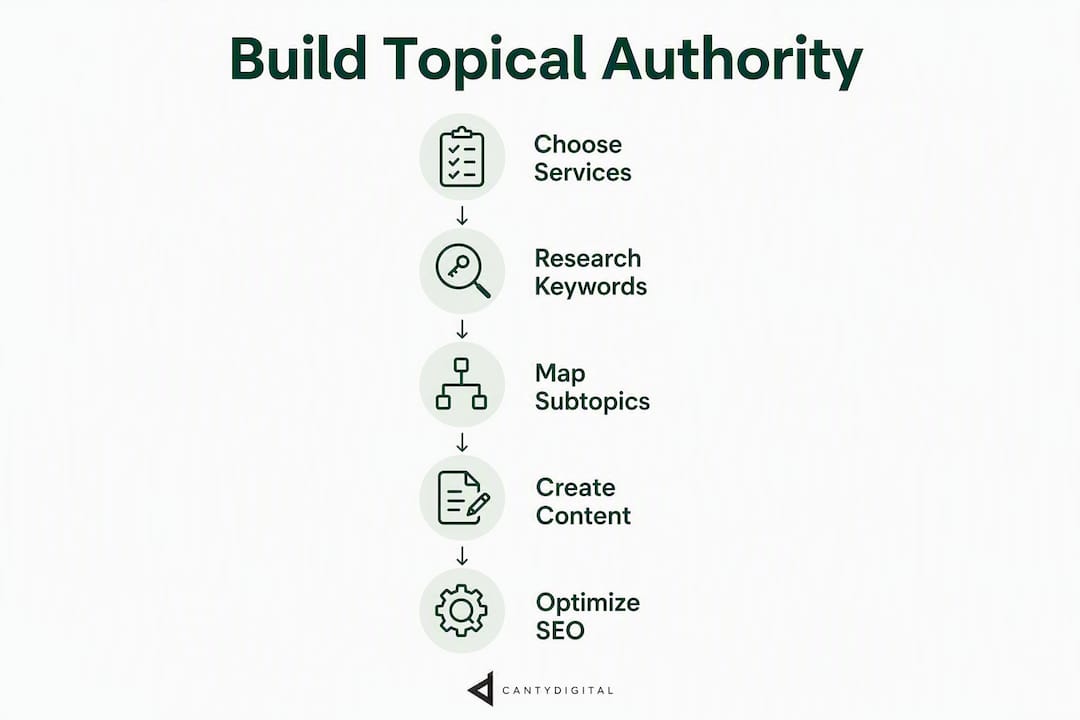
For Australian businesses, this matters more in 2026 than it did three years ago. AI-powered search surfaces in Google’s AI Overviews, Perplexity and ChatGPT now pull structured, extractable answers from local businesses. If your content is not structured to be cited, you are invisible in that channel regardless of your traditional rankings.
How do you build a topical map for your local market?
A topical map is a structured plan that connects your core services to every question, comparison and location variant a nearby customer might search. Here is a practical method to build one.
Step 1: Choose your core services and seed keywords
List your two or three most profitable services. For each one, write down the most obvious search phrase a local customer would use: “emergency electrician Sydney,” “wedding photographer Geelong,” “bookkeeper Hobart.” These are your seeds.

Step 2: Expand each seed into subtopics by intent
Group subtopics into three buckets:
- Informational: “how much does it cost to rewire a house in NSW,” “what to look for in a wedding photographer,” “when do I need a bookkeeper vs an accountant”
- Commercial: “best electrician Sydney,” “wedding photographer packages Geelong,” “small business bookkeeping services Hobart”
- Local: “electrician Surry Hills,” “wedding photographer Barwon Heads,” “bookkeeper Sandy Bay”
Step 3: Score subtopics by business impact vs content effort
Not every subtopic deserves a page. Score each one on two axes: how directly it leads to an enquiry (business impact) and how much content it requires to cover well (effort). Prioritise high-impact, low-effort subtopics first. Cost pages and FAQ pages almost always sit in that quadrant because competitors rarely publish them well.
Step 4: Research using local sources
Your best keyword research sources are not always the obvious ones. Check:
- GBP Insights for the queries people use to find your listing
- Google’s “People Also Ask” boxes for your seed terms
- The language customers use in your existing reviews
- Local Facebook groups and community forums like Nextdoor
Advanced Web Ranking recommends creating several supporting blog articles for every main service or pillar page. That ratio is a useful planning target.
Example topical map: residential electrician in Newcastle
| Page type | Example page | Intent |
|---|---|---|
| Pillar | Residential electrician Newcastle | Commercial |
| Cluster | How much does rewiring cost in NSW? | Informational |
| Cluster | Safety switch installation: what you need to know | Informational |
| Cluster | Switchboard upgrade vs repair: which do you need? | Commercial |
| Location variant | Electrician Maitland | Local |
| Location variant | Electrician Lake Macquarie | Local |
How do you execute a content cluster for local SEO?
The pillar-cluster model gives search engines a clear map of your topical territory. Each page type has a specific job.
Pillar pages
A pillar page covers your core service comprehensively. It answers the broadest version of the query (“residential electrician Newcastle”), links out to every cluster page beneath it, and carries your primary Service schema. The goal is not to be the longest page on the internet. The goal is to be the most complete answer to the commercial-intent query for that service in that location.
Cluster pages
Cluster pages answer specific informational or comparison questions. They link back to the pillar and to each other where the topics are genuinely related. Each cluster page should carry FAQ schema where it answers a defined question, and HowTo schema where it walks through a process. This structured markup makes the content extractable by AI models.
TopicalMap advises combining intent variations into one authoritative page rather than creating near-duplicate pages that compete with each other. If you have a page on “cost of rewiring” and another on “rewiring price guide,” consolidate them. Two thin pages split the authority that one strong page would accumulate.
Location and service pages
Each location page targets one suburb or region paired with one service. Keep the content genuinely local: reference nearby landmarks, local regulations (relevant council requirements, for example), and local customer outcomes. Thin location pages that swap only the suburb name are a common mistake and Google has become adept at identifying them.

Internal linking
Internal links carry topical signals. Use descriptive anchor text that names the topic, not generic phrases like “click here.” A cluster page on switchboard upgrades should link to the pillar with anchor text like “residential electrician Newcastle” and to related clusters with anchors like “safety switch installation.” Every location page should link to the relevant pillar and receive a link from it in return.
Pro Tip: Map your internal links in a simple spreadsheet before you build pages. List each page, its target anchor text, and which pages it links to and receives links from. This prevents orphan pages and ensures every cluster page is within two clicks of the pillar.
Which content types build topical authority in Australia?
Not all content formats carry equal weight for local authority. The ones that consistently perform are:
- Press releases: — distributed across Australian platforms, these create structured citations that AI models can verify
For distribution, publish primarily on your own site, then repurpose: post summaries to your GBP, upload video versions to YouTube, pitch local angles to community news sites and regional publications. Local news sites and community organisations provide backlinks with strong local relevance, which Moz identifies as a key off-site authority signal.
Pro Tip: When you attend a local event, sponsor a community activity or speak at a business breakfast, document it with photos and a short written summary. Publish that as a structured post on your site. This converts offline community leadership into indexed, citable content — one of the clearest differentiators between businesses that build genuine local authority and those that only publish service pages.
For a broader view of the platforms that amplify AI citations, the top platforms for brand mentions in AI search are worth reviewing before you plan your distribution.
What local technical signals do search engines actually check?
Technical and on-page signals are the foundation that makes your content trustworthy to both Google and AI models. A well-written pillar page with mismatched schema or an inconsistent address across directories will underperform a simpler page with clean, consistent signals.
NAP consistency
Your business name, address and phone number must be identical across your website, GBP, and every directory listing. Not “similar” — identical. “St” vs “Street” is enough to create a signal conflict. Audit your listings in tools like Semrush’s Listing Management or BrightLocal and correct every variation.
Google Business Profile alignment
Your GBP services, categories and description should mirror the language on your site. If your site calls it “emergency plumbing” and your GBP says “urgent plumbing repairs,” you are creating a relevance gap. Update both to use the same terminology.
Schema markup
Apply LocalBusiness schema to your homepage and contact page. Apply Service schema to each service page. Use FAQ schema on pages that answer defined questions and HowTo schema on process pages. Schema markup only helps when it exactly matches the visible page copy. A common error is updating the page text but forgetting to update the schema, or vice versa. That mismatch weakens trust signals rather than building them.
Citation strategy
Prioritise Australian directories: True Local, Yellow Pages, Hotfrog, Yelp Australia, and your local council’s business directory where one exists. Industry-specific directories (like HiPages for trades or HealthEngine for health practitioners) carry strong relevance signals. Aim for 20–30 consistent, high-quality citations before chasing volume.
Review strategy
Ask for reviews immediately after a job is completed, while the experience is fresh. Prompt customers to mention the specific service, the location and the outcome. A review that says “Matt fixed our switchboard in Cronulla, explained everything clearly and had it done in two hours” is far more valuable to AI citation than “Great service, highly recommend.” Surferstack confirms that AI models use GBP activity and the content of reviews to build semantic connections about what a business actually does.
Pro Tip: Respond to every review, positive or negative, using the service name and location in your reply. “Thanks for choosing us for your switchboard upgrade in Cronulla” reinforces the semantic connection Google and AI models are building about your business.
How does E-E-A-T apply to local business content?
E-E-A-T (Experience, Expertise, Authoritativeness, Trustworthiness) is Google’s quality framework, and it applies to local content as much as it does to national publishers. The difference is that local businesses have a natural advantage: they have real, verifiable, place-based experience that a generic content farm cannot replicate.
Author bios and bylines
Every piece of content on your site should have a named author with a short bio that states their credentials, years of experience and location. A bio for a Wollongong-based electrician might read: “James Chen, licensed electrician with 14 years of residential and commercial experience across the Illawarra region.” Link the author name to a dedicated author page that lists their qualifications, their work history and links to their LinkedIn profile or trade licence number.
Place bylines on:
- All blog posts and guides
- Case study pages
- FAQ pages where professional judgement is implied
- Service pages where credentials are relevant (health, legal, financial services especially)
Case study structure
A local case study that builds authority follows this pattern:
- Client context: industry, location, problem they came with
- Diagnosis: what you found and why it mattered
- Process: what you did, step by step, with enough detail to demonstrate expertise
- Outcome: measurable result (rankings, calls, revenue, time saved) with a timeframe
- Local context: why the local environment was relevant to the solution
Keep clients anonymous if needed, but keep the location specific. “A Wollongong-based café” is more credible than “a hospitality client.”
Testimonials and press mentions as structured evidence
“You’re in a unique position to leverage your community connections and niche expertise to climb the search engine rankings.” — The Small Business Expo
Testimonials should be published as structured content on a dedicated page, not just scattered across the homepage as image carousels. Include the customer’s first name, suburb and the specific service they used. Press mentions from local newspapers, radio stations or community organisations should be listed on a dedicated “media” or “in the press” page with links to the original coverage. These become extractable evidence for AI models building a picture of your business’s authority.
How do you measure topical authority progress?
Measurement without a baseline is guesswork. Before you publish a single new page, record your starting position for the KPIs below.
KPIs to track
- Topical coverage score: the number of target queries for which you rank in the top 20 (track in Google Search Console or a rank tracker)
- Cluster query rankings: average position for your cluster page target keywords
- GBP engagement: calls, direction requests and website clicks from your GBP listing (available in GBP Insights)
- Review volume and sentiment: total review count, average star rating, and percentage of reviews mentioning specific services
- Referral mentions: citations and links from local directories, news sites and community organisations
90 / 180 / 360-day timeline
| Milestone | Focus | Expected outcome |
|---|---|---|
| 90 days | Topical map complete, pillar pages live, GBP and schema aligned, 10+ citations | Cluster query impressions rising; GBP calls stable or increasing |
| 180 days | Cluster pages live, review cadence established, first local press or community content | Top-20 rankings for 60–70% of cluster queries; AI citation appearances beginning |
| 360 days | Location variants live, refresh cycle running, outreach producing links | Consistent local pack presence for core service queries; measurable GBP engagement lift |
Rough cost brackets
The investment in local SEO varies significantly depending on how much you do yourself.
- DIY effort: $0–$500/month in tools (rank tracker, schema plugin, citation management). High time cost; realistic if you or a team member can commit 8–10 hours per week.
- Hybrid agency support: $500–$1,500/month. An agency handles technical setup, schema, and content briefs; you write or review content and manage GBP.
- Full-service retainer: $1,500–$4,000+/month. Agency handles the full stack: topical map, content production, schema, citations, outreach and reporting.
How do you maintain and scale topical authority over time?
Publishing a cluster of pages and then leaving them untouched is one of the most common ways local businesses stall after an initial rankings lift. Search engines treat content freshness as a trust signal, particularly for service categories where prices, regulations or best practices change.
Refresh cadence
- Pillar pages: review every six months. Update pricing references, add new FAQs based on recent customer questions, and check that schema still matches the page copy.
- Cluster pages: review annually unless there is a regulatory or market change that makes the content inaccurate sooner.
- Location pages: review when you expand to a new suburb or when a competitor enters your target area.
For practical guidance on updating your local SEO strategies as search and AI trends shift, that resource covers the specific signals worth revisiting each quarter.
Content reuse workflow
One piece of content can do multiple jobs. A 1,000-word how-to guide becomes:
- A YouTube video walkthrough (captures video SERP real estate)
- A transcript published as a supporting cluster page
- A GBP post summarising the key point with a link back to the full guide
- A short-form social post for Facebook or Instagram with a local angle
This workflow multiplies the reach of each content investment without proportionally multiplying the effort.
Outreach checklist
- Contact your local chamber of commerce about member spotlights or guest articles
- Pitch local news outlets with a data angle or community story tied to your expertise
- Offer to speak at local business events or community groups, then publish the talk summary on your site
- Partner with complementary local businesses for co-authored guides or cross-referral content
- Submit to industry associations’ member directories and local council business listings
Local link building strategies for small businesses covers the outreach mechanics in more detail if you want a step-by-step process.
What mistakes do local businesses make when building topical authority?
Most local businesses make the same handful of errors. Each one has a fast fix.
- Splitting similar queries across thin pages: a page for “plumber Sydney” and a separate page for “Sydney plumber” that cover the same content split authority between themselves. Consolidate into one page that covers the topic fully, using internal anchors for intent variations.
- Inconsistent GBP and site signals: if your site says you offer “commercial refrigeration” but your GBP categories say “appliance repair,” Google sees two different businesses. Audit both and align the language.
- Over-reliance on generic service pages: a page that says “We offer professional plumbing services in Sydney” with three paragraphs of generic copy ranks for nothing. Replace it with a page that answers specific questions, includes pricing context, and links to cluster pages.
- Ignoring reviews: businesses that collect reviews passively (no prompting, no response) miss the semantic value that detailed, service-specific reviews provide. Build a post-job review request into your workflow.
- Ignoring local press: a mention in the Illawarra Mercury or the Newcastle Herald carries far more local relevance than a generic directory listing. Pitch stories actively rather than waiting to be found.
- Mismatched schema: updating page copy without updating the corresponding schema is a frequent technical error. After any content update, check that your schema reflects the current page text.
Small technical fixes can have outsized effects. The relationship between small site changes and ranking shifts is worth understanding before you start making updates.
CantyDigital: anonymised examples of building topical authority for Australian local businesses
Example 1: Home services business, NSW South Coast
A residential trades business had 12 service pages, no cluster content, and a GBP that listed 22 service categories with no corresponding site pages. Organic visibility was flat for 18 months.
The approach: build a topical map covering five core service areas, each with a pillar page and three cluster pages. Align GBP categories to match the five pillars exactly. Add LocalBusiness and Service schema to every page. Publish two cost pages (the most common customer questions) in the first 30 days.
Outcome at 90 days: GBP calls up and impressions for cluster queries rising across service areas, and the business appeared in AI Overview results for informational queries it had not ranked for organically.
Example 2: Professional services firm, Greater Sydney
A small accounting firm had strong domain authority but almost no informational content. Competitors were capturing research-phase traffic with cost guides and comparison pages; the firm was only visible for its brand name.
The approach: a topical map covering small business accounting, tax planning and SMSF services. Pillar pages for each, supported by cluster pages answering the questions clients asked most often in initial consultations. Author bios added to every page, linking to the lead accountant’s CPA credentials. A press release distributed across Australian financial news platforms to establish off-site authority.
Outcome at 180 days: rankings for new informational queries, a measurable increase in organic contact form submissions, and citations in AI-generated answers to small business tax questions.
Templates CantyDigital uses
- Topical map template: a spreadsheet with columns for seed keyword, intent type, page type, target URL, schema type and internal link targets
- Content brief template: includes target query, word count, required headings, schema type, internal links in and out, and a “what this page must answer” checklist
- Internal linking checklist: lists every page in a cluster, its pillar, and the two-way links required before the page is published
How do social proof and local influencer endorsements strengthen your content strategy?
Social proof is not just a conversion tool. When it is structured and published correctly, it becomes a topical authority signal that search engines and AI models can extract and verify.
The most effective approach is to treat every piece of social proof as content. A five-star review that mentions a specific service and location is more valuable published on a dedicated testimonials page with structured markup than it is sitting only on your GBP. A local micro-influencer’s Instagram post about your café is more valuable when you embed it in a blog post that contextualises the experience and links to your menu and location page.
Local influencer endorsements work best when they are genuinely local. A food blogger with 8,000 followers in Wollongong who writes a detailed post about your restaurant carries more local topical relevance than a national influencer with 200,000 followers who mentions you in passing. The local blogger’s content is indexed, linked and geographically relevant. It creates a citation that AI models can connect to your business entity.
Practical steps:
- Identify three to five local content creators in your category (food, home, business, lifestyle) whose audience overlaps with your customers
- Offer a genuine experience or collaboration, not a paid post with no substance
- Ask them to publish a detailed written piece, not just a social post, and link to your site
- Republish or reference their content on your own site with their permission, adding your own context
For businesses in service categories, local business associations and chamber of commerce endorsements carry similar weight. A quote from your local BEC (Business Enterprise Centre) or a feature in a regional business publication creates the kind of multi-source validation that Surferstack identifies as a key factor in AI citation.
Key takeaways
Building topical authority for a local business requires a focused topical map, aligned technical signals, consistent community engagement, and a content refresh cycle that keeps your expertise current and citable.
| Point | Details |
|---|---|
| Start with a topical map | Group core services into pillar topics, then expand each into informational, commercial and local-intent cluster pages. |
| Align every signal | GBP categories, schema, NAP citations and review language must all reflect the same services your site pages target. |
| Publish what competitors avoid | Cost pages, comparison guides and local case studies are the lowest-effort, highest-impact content for most local businesses. |
| Measure at 90, 180 and 360 days | Track topical coverage score, GBP calls, cluster query rankings and review volume at each milestone. |
| CantyDigital handles the full stack | CantyDigital builds topical maps, executes content clusters and aligns local signals for Australian businesses on flexible monthly plans. |
Why community-centred authority beats template SEO every time
Most local SEO advice focuses on the mechanics: schema, citations, GBP optimisation. Those things matter, but they are table stakes. Every competent agency does them. The businesses that pull ahead are the ones that become genuine community resources, not just optimised listings.
The pattern is consistent. A business that publishes a detailed guide to navigating local council permits, sponsors the local netball club and documents that sponsorship as structured content, and collects reviews that read like real conversations will outperform a competitor with a cleaner site and more backlinks. The reason is that community engagement creates signals that cannot be faked at scale: local press mentions, geographically specific reviews, inbound links from organisations with real local relevance.
There is also a practical argument for this approach that rarely gets made explicitly. Template SEO is easy to copy. If your only advantage is a well-structured service page and consistent citations, a competitor can replicate that in three months. Community authority takes years to build and cannot be purchased overnight. It is the most durable form of local competitive advantage available to a small business.
The businesses I see winning in local search in 2026 are not the ones with the most pages. They are the ones whose content makes a reader think: “This business actually knows this area and these customers.” That impression comes from specificity, from real examples, from documented community involvement. It is not something you can generate with a content template.
CantyDigital can build your topical authority without the DIY grind
Doing this well takes time: building the topical map, writing pillar and cluster pages, aligning schema, managing citations, running outreach. Most local business owners have the knowledge but not the hours.
CantyDigital is a Wollongong-based digital agency with 12 years of experience building local authority for Australian businesses. No lock-in contracts. No generic templates. The work is specific to your service area, your competitors and your customers.
Services relevant to topical authority building include local SEO, content strategy and creation, GBP optimisation, press release distribution across Australian platforms, and backlink outreach. Getting started is straightforward: a site and GBP audit identifies your current topical gaps, a topical map sets the content priorities, and an execution plan maps the work to a realistic timeline and budget.
Monthly SEO plans start from $170 for businesses that want ongoing support without committing to a long-term contract. For a more detailed picture of what the work involves, the SEO FAQs page covers the most common questions about timelines, deliverables and what to expect.
Useful sources and further reading for Australian local businesses
- Building your local authority: The essential local SEO strategy guide (Moz) — the most thorough free resource on combining online optimisation with community engagement for local authority; directly applicable to Australian markets.
- How to build a local SEO strategy for Google and AI search (Surferstack) — the most current resource on AI-aware local SEO, covering structured answers, multi-source validation and GBP activity signals.
- Strategies to build local business authority and stand out (The Small Business Expo) — practical framing for leveraging community connections and niche expertise in local search.