

Geographic targeting in SEO is the practice of optimising your online presence so the right people in the right locations find your business. It connects your content and local signals to the physical areas you actually serve, which means better traffic quality, not just more of it.
Here is what it shapes across your entire SEO effort:
- Relevance: matching your content to what local searchers actually want
- Distance: signalling clearly where your business operates so Google can surface you for nearby queries
- Prominence: building the review volume, citations, and backlinks that tell Google your business matters in its area
- Traffic quality: local searchers tend to have higher commercial intent than general visitors
- AI visibility: as search shifts toward generated answers, location signals now determine whether AI platforms cite your business at all
What is geo-targeting SEO and why does it matter?
Geo-targeting SEO, also called local search optimisation, is the practice of aligning your website, listings, and content with the geographic areas you serve. The goal is straightforward: appear in search results when someone in your target location looks for what you offer.
It goes well beyond dropping a suburb name into a page title. Effective geo-targeting integrates location signals across your keyword strategy, your Google Business Profile, your on-page content, and your off-site citations. Every layer needs to tell the same story about where you are and who you serve.
Search behaviour has shifted hard toward location-aware intent. People type “near me,” add city names, or simply let their device location do the work. Google ranks local results primarily on relevance, distance, and prominence, with physical location as a key factor in “near me” searches. Your job is to give Google enough consistent, specific signals to confidently match your business to those queries.
The relationship between geo-targeting and keyword strategy is direct. A plumber in Wollongong who targets “emergency plumber Wollongong” rather than just “emergency plumber” is not just being specific. They are filtering out irrelevant traffic and competing in a smaller, more winnable pool.
Why geographic targeting works for local SEO rankings
Local searchers convert at higher rates than general organic visitors. Someone searching “dentist Shellharbour open Saturday” is not browsing. They want to book. Geo-targeting puts your business in front of that intent at exactly the right moment.

Google’s local ranking factors come down to three things: relevance, distance, and prominence. Relevance measures how well your Business Profile and website match the search. Distance is self-explanatory. Prominence reflects how well-known and trusted your business is, based on review volume, backlinks, and citation consistency across the web.
Without proper geo-targeting, local businesses face a specific problem: they compete against every business in their category nationally, rather than the handful of competitors in their suburb. A Sydney florist with no location signals is invisible to someone searching “flowers Newtown” even if their shop is two streets away.
Geo-targeted content also improves engagement. When a page feels built for the reader’s city or neighbourhood, they stay longer and interact more. That behaviour signals quality to search engines, which can lift local rankings further.
Pro Tip: Review response rate is one of the most overlooked prominence signals. Responding consistently to Google reviews, positive and negative, builds both trust and local ranking strength.
How to build a geo-targeting SEO strategy
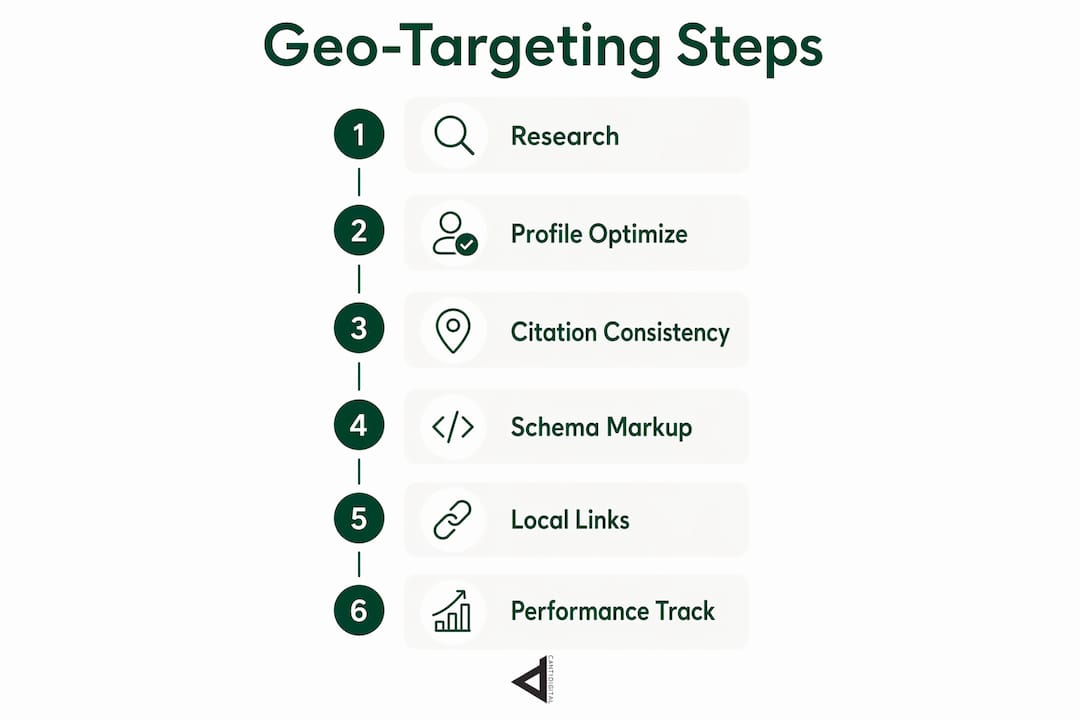
A geo-targeting strategy has six practical components. Get all six working together and the signals reinforce each other.
Location-specific content and local keywords
Write pages that address the specific needs, language, and context of your target area. A page for “conveyancing services Kiama” should reference local property trends, nearby suburbs, and the specific concerns of buyers in that market. Generic city-name insertion does not cut it. Local SEO for small businesses depends on content that earns its geographic relevance rather than just claiming it.
Google Business Profile optimisation
A complete, accurate Google Business Profile is the single highest-leverage action for local visibility. Businesses with complete and accurate info are more likely to appear in local search results. Fill every field: categories, services, hours, photos, and a detailed description. Keep it updated. An outdated profile actively hurts your prominence score.
Local citations and NAP consistency
Your business name, address, and phone number must match exactly across every directory, social profile, and listing. Inconsistencies confuse both search engines and potential customers. Build citations on relevant Australian directories and industry-specific platforms, not just generic global ones.
Structured data and schema markup
Schema.org’s LocalBusiness markup gives search engines and AI systems a machine-readable summary of your business entity: name, address, service area, opening hours, and more. This is not optional for AI-era SEO. Structured data is how AI platforms confirm your entity data before citing you in generated answers.
Local backlinks and authority signals
Links from local press, chamber of commerce listings, industry associations, and community organisations carry more weight for local rankings than generic directory links. A mention in a regional business journal signals genuine local prominence in a way that a bulk directory submission never will.
Measuring geo-targeting performance
Track rankings by location, not just globally. Monitor Google Business Profile insights for search queries, direction requests, and call clicks. Watch for changes in local pack visibility after any profile or content updates.
| Strategy component | Primary signal type | Key tool |
|---|---|---|
| Google Business Profile | Relevance and prominence | Google Business Profile |
| Location-specific pages | Relevance | Google Keyword Planner |
| Schema markup | Entity clarity | Schema.org |
| Local citations | Prominence | Moz Local |
| Review management | Prominence | Google Business Profile |
| Local keyword tracking | Relevance | SEMrush Local |
Tools and techniques for geo-targeting SEO in Australia
The right tools cut the time it takes to find gaps and fix them. These four are the ones worth knowing.
Google Business Profile is the foundation. It controls how your business appears in Google Maps and the local pack. Claim it, verify it, and treat it as a live asset rather than a one-time setup. Post updates, add photos regularly, and respond to every review. Australian businesses often underestimate how much the profile’s completeness affects map pack placement.
Google Keyword Planner is the starting point for local keyword research. Filter by location to see actual search volumes for suburb-level and city-level terms in Australia. You will often find that “electrician Wollongong” has meaningful volume while “electrician NSW” is dominated by aggregators you cannot outrank. Targeting the specific term is the smarter play.
SEMrush Local helps monitor and manage local listings across directories, track local keyword rankings, and analyse competitor local SEO performance. Its Map Rank Tracker monitors visibility in local Google Maps results for up to 100 keywords, which makes it practical for businesses with multiple locations or service areas across different suburbs.

Moz Local focuses on citation management and consistency. It audits your business listings across major data aggregators and flags inconsistencies in your NAP data. For Australian businesses, consistent citations across platforms like True Local, Yellow Pages Australia, and Yelp Australia contribute to the prominence signals Google weighs.
Beyond tools, two techniques deliver outsized results for Australian businesses. Location-based landing pages, one per suburb or service area you genuinely serve, give you a page that can rank for that specific location query. And local keyword targeting at the hyperlocal level, think “accountant Fairy Meadow” rather than “accountant Illawarra,” puts you in front of searchers with the clearest commercial intent.
Reviews deserve a separate mention. Volume, recency, and your response rate all feed into Google’s prominence calculation. Actively asking satisfied customers to leave a Google review is one of the highest-return activities in local SEO.
How AI search is changing geographic targeting
The role of geographic targeting in SEO is shifting in a way that most Australian marketers have not fully absorbed yet. Traditional SEO optimises for rankings and clicks. Generative Engine Optimisation (GEO) optimises for citations and mentions inside AI-generated answers from platforms like Google AI Overviews, ChatGPT, and Perplexity.
GEO shifts the focus to earning mentions in AI-powered search answers rather than traditional ranking alone. For local businesses, this means a competitor with a cleaner location page, more recent reviews, and consistent entity data across the web may be cited by an AI assistant even when you outrank them in organic results.
AI-driven local search visibility depends on clear location data, recent reviews, and strong local proof points on websites. The AI system is not just checking your rankings. It is assessing whether your business entity is clear, consistent, and trustworthy enough to recommend.
Consistent entity data across platforms enables AI systems to confidently cite and reuse a business’s localised content. Your brand name, address, service categories, and service area must agree across your website, Google Business Profile, social profiles, and directory listings. When they conflict, AI platforms lose confidence and skip you.
In AI search, visibility equates to citation frequency in AI answers rather than clicks. That requires machine-readable content, structured data, and cross-platform presence. A business that ranks well but has thin location pages, no schema markup, and inconsistent NAP data will increasingly lose local leads to competitors who have built a cleaner evidence trail.
The strategic implication is real. SEO professionals who focus only on rankings risk losing ownership of GEO outcomes to brand, PR, and content teams who are building the authority signals AI systems actually trust. For Australian marketers, the practical response is to treat generative engine optimisation as an extension of local SEO, not a replacement for it.
Pro Tip: Run a GEO audit on your business to check whether AI platforms can correctly identify your location, services, and service area. CantyDigital offers a free GEO audit specifically for this.
Key takeaways
Geographic targeting in SEO drives local visibility by aligning your content, listings, and entity data with the specific locations you serve, and in 2026 that alignment must satisfy both traditional search algorithms and AI citation systems.
| Point | Details |
|---|---|
| Three ranking factors | Google ranks local results on relevance, distance, and prominence — all three need active management. |
| Google Business Profile | A complete, accurate profile is the highest-leverage action for local pack visibility. |
| Entity consistency | Your business name, address, and services must match across every platform for AI systems to cite you. |
| GEO extends local SEO | Generative Engine Optimisation builds on traditional local SEO by optimising for AI citations, not just rankings. |
| Location-specific content | Suburb-level pages and hyperlocal keywords outperform generic city-level targeting for commercial intent queries. |
Ready to improve your local search visibility?
CantyDigital is a Wollongong-based digital agency with 12 years of experience in local SEO and AI-ready search optimisation. Whether you need a full geo-targeting audit, location-specific landing pages, or a monthly SEO growth plan that covers both traditional and AI search, the team at CantyDigital builds strategies around the signals that actually move rankings.
Get in touch to find out how geographic targeting can put your business in front of the customers who are already searching for you.