


Review signals are one of the fastest-moving levers in local SEO. If your Google Business Profile sits below competitors in the Map Pack, your review profile is almost certainly part of the reason.
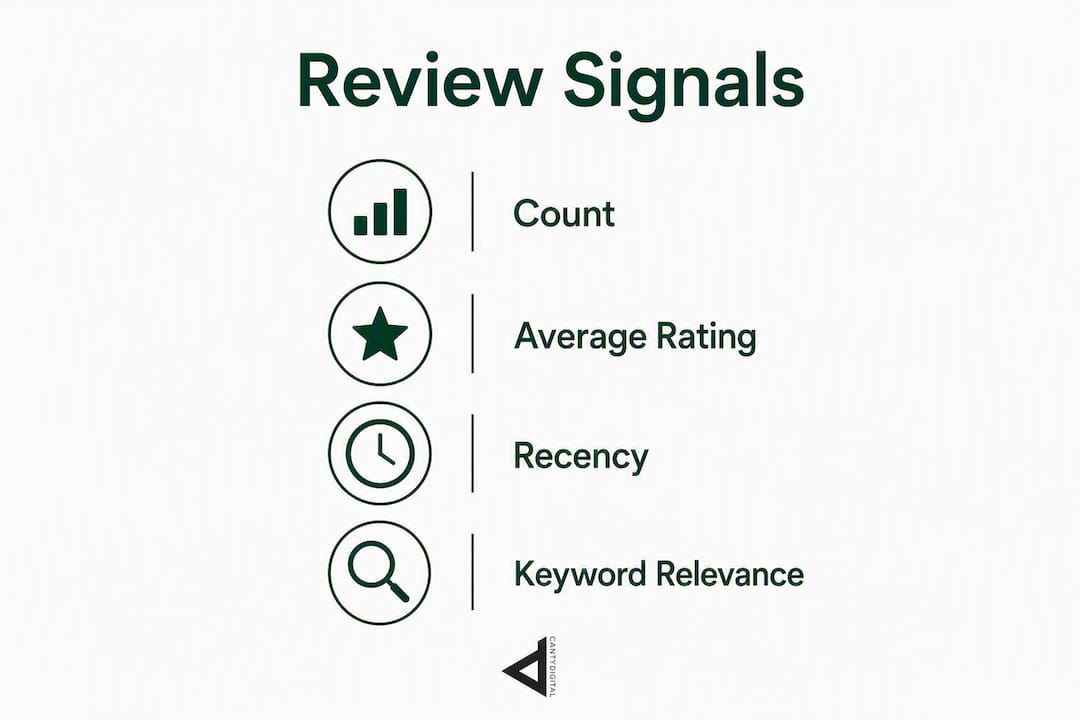
Here is the short answer: yes, review signals directly affect local pack and map rankings, and they also change how many people click on your listing once it appears. The four signals that carry the most weight are:
- Review count — total number of reviews across your profile
- Average star rating — your aggregate score, especially relative to nearby competitors
- Recency — how recently reviews were posted, with the trailing 90 days carrying extra weight
- Review text — whether customers mention your service name, suburb, or specific details
Two operational modifiers shape how those four signals perform: velocity (a steady monthly inflow rather than sporadic bursts) and owner responses (timely, contextual replies that signal an active business).
Three things you can do today:
- Send a review request to your last ten customers with a direct Google Business Profile link.
- Reply to every unanswered review on your profile, positive or negative.
- Set a monthly reminder to check your review count, average rating, and Map Pack position.
Expect to see early movement in 4–8 weeks if you start consistently. Meaningful ranking shifts typically take 3–6 months of sustained effort.
Table of Contents
- What review signals does Google actually measure?
- How do reviews change your rankings and your click rate?
- Which review platforms matter most for Australian businesses?
- How to collect and manage reviews without crossing the line
- How do you measure the impact of your review programme?
- Australian rules and platform policies you need to know
- Key takeaways
- What CantyDigital actually sees working for local clients
- CantyDigital’s local review and reputation services
What review signals does Google actually measure?
Google’s local ranking system treats reviews as structured signals under three ranking pillars: relevance, distance, and prominence. Reviews feed directly into prominence, and their text content feeds into relevance. Here is what each signal does in practice.
Total review count tells Google your business has enough social proof to surface confidently. Businesses with a significantly higher number of reviews tend to rank better in local pack results than those with far fewer reviews. That said, the meaningful threshold is always relative to your competitors. A plumber in Wollongong with far more reviews may dominate a suburb where rivals have much fewer. A Melbourne restaurant competing in a dense hospitality corridor generally needs a substantially higher review count to remain competitive.

Average star rating matters, but not in isolation. A 4.6-star average with 80 reviews typically outperforms a 5.0 with 12. Google appears to treat a high volume of credible, varied reviews as more trustworthy than a perfect score from a thin sample.
Recency is where most businesses leave ranking gains on the table. Reviews posted in the last 90 days carry significantly more weight than older ones. A business that collected 60 reviews two years ago and stopped is effectively running on a depleted signal. Fresh reviews mentioning your service and suburb — “great plumber in Fairy Meadow, fixed our hot water system same day” — improve both recency and relevance in one hit.
Review text and keyword relevance is the most underused signal. When a customer writes your service category and location into a review, that text gets indexed. It acts like user-generated local copy, reinforcing your relevance for those exact search terms. Prompting customers to mention what you did and where you did it is one of the highest-return moves in local SEO review strategies.
Reviewer diversity and velocity matter because a sudden spike of 30 reviews in a week looks suspicious. A steady inflow of 2–5 reviews per month from different accounts keeps your profile active without triggering spam filters. Diversity of reviewers — different names, locations, device types — also signals authenticity.
Owner responses are an indirect signal. They do not directly boost rankings, but they improve engagement metrics on your profile and demonstrate to Google that the business is active. Multiple 2026 guides confirm that responses and photos influence engagement rather than ranking directly.
Statistic callout: Industry research found review signals account for a noticeable share of local pack ranking factors in recent years.
Pro Tip: Don’t chase a round number of reviews. Check what your top three local competitors have, then set your target 20–30% above the highest. That relative gap matters more than any absolute threshold.
How do reviews change your rankings and your click rate?
Reviews affect local rankings through two distinct mechanisms, and most businesses only think about one of them.
The first is direct: review signals feed into Google’s prominence calculation, which is one of the three pillars of its local ranking algorithm. More reviews, a stronger rating, and fresher content all push prominence higher.
The second is indirect and often more powerful over time. Higher star ratings and recent reviews increase click-through rates in the Map Pack. When more people click your listing, Google reads that as a behavioural validation signal — evidence that your result matched what the searcher wanted. That CTR lift feeds back into your ranking, which puts you in front of more searchers, which generates more clicks. The loop compounds.

Star ratings are visible in the Map Pack before a user clicks anything. A listing showing 4.8 stars and 120 reviews next to a competitor showing 3.9 stars and 14 reviews will pull the majority of clicks even when the competitor ranks one position higher. Search Engine Land’s research confirms that customer reviews are the most influential form of local business content, and surveys consistently show that over 90% of consumers read reviews when searching for nearby goods and services.
AI Overviews and LLM-driven local recommendations add a third layer. When Google’s AI generates a local answer, it draws on review text and recency to assess which businesses are genuinely active and relevant. A business with recent, detailed reviews mentioning specific services and locations is far more likely to be cited in an AI-generated summary than one with a static, dated profile. Cross-platform review consistency — matching signals across Google Business Profile, ProductReview.com.au, and category sites — strengthens the probability of appearing in those AI citations.
Which review platforms matter most for Australian businesses?
Not all review platforms carry equal weight, and the right priority order depends on your category.
- Google Business Profile (Google Reviews) — always first. This is the platform Google trusts most for its own local results. Every other platform is secondary.
- ProductReview.com.au — the most-used independent review platform in Australia. Strong for retail, home services, financial products, and consumer electronics. A well-maintained profile here adds credibility and appears in branded search results.
- Facebook Reviews — still relevant for service businesses with an active social presence. Facebook reviews surface in Google’s knowledge panel and contribute to your broader reputation footprint.
- Apple Maps — growing in relevance as iPhone usage remains high in Australia. Ratings here affect visibility in Siri local results and Apple Maps searches.
- TripAdvisor — non-negotiable for hospitality, tourism, and food and beverage. For a restaurant or accommodation provider, TripAdvisor reviews often carry more category trust than Google reviews among high-intent searchers.
- HealthEngine, HotDoc, Whitecoat — for medical and allied health practices, these platforms are where patients actually search. A GP with 200 Google reviews but no HealthEngine presence is invisible to a large segment of their audience.
- TrueLocal, Oneflare, hipages — useful for trades and home services. These platforms rank independently for service + suburb queries and add a second citation point for your business.
Diversity across review platforms strengthens your reputation footprint and helps AI summarisation systems build a more complete picture of your business. The practical recommendation: get your Google Business Profile to a competitive review count first, then build out the one or two platforms most relevant to your category and where your customers actually look.
For hospitality businesses specifically, SEO for hotels requires a deliberate TripAdvisor and Google strategy running in parallel — one without the other leaves significant visibility on the table.
How to collect and manage reviews without crossing the line
Getting more reviews is not complicated. Getting them consistently, with useful content, and within platform rules — that is where most businesses fall short.
The ask flow:
- Time your request 24–48 hours after service delivery, when the experience is fresh.
- Send via SMS first (higher open rates), then follow up by email if no response within 48 hours.
- Include a direct link to your Google Business Profile review page — never make the customer hunt for it.
- Ask them to mention what you did and where, not just to leave a star rating.
Sample SMS template:
“Hi [Name], thanks for choosing [Business]. We’d love to hear how we went — could you leave us a quick Google review? It only takes a minute: [direct link]. Feel free to mention what we helped you with and where you’re based — it really helps others find us.”
Sample email subject: “How did we go, [Name]?”
Sample email body:
“Hi [Name], we hope [service] went smoothly. If you have 60 seconds, a Google review would mean a lot to us. Just mention what we helped you with and your suburb if you’re happy to — it helps locals find us. [Direct link]. Thanks, [Your name].”
In-person script (for retail or trade):
“If you’re happy with the work, a Google review would really help us out — just mention what we did and your area. I can text you the link right now if that’s easier.”
Prompting customers to mention the service and suburb reliably increases the appearance of SEO-relevant keywords in review text. It is the single highest-return tweak to a review request template.
Response templates:
Positive review: “Thanks so much, [Name]! Really glad we could help with [service] in [suburb]. We appreciate you taking the time — it means a lot to the team.”
Neutral/3-star review: “Thanks for the feedback, [Name]. We’re glad [positive element] worked well. We’d love to understand more about [concern] — please reach out to us directly at [contact] so we can make it right.”
Negative review: “Hi [Name], thank you for letting us know. We’re sorry the experience didn’t meet expectations. Please contact us at [contact] so we can look into this properly and resolve it for you.”
Keep responses short, specific, and free of defensive language. Never copy-paste the same response to multiple reviews — Google notices template repetition and it signals low engagement.
Pro Tip: Never ask customers to leave a review only if they had a positive experience. That is review-gating, and it violates both Google’s policies and ACCC guidance on misleading conduct. Ask everyone, respond to everyone.
How do you measure the impact of your review programme?
Tracking review impact requires separating the signal from the noise. Here are the KPIs worth monitoring and the tools that make it practical.
KPIs to track monthly:
- Review volume (total and new per month)
- Average star rating (track movement, not just the current number)
- Review velocity (reviews per month — target consistency over spikes)
- Owner response rate and median response time
- Google Business Profile views and clicks (calls, website visits, direction requests)
- Map Pack ranking position for your top 3–5 local keywords
- CTR from local listings
- Conversions attributed to local search (calls, form fills, bookings)
Recommended tools for Australian businesses:
Google Business Profile’s built-in Insights dashboard covers views, clicks, and search queries at no cost. For Map Pack rank tracking, tools like BrightLocal and Whitespark track local positions across suburbs and postcodes. For review monitoring across multiple platforms including ProductReview.com.au and Facebook, a reputation management dashboard saves significant manual effort.
Timeline table:
| Timeframe | What to expect |
|---|---|
| Weeks 1–4 | Profile activity increases; GBP views may lift slightly with fresh reviews |
| Months 1–3 | CTR improvements visible; early Map Pack movement in lower-competition suburbs |
| Months 3–6 | Sustained ranking gains in competitive categories; review velocity stabilises |
| Months 6–12 | Compounding effect visible; AI citation probability increases with cross-platform presence |
| 12 months | Disciplined programmes typically outperform ad-hoc pushes at this horizon |
Attribution note: isolating review impact from other SEO activities is genuinely difficult. The cleanest approach is to hold other variables steady for 60–90 days while you run a review push, then compare GBP metrics before and after. Pair this with measuring ROI from your local SEO campaign to connect review-driven visibility to actual revenue.
Australian rules and platform policies you need to know
The ACCC is explicit: businesses must not post fake reviews, pay for positive reviews, or suppress negative ones. Under Australian Consumer Law, misleading conduct in reviews can attract significant penalties.
ACCC guidance summary: Businesses must not create, commission, or facilitate fake reviews. Offering incentives — discounts, gifts, cash — in exchange for positive reviews constitutes misleading conduct. Selectively publishing only positive reviews while suppressing negative ones is also prohibited. The ACCC’s position is that consumer reviews must reflect genuine experiences, and businesses are responsible for review content they control or influence.
Platform-specific rules:
- Google Reviews prohibits fake reviews, incentivised reviews, review-gating, and posting reviews of your own business or competitors. Violations can result in review removal or profile suspension.
- ProductReview.com.au requires reviews to come from genuine customers. Businesses can respond but cannot edit or remove reviews except through a formal dispute process.
- Facebook Reviews (now Recommendations) prohibits fake or incentivised recommendations and allows users to report suspicious activity directly.
Dos and don’ts:
- ✅ Ask all customers for honest feedback
- ✅ Respond to every review, positive or negative
- ✅ Report fake reviews through platform dispute channels
- ✅ Train staff to mention reviews naturally at the point of service
- ❌ Never offer discounts, gifts, or any reward in exchange for a review
- ❌ Never ask customers to change or remove a negative review as a condition of resolving a complaint
- ❌ Never post reviews yourself or ask friends and family to pad your count
- ❌ Never use third-party services that promise to “buy” reviews
Flagging fake reviews: on Google, use the “Report review” flag on the specific review. On ProductReview.com.au, use the dispute form in your business dashboard. For persistent fake review campaigns, the ACCC’s report a scam portal and the platform’s trust and safety teams are the escalation path.
Key takeaways
Review signals are the single most accessible local ranking lever for Australian businesses — and most are not using them consistently.
| Point | Details |
|---|---|
| Four signals drive rankings | Count, average rating, recency (trailing 90 days), and review text are the measurable signals that move local pack positions. |
| Recency outweighs old volume | A business that stopped collecting reviews 12 months ago is running on a depleted signal, regardless of total count. |
| Text content gets indexed | Prompting customers to mention the service and suburb turns reviews into user-generated local copy that reinforces keyword relevance. |
| Measure CTR, not just rankings | Reviews affect both algorithmic prominence and click-through rate — track both to see the full impact on leads and conversions. |
| CantyDigital’s local SEO services | CantyDigital manages Google Business Profile, review velocity, and cross-platform reputation as part of its local SEO services. |
What CantyDigital actually sees working for local clients
The businesses that get the most out of review programmes are not the ones with the most reviews. They are the ones with the most consistent programmes.
The pattern is predictable: a local business runs a review push, collects 30 reviews in a month, sees a ranking bump, then stops. Six months later, the recency signal has decayed and they are back to asking why their position dropped. The businesses that hold and build on their gains treat review collection the same way they treat invoicing — it happens after every job, without exception.
What moves the needle fastest for a typical local client is not volume alone. It is the combination of recency, response cadence, and review text quality. A client in a competitive service category who starts getting reviews that mention specific suburbs and service types will often see Map Pack movement within 8 weeks, even before their total count changes significantly. That is the recency and relevance mechanism working together.
The underappreciated piece is the AI citation layer. As Google’s AI Overviews become more prominent in local queries, the businesses with detailed, recent, cross-platform review profiles are the ones getting cited in generated answers. That is a visibility channel that did not exist two years ago, and most local businesses are not thinking about it yet.
Three priority actions for any local client starting from scratch: get your Google Business Profile fully optimised and verified, set up a post-service review request flow that goes out within 48 hours, and commit to responding to every review within 72 hours. Everything else — platform diversification, schema markup, updating your local SEO strategies — builds on that foundation.
CantyDigital’s local review and reputation services
Local businesses across Australia are leaving ranking gains on the table because their review programmes are inconsistent or non-existent. CantyDigital fixes that with a practical, done-for-you approach: Google Business Profile management, review velocity programmes, cross-platform reputation monitoring, and monthly reporting that ties review activity to actual ranking and conversion outcomes.
There are no lock-in contracts. You get a clear audit of where your review signals stand today, a prioritised action plan, and the option to have CantyDigital manage the ongoing programme so you can focus on running your business.
For businesses in high-competition markets, the SEO growth plans from $170/month include local optimisation and reputation management as standard. If you want to understand exactly where your review signals sit relative to your competitors, book a local SEO audit with CantyDigital at cantydigital.com.au and get a clear picture of what to fix first.