


Most Australian marketing teams searching for GlobalVision alternatives don’t actually need a like-for-like replacement. They need one of two very different things: either a regulated, audit-grade inspection platform (for pharma, medtech, or packaging compliance), or a browser-based creative review tool for faster approvals and feedback loops. Getting that distinction wrong is the single most expensive mistake in this category.
Quick shortlist:
- Inspection-grade: Esko (ArtPro+/Automation Engine), Enfocus PitStop Pro/Server, AVT print inspection systems
- Creative review: Ziflow, Filestage, Valiz, Wrike, Asana
One-line decision rule: If your process touches TGA-regulated labelling, pharmaceutical packaging, or any workflow requiring a validated audit trail, evaluate inspection-grade tools first. If you’re a marketing team managing campaign approvals and creative sign-offs, a creative review platform will serve you better at a fraction of the cost and complexity.
Table of Contents
- Which kind of alternative do you actually need?
- Regulated-grade inspection solutions: true GlobalVision alternatives
- Creative review and approval platforms (when GlobalVision is overkill)
- Checklist: questions to ask and evaluation criteria for demos
- Migration versus integration: when to rip-and-replace and when to add an integration
- At-a-glance comparison: inspection vs review platforms
- Key takeaways
- The case for getting the category right before the vendor
- CantyDigital can help you choose and implement the right path
Which kind of alternative do you actually need?
The core distinction is this: GlobalVision is an inspection engine, not a collaboration tool. It performs automated mechanical checks — barcode verification, Braille inspection, print delta detection, spell-check against a master file — and produces a validated audit trail. That’s a fundamentally different job to “leave a comment on this PDF.”
Inspection-grade needs look like this:
- Regulatory proofing for TGA-registered products, pharmaceutical labelling, or export packaging
- Automated barcode, colour, and Braille verification against approved masters
- Validated inspection templates and exportable audit trails for compliance audits
Creative review needs look like this:
- Browser-based annotation and version comparison for marketing assets
- Approval workflows across agencies, clients, and internal stakeholders
- Campaign asset sign-off without a formal audit requirement
The most common procurement mistake is skipping the “source of truth” question entirely. Before you shortlist anything, ask: does this process need an objective inspection engine, or a workflow manager? One wrong answer and you’ll spend six months implementing a QMS when a $99/month SaaS tool would have done the job.
Pro Tip: Map your compliance requirements before your first vendor demo. If TGA evidence or a validated audit trail is required, that single requirement eliminates every creative review platform from your shortlist immediately.
Regulated-grade inspection solutions: true GlobalVision alternatives
These are the platforms that actually replicate GlobalVision’s core capability: automated mechanical inspection, validated templates, audit trails, and print-level delta detection. They’re built for packaging, pharma, and regulated print environments.

Esko (ArtPro+/Automation Engine)
Esko is the dominant packaging toolchain platform globally, and for Australian businesses already running Esko workflows, adding an inspection integration is often smarter than migrating to a new system. ArtPro+ handles PDF-native artwork editing with built-in preflight; Automation Engine connects inspection into production workflows. Local resellers operate in Australia, and Esko’s integration ecosystem is the broadest in the packaging sector.
Enfocus PitStop Pro / PitStop Server
Enfocus PitStop is the industry standard for PDF preflight and automated correction. PitStop Pro suits smaller teams doing manual preflight; PitStop Server handles high-volume automated processing. It integrates directly into Esko’s Automation Engine, which makes it a natural fit for Australian packaging operations already in that ecosystem. Audit trail depth is strong, though it’s primarily a preflight and correction tool rather than a full artwork comparison engine.
AVT print inspection systems
AVT focuses on inline and offline print inspection, primarily for label and packaging converters. It’s hardware-adjacent, often deployed at the press or finishing line, and produces inspection records suitable for quality audits. For Australian businesses in contract packaging or label printing, AVT addresses a different point in the workflow than GlobalVision’s pre-press proofing, but the two can complement each other.
| Best for | Automated inspection | Audit trail/compliance | Packaging toolchain integration | API/extensibility | Deployment | Typical timeline | Pricing shape |
|---|---|---|---|---|---|---|---|
| Esko ArtPro+/Automation Engine | Packaging design + preflight | Strong, validated | Native (Esko ecosystem) | Yes, SDK available | On-prem / hybrid | several months to over a year | Enterprise |
| Enfocus PitStop Pro/Server | PDF preflight + correction | Good | Esko Automation Engine | Yes, via Switch | On-prem / cloud | weeks to a few months | Mid-market to enterprise |
| AVT print inspection | Inline/offline press inspection | Strong, press-level records | Limited (press-side) | Vendor-dependent | On-prem | weeks to a few months | Enterprise |
Australian availability note: All three vendors have reseller or distributor presence in Australia. Data residency for on-premises deployments is straightforward; cloud-hosted modules should be confirmed for Australian data sovereignty requirements before procurement.
Enterprise PLM/QMS migrations typically run several months to over a year for validated inspection environments. Budget accordingly and align your implementation timeline with your next regulatory audit window, not the other way around.
Creative review and approval platforms (when GlobalVision is overkill)
If your team’s real problem is slow approvals, scattered feedback, and version confusion rather than regulatory inspection, these platforms solve that problem at a fraction of the cost and complexity. None of them perform automated barcode, Braille, or print delta inspection. That’s not a gap — it’s a feature, because they’re not trying to be inspection engines.
- Ziflow: Cloud-native proofing platform built for agencies and in-house creative teams. Strong version control, annotation tools, and approval workflows. Good API support and integrates with tools like Slack, Teams, and Adobe Creative Cloud. Trial available.
- Filestage: Focused on structured review cycles with clear approval stages. Well-suited to marketing teams managing multiple campaigns simultaneously. Simple to train, cloud-native, and offers a free trial.
- Wrike: Broader project management platform with proofing and approval features built in. Better suited to teams that want creative review as part of a wider work management system rather than a standalone tool. Strong API and integration options.
- Asana: Similar to Wrike in scope. Approval workflows exist but are less specialised than dedicated proofing tools. The value is in connecting creative review to broader campaign planning and task management.
Pro Tip: Ask every vendor for a 14-day trial with your own assets before committing. The platforms that let you test with real files — not demo content — are the ones confident in their product. Platforms that resist real-file trials often have interface or workflow gaps they’d rather you discover post-contract.
For social media campaign production and marketing asset governance, these tools slot in quickly. Most teams are productive within days, not months.
Checklist: questions to ask and evaluation criteria for demos
Walk into every vendor demo with these questions ready. They separate tools that look good in a scripted demo from ones that hold up in production.
Demo questions for inspection-grade tools:
- Can you show automated inspection running against a validated master file, with a full audit trail exported?
- How are validated templates managed, versioned, and locked for regulatory use?
- What does the audit trail look like if an inspector overrides a flagged difference?
- How is historical proof data exported if we migrate away from your platform?
Demo questions for creative review platforms:
- How does version control work when an external agency uploads a revised file?
- What happens to approval records if we cancel our subscription?
- Is there an API or webhook for connecting approvals to our DAM or project management tool?
Red flags to watch for:
- No API or data export capability (creates lock-in and migration risk)
- Opaque or usage-based pricing with no clear ceiling
- No Australian reseller, support contact, or local data hosting option
- Audit trail that can’t be exported in a format acceptable to a regulatory auditor
- Pressure to sign annual contracts before a pilot is complete
Robust API/SDK documentation is the single best predictor of a smooth integration and lower training overhead for distributed teams. If a vendor can’t point you to their API docs in the first demo, that tells you something.
Migration versus integration: when to rip-and-replace and when to add an integration
For businesses already running Esko or a similar packaging ecosystem, adding an inspection integration almost always beats a full platform migration. You preserve validated templates, keep your audit history intact, and avoid the revalidation overhead that comes with switching systems.
Full migration makes sense when:
- The current platform has no viable API or integration path to your toolchain
- Validated templates can’t be exported in a usable format
- The vendor is end-of-life or support has degraded significantly
- A new regulatory requirement demands capabilities the current tool can’t provide
Implementation timeline expectations:
- Validated inspection or PLM migrations: several months to over a year (typical, depending on scope and regulatory validation requirements)
- Creative review platform deployments: weeks to a few months
Migration risks specific to Australian organisations:
- Data residency: confirm where audit records and master files are stored, particularly for TGA-regulated products
- Revalidation overhead: switching inspection platforms can trigger a full revalidation cycle, which must be planned against your audit calendar
- Downtime during cutover: schedule migrations outside peak production periods
What to preserve during any migration:
- All validated inspection templates and their version history
- Complete audit trails and historical proof records
- Approved packaging master files and their associated metadata
- User training documentation and sign-off records
At-a-glance comparison: inspection vs review platforms
| Category | Best for | Automated inspection | Audit trail/compliance | Packaging toolchain integration | API/extensibility | Deployment | Typical timeline | Pricing band |
|---|---|---|---|---|---|---|---|---|
| Esko ArtPro+/Automation Engine | Packaging/regulated print | High | Strong, validated | Native | Yes | On-prem/hybrid | several months to over a year | Enterprise |
| Enfocus PitStop Pro/Server | PDF preflight, mid-market | Medium-high | Good | Esko/Switch | Yes | On-prem/cloud | weeks to a few months | Mid to enterprise |
| AVT print inspection | Press-side quality | High (inline) | Strong | Limited | Vendor-dependent | On-prem | weeks to a few months | Enterprise |
| Ziflow | Agency/creative review | None | Basic approval records | Limited | Yes | Cloud | Days–weeks | SMB to mid-market |
| Filestage | Marketing team approvals | None | Basic approval records | Limited | Yes | Cloud | Days–weeks | SMB to mid-market |
| Wrike | Work management + review | None | Workflow records | Moderate | Strong | Cloud | Weeks–months | Mid to enterprise |
| Asana | Campaign planning + approvals | None | Workflow records | Moderate | Strong | Cloud | Weeks–months | Mid to enterprise |
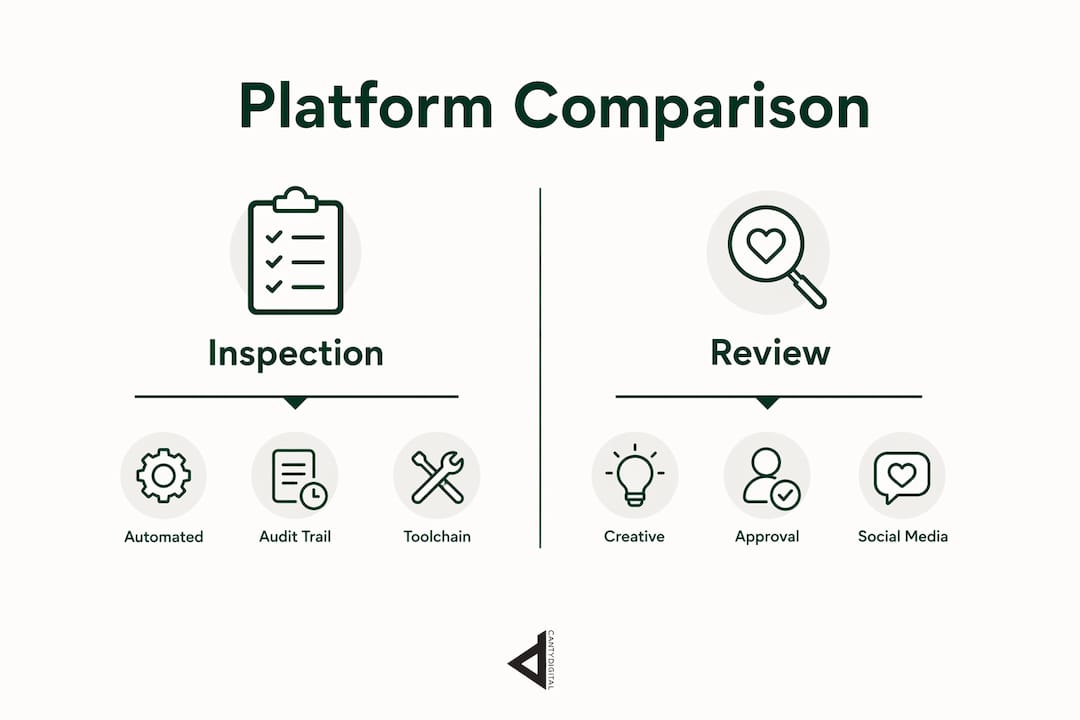
Verify trial/demo availability, local Australian reseller support, and validated compliance modules directly with each vendor. Rows with “Enterprise” pricing and longer timelines carry higher implementation risk for smaller Australian teams without dedicated IT or regulatory resources.
Key takeaways
Choosing the right GlobalVision alternative comes down to one question first: does your process require a validated audit trail, or just faster approvals?
| Point | Details |
|---|---|
| Classify your need first | Inspection-grade tools (Esko, Enfocus, AVT) and creative review platforms (Ziflow, Filestage) solve different problems entirely. |
| Ask the audit trail question | In every demo, request a live export of the audit trail — if a vendor can’t show it, that’s a disqualifying gap for regulated use. |
| Integration beats migration | For businesses already in the Esko ecosystem, adding an inspection integration preserves validated templates and avoids extended migration timelines. |
| Watch for lock-in red flags | No API, no data export, and no Australian support contact are the three clearest signs of a vendor to avoid. |
| CantyDigital can help | CantyDigital supports Australian businesses with tooling selection and integration — including scoping, pilot management, and local compliance checks. |
The case for getting the category right before the vendor
Most of the frustration teams report with GlobalVision isn’t about the software’s core capability. It’s about the mismatch between what the tool was built for and what the team actually needed. A regulated inspection engine in a marketing team’s hands is like bringing a calibrated torque wrench to hang a picture frame. Technically capable, completely wrong for the job.
The vendors that tend to win in Australian packaging and pharma environments are the ones with local reseller relationships, clear API documentation, and a willingness to run a scoped pilot before a full contract. That last point matters more than most procurement guides acknowledge. A four-week pilot with your own files, your own users, and your own compliance requirements will surface more useful information than six months of vendor demos.
Creative review platforms, on the other hand, are genuinely underused in Australian marketing teams. The gap between what Ziflow or Filestage can do for campaign approval cycles and what most teams are currently doing with email chains and shared drives is significant. The barrier isn’t capability. It’s that teams haven’t separated the “we need faster approvals” problem from the “we need a regulated inspection engine” problem, so they end up evaluating the wrong category entirely.
For marketing toolchain decisions, the right starting point is always the compliance requirement, not the feature list.
CantyDigital can help you choose and implement the right path
If you’ve read this far, you probably already know which category you’re in. The harder part is shortlisting vendors, scoping a pilot, and making sure the implementation doesn’t blow out your timeline or your budget.
CantyDigital is a Wollongong-based digital agency with 12 years of experience helping Australian businesses select, integrate, and get real value from their marketing and content tooling. Unlike a software reseller, we come in on your side: scoping the requirement, running a structured pilot, and making sure the tool you choose actually fits your workflow and compliance obligations. No lock-in contracts, no opaque retainers.
To get started, prepare three things before a scoping call: examples of your current proofing or approval workflow, a list of your existing tools (DAM, project management, packaging software), and a clear note on whether TGA or other regulatory requirements apply. That’s enough for CantyDigital to give you a straight answer on which category and which vendors to prioritise.
Talk to CantyDigital about a scoping call or pilot today.