

Why images are the backbone of effective web design
Images are not decoration. They are functional design tools that shape how users navigate, what they trust, and whether they convert. The role of images in web design goes well beyond filling white space: a single well-placed photograph can communicate brand personality, direct attention to a call-to-action, and build credibility faster than any headline.
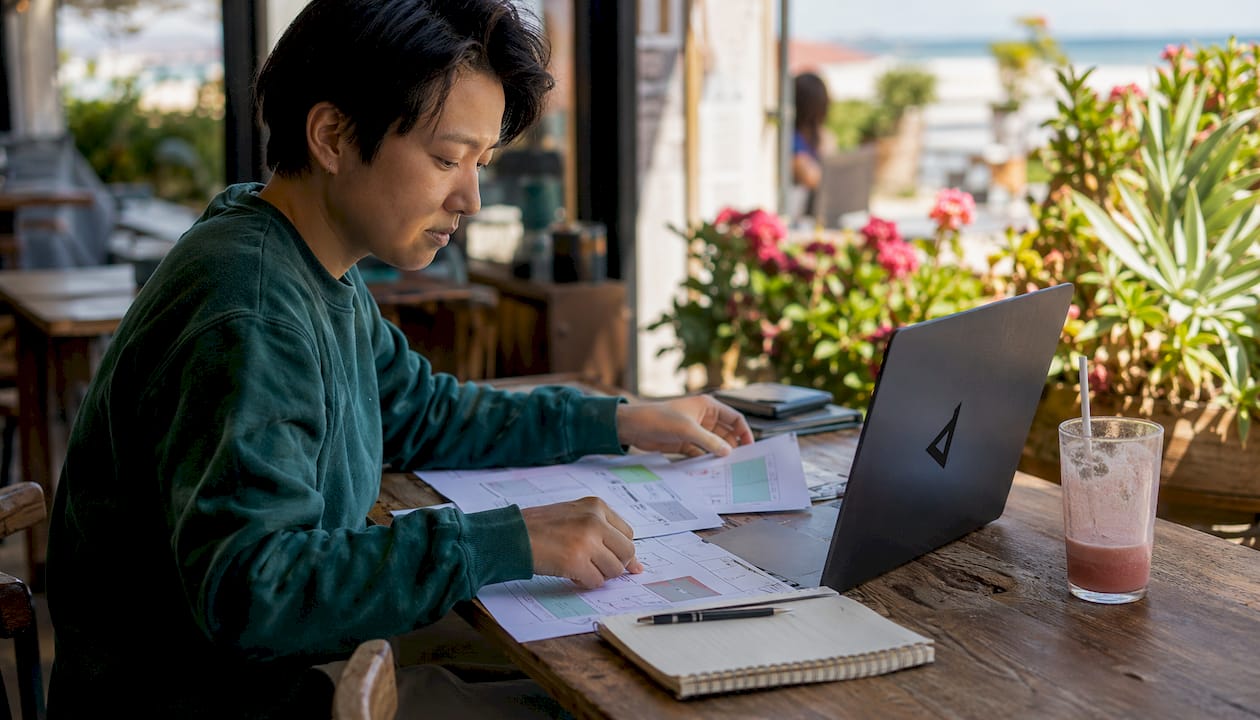
Research from MIT confirms the brain processes visuals in as little as 13 milliseconds. That means a visitor has already formed an impression of your site before they have read a single word. For Australian businesses competing in crowded online markets, that first impression is the difference between a bounce and a lead.
Here is what strategic image use actually delivers:
- Trust and credibility — authentic photography signals that a real business stands behind the website
- Emotional connection — visuals trigger responses that text alone cannot replicate
- Navigation guidance — images direct the eye toward key content and calls-to-action
- Brand consistency — a coherent visual style reinforces recognition across every page
- SEO performance — properly optimised images contribute to faster load times and better search rankings
- Accessibility — correctly implemented images make content available to all users, including those using screen readers
CantyDigital, a Wollongong-based digital agency with 12 years of experience building high-performance websites, treats imagery as a structural element from the very first wireframe, not an afterthought added at the end of a project.
Table of Contents
- What types of images does your website actually need?
- How images drive user engagement and business results
- How to optimise images for performance and accessibility
- Strategic image use for Australian business websites
- CantyDigital builds websites where images work as hard as the copy
- Key takeaways
What types of images does your website actually need?
Not every image serves the same purpose, and choosing the wrong type for a given context is one of the most common web design mistakes that quietly kills engagement.
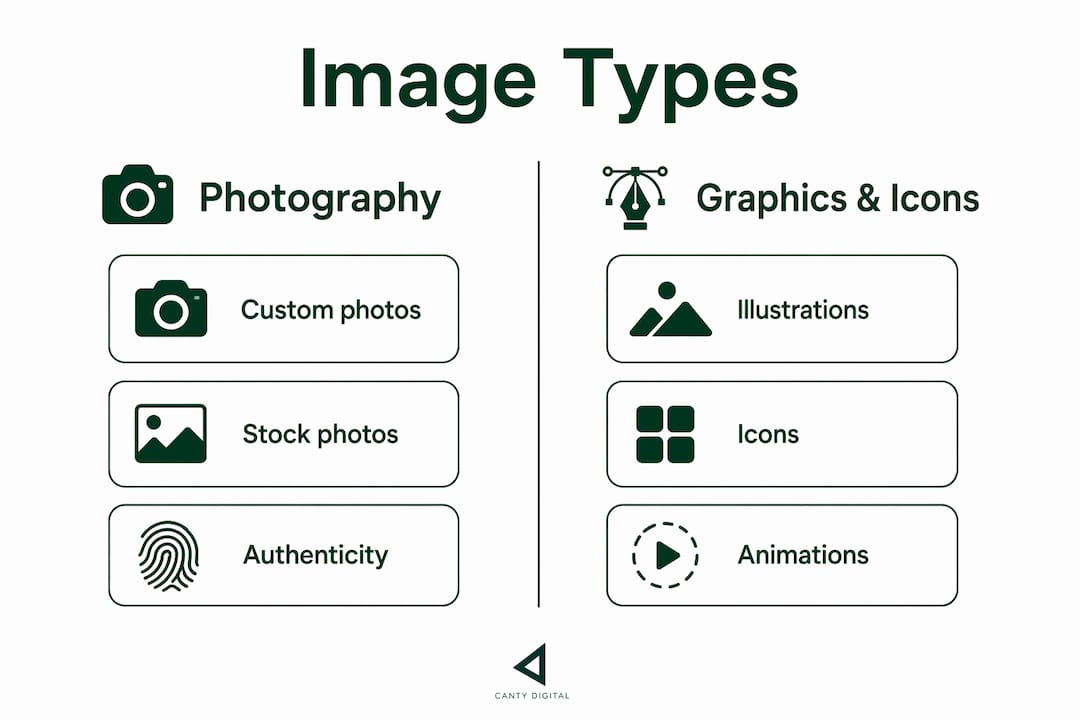
Photographs
Photography is now a core structural element in modern website design, directly shaping first impressions and brand communication within milliseconds. Custom photography outperforms stock imagery because it can be directed to fit the exact layout, colour palette, and brand narrative of the site. A professional photographer working from a design brief produces images with the right focal points, negative space, and tonal range to integrate with the layout rather than fight against it.
Stock photos are not always wrong. They work well for supporting content, blog illustrations, or placeholder imagery during development. The problem arises when generic, obviously staged stock photos represent a business’s people, premises, or products. Visitors notice the disconnect, and trust erodes quickly.
Illustrations and graphics
Custom illustrations give brands a distinctive visual identity that photography cannot always achieve. They are particularly effective for explaining abstract concepts, software interfaces, or service processes. A well-drawn illustration of a workflow communicates more clearly than three paragraphs of text.
Icons
The role of icons in web design is often underestimated. Icons reduce cognitive load by replacing text labels with universally understood symbols, making interfaces faster to scan. They work best when they are consistent in style, weight, and size across the entire site. Mixing flat icons with outlined ones, or varying stroke weights between sections, creates visual noise that disrupts layout harmony.
Data visualisations and infographics
Charts, graphs, and infographics translate complex information into something a visitor can absorb in seconds. For service businesses, a simple comparison graphic can do the work of an entire page of copy. For ecommerce, product specification tables with visual indicators outperform plain text lists.
Animations and motion graphics
The role of animations in web design has matured considerably. Purposeful animation supports micro-interactions and state changes, helping users understand what just happened or what to do next. A button that responds on hover, a loading indicator, a form field that shakes on invalid input — these are functional signals, not decorative flourishes. Overuse distracts and frustrates; subtlety is the standard.
Consistency across all image types matters. Matching brightness, exposure, colour temperature, and visual style across every image on a site creates harmony. A single image that breaks the visual pattern draws attention to itself for the wrong reasons.
How images drive user engagement and business results
Good imagery captures attention, triggers emotion, and can directly increase conversion rates by influencing user behaviour. That is not a vague claim about aesthetics — it has measurable business consequences.
Trust and brand identity
Custom photography builds trust rapidly by showcasing authenticity and professionalism. When a visitor sees real team members, real premises, and genuine products, their internal question shifts from “is this business legitimate?” to “is this the right fit for me?” That is a much more productive conversation. Generic stock photos, by contrast, signal that a business has not invested in its own presentation, which raises doubts about whether it will invest in its customers.
Emotional influence on decisions
Visuals trigger emotional responses that shape decisions before rational analysis kicks in. A hero image of a smiling, relatable person creates warmth. A dramatic landscape photograph creates aspiration. A clean, minimal product shot on white communicates precision and quality. Each of these is a deliberate choice that primes the visitor’s attitude toward the brand.
Strategically placed images improve both engagement and conversions — not by accident, but because they guide the emotional and cognitive journey a visitor takes through a page.
Attention and scanning behaviour
Users scan web pages in predictable patterns, and images anchor those patterns. A strong visual placed beside a key message pulls the eye to that content first. Product images on an ecommerce page determine which items get considered. A poorly placed or irrelevant image can actually divert attention away from a call-to-action, which is one reason image placement decisions deserve the same rigour as copy decisions.

SEO benefits
Optimised images contribute to SEO in two ways. First, descriptive alt text helps search engines understand page content, which improves relevance signals. Second, fast-loading images improve Core Web Vitals scores, particularly Largest Contentful Paint (LCP), which Google uses as a direct ranking factor. An image-heavy page that loads slowly will underperform in search regardless of how good the copy is.
- Alt text should describe the image content succinctly and serve the user, not stuff keywords
- File names should be descriptive (e.g.
wollongong-web-design-team.jpgrather thanIMG_4821.jpg) - Structured data for product images can generate rich results in Google Search
The connection between SEO and web design runs directly through image strategy.
How to optimise images for performance and accessibility
A beautiful image that takes four seconds to load is a liability. Optimisation is where the role of photography in web design meets the technical realities of modern search and user expectations.
Choosing the right file format
Each format has a specific use case, and picking the wrong one wastes bandwidth or degrades quality:
- JPEG — best for photographs with complex colour gradients; lossy compression keeps file sizes manageable
- PNG — best for images requiring transparency or sharp edges (logos, icons, screenshots); larger file sizes than JPEG
- SVG — ideal for icons, logos, and simple illustrations; scales perfectly at any resolution with tiny file sizes
- WebP — Google’s format offering better compression than JPEG and PNG while maintaining quality; supported by all modern browsers
- AVIF — the newest format, offering even greater compression than WebP; excellent for high-quality photographs where file size is critical
WebP and AVIF are the current standards for performance-focused web design. Both deliver significant file size reductions while maintaining visual quality, which directly supports fast-loading websites and strong Core Web Vitals scores.
Responsive images
A desktop-sized image served to a mobile device wastes data and slows load times. The srcset and sizes HTML attributes solve this by telling the browser which image file to load based on the device’s screen width and pixel density. A visitor on a phone gets a smaller, appropriately sized file; a visitor on a 4K monitor gets the full-resolution version. Neither gets a compromised experience.
Compression and lazy loading
Compression reduces file size before upload. Tools like Squoosh, ImageOptim, and Cloudinary handle this without visible quality loss. Lazy loading defers the loading of off-screen images until the user scrolls toward them, which dramatically improves initial page load speed, particularly on long pages.
Accessibility best practices
Alternative text for images is the single most important accessibility consideration. It should describe what the image shows in plain language, without repeating captions or stuffing keywords. Decorative images that add no informational value should carry an empty alt="" attribute so screen readers skip them entirely. For complex images like charts or infographics, a longer description in the surrounding text or a linked transcript serves users who cannot see the visual.
Accessibility compliance is not optional for Australian businesses. The Web Content Accessibility Guidelines (WCAG) set the standard, and failure to meet them creates both legal exposure and a worse experience for a meaningful portion of your audience.
Pro Tip: Use Google PageSpeed Insights or Lighthouse to audit your images before launch. Both tools flag oversized files, missing alt text, and format inefficiencies in a single report, giving you a prioritised fix list rather than a guessing game.
Strategic image use for Australian business websites
Australian businesses face the same global competition for attention as anyone else, but with a local audience that responds to local authenticity. Generic international stock photography often misses the mark because it does not reflect Australian environments, faces, or contexts.
Copyright and licensing
Every image used on an Australian website must be properly licensed or original. Using an image found via Google Images without checking its licence is a copyright infringement under Australian law, regardless of whether the image carries a visible watermark. Safe options include:
- Original photography commissioned specifically for the site
- Royalty-free stock libraries with clear commercial licences (read the terms for each image)
- Creative Commons licensed images where the licence permits commercial use
The cost of a copyright dispute far exceeds the cost of doing this correctly from the start.
Aligning images with brand consistency
Consistent branding depends heavily on visual consistency. That means choosing a photographic style and sticking to it: warm tones or cool tones, candid or posed, lifestyle or product-focused. It means using the same icon set throughout rather than mixing styles from different libraries. It means ensuring that every image on the site could plausibly belong to the same visual family.
Testing image impact on conversions
Images should be tested, not assumed. A/B testing different hero images, product photographs, or team photos against conversion metrics reveals what actually resonates with your specific audience. Australian audiences may respond differently to imagery than the US or UK benchmarks that dominate global UX research. Local testing with local traffic produces local insights.
Working with professional photographers
A professional photographer who understands web design briefs produces images that fit the layout rather than forcing the layout to accommodate the images. The ability to direct a shoot around specific design requirements, such as leaving negative space on the right side of a hero image for a text overlay, is something no stock library can replicate. For ecommerce businesses in particular, product photography quality directly correlates with conversion rates.
Images as part of your broader SEO strategy
Optimised images are not just a performance consideration. They are an SEO asset. Descriptive file names, relevant alt text, and structured image data all contribute to how search engines index and rank your pages. For local Australian businesses, geotagged photography and location-specific image content can support local SEO signals alongside your broader digital design strategy.
CantyDigital builds websites where images work as hard as the copy
Most web design projects treat images as the last thing to sort out. CantyDigital does it differently. As a Wollongong-based agency with 12 years of hands-on experience, the team integrates image strategy from the first wireframe, choosing formats, planning photography briefs, and building responsive image delivery into every site from the ground up.
For Australian businesses that want a website where every visual element earns its place, CantyDigital offers high-performance web design with no lock-in contracts. Whether you are a regional business in Kiama, Shellharbour, or Goulburn, or a national brand looking to sharpen your digital presence, the approach is the same: images chosen for purpose, optimised for speed, and built to convert.
Check the website design FAQs to see how CantyDigital approaches image strategy as part of a full web design build, or get in touch directly to talk through what your site actually needs.
Key takeaways
Images are the fastest-acting trust and conversion tool on any website, and their impact is determined entirely by how deliberately they are chosen, optimised, and placed.
| Point | Details |
|---|---|
| Images build trust instantly | The brain processes visuals in as little as 13 milliseconds, making image quality a first-impression priority. |
| Format choice affects performance | WebP and AVIF deliver better compression than JPEG and PNG, directly supporting Core Web Vitals scores. |
| Alt text serves users and SEO | Descriptive alt text improves accessibility for screen reader users and helps search engines index page content accurately. |
| Copyright compliance is mandatory | Australian businesses must use licensed or original images; unlicensed use carries real legal risk under Australian copyright law. |
| CantyDigital integrates image strategy | The Wollongong agency builds image optimisation, responsive delivery, and accessibility into every web design project from the start. |