


A website redesign is defined as a comprehensive overhaul of a site’s structure, visual design, content, and underlying technology to better serve business goals and users. This goes far beyond swapping colours or updating a logo. A true redesign changes site architecture, navigation, backend systems, and user experience from the ground up. Done well, a redesign can boost conversion rates by up to 30%, making it one of the highest-return investments a business can make in its digital presence. CantyDigital works with business owners across Australia who treat their website as a revenue asset, not a brochure.
What does a website redesign actually involve?
A website redesign is not the same as a website refresh. A refresh might update fonts, swap images, or adjust colours. A redesign changes the site’s internal structure and source code to deliver an almost entirely new product, affecting how users interact with and move through the site.
The core components of a redesign typically include:
- Site architecture and navigation: Restructuring how pages are organised and linked so users find what they need faster.
- Visual and brand identity: Updating layouts, typography, colour systems, and imagery to reflect current brand positioning.
- Content organisation: Rewriting, merging, or removing pages based on a content audit, not just adding new copy on top of old.
- Backend and technology: Migrating to a faster platform, improving database structure, or integrating new tools such as CRM systems or analytics platforms.
- Mobile responsiveness: Rebuilding page layouts to perform correctly on all screen sizes, not just desktop.
- Page speed: Reducing load times through image compression, cleaner code, and better hosting configurations.
The distinction between a refresh and a redesign matters because they require different budgets, timelines, and teams. A business owner who commissions a “refresh” but expects redesign-level results will be disappointed. Knowing which one you need before briefing an agency saves significant time and money.
Pro Tip: If your site’s bounce rate is high and users are not completing key actions, a refresh will not fix it. The problem is structural, and that requires a redesign.

How does a website redesign improve business outcomes?
A well-executed redesign directly improves the metrics that matter most to business owners: conversions, engagement, and organic traffic. The evidence is consistent across industries.
A one-second delay in page load reduces conversion rates by 7% and page views by 11%. That single statistic explains why technology improvements are not optional extras in a redesign. They are central to the business case.
Mobile optimisation carries equal weight. Responsive, mobile-optimised sites achieve 11% higher conversion rates than their non-responsive counterparts. With the majority of web traffic now arriving on mobile devices, a site that performs poorly on a phone is actively losing revenue.
The benefits of a well-planned redesign extend beyond speed and mobile performance:
- Improved user engagement: Clear navigation and logical content hierarchy keep visitors on site longer and guide them toward conversion points.
- Stronger brand perception: A site that looks current and loads quickly signals professionalism and builds trust before a word is read.
- SEO gains: Restructured architecture, faster load times, and properly tagged content all contribute to better search rankings.
- Higher lead quality: When site architecture supports content and lead generation goals, the visitors who convert are more likely to be the right fit.
Understanding web design elements that hurt conversions is just as important as knowing what to add. Many sites lose leads not because they lack content, but because poor design gets in the way of it.
What is the recommended website redesign process?
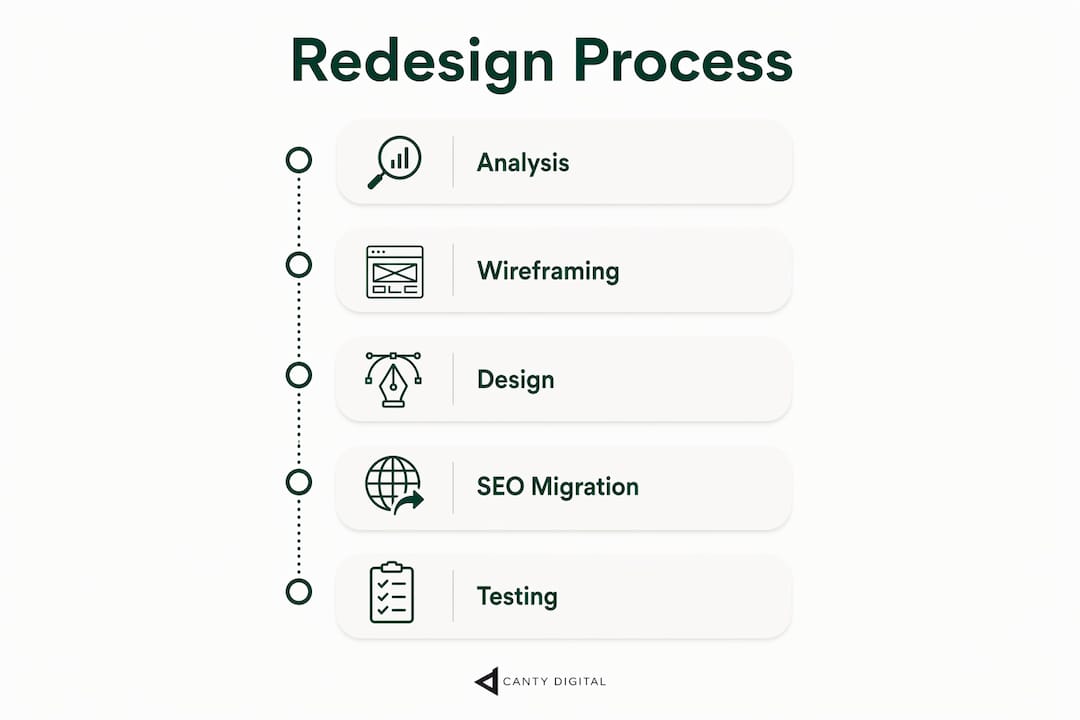
A successful redesign follows a defined sequence. Skipping phases to save time is the most common reason projects fail to deliver results.
Phase 1: Pre-design analysis
Start with data, not opinions. Pull analytics to identify which pages drive traffic, which have high exit rates, and where users drop off in the conversion funnel. Gather user feedback through surveys or session recordings. Then conduct a content audit, categorising every page as keep, rewrite, merge, or delete. A thorough content audit protects SEO value and prevents budget being spent on low-value content that should simply be removed.
Phase 2: Information architecture and wireframing
Critical decisions about content and information architecture must happen before any visual design begins. Map out the new site structure, define the primary user journeys, and create wireframes that show layout and hierarchy without the distraction of colour or imagery. This phase is where most of the strategic thinking occurs.
Phase 3: Visual design and development
Once the structure is approved, visual design can begin. Design should serve the architecture, not the other way around. Development follows approved designs, with mobile responsiveness and responsive web design principles built in from the start, not retrofitted at the end.
Phase 4: SEO migration
SEO migration runs in parallel with development. Failing to manage SEO migrations correctly can cause 30–40% organic traffic loss within weeks if redirects and metadata are not handled properly. Every URL that changes needs a 301 redirect. Every page title and meta description must be reviewed and carried across.
Phase 5: Phased launch and testing
The big-bang launch approach is the most consistent failure mode in redesign projects. Phased rollouts and A/B testing allow precise measurement of impact and make it far easier to roll back changes that do not perform. Launch to a segment first, measure, then roll out fully.
Pro Tip: Set your baseline metrics before launch day. Conversion rate, bounce rate, and average session duration from the three months prior give you a clean comparison point to measure redesign impact.
Common pitfalls to avoid during a website redesign
Most redesign failures share the same root causes. Recognising them before a project starts is the difference between a site that performs and one that costs a lot and delivers little.
- Treating it as a design exercise: A redesign is a fundamental product change, not a creative project. Decisions about content and architecture drive outcomes. Design executes those decisions.
- Skipping the content audit: Launching a redesigned site with the same poorly organised, outdated content wastes the entire investment. The audit must come first.
- Neglecting SEO migration: Changing URLs without redirects, removing pages without consolidating their authority, or stripping metadata during a platform migration can destroy years of search ranking progress.
- Rushing the timeline: Compressed timelines force teams to skip testing, cut corners on mobile optimisation, and launch before the site is ready. The cost of fixing problems post-launch is always higher than taking the time to do it right.
- No alignment with business goals: A site that looks great but does not support lead generation, e-commerce, or content marketing goals has failed its brief. Every design decision should trace back to a measurable business objective.
For a deeper look at where redesigns go wrong, common redesign mistakes in 2026 covers the specific errors that cost businesses the most. The relationship between SEO and web design is also worth understanding before briefing any agency, because the two disciplines must work together from day one.
Key takeaways
A website redesign is a strategic product change, not a cosmetic update, and its success depends on pre-design analysis, SEO migration, and phased rollout rather than visual execution alone.
| Point | Details |
|---|---|
| Redesign vs. refresh | A redesign changes site architecture and backend systems; a refresh only updates surface-level visuals. |
| Conversion impact | Successful redesigns can increase conversion rates by up to 30%, with page speed and mobile optimisation as key drivers. |
| Content audit first | Categorise every page as keep, rewrite, merge, or delete before any design work begins. |
| SEO migration is non-negotiable | Poor redirect management during a redesign can cause 30–40% organic traffic loss within weeks. |
| Avoid big-bang launches | Phased rollouts and A/B testing reduce risk and allow accurate measurement of redesign impact. |
Why most redesigns fail before the first wireframe is drawn
After working on web projects for over a decade, the pattern is clear: the businesses that get the best results from a redesign are the ones that do the hard thinking before anything is designed. They know which pages are driving leads, which content is outdated, and what their users are actually trying to do on the site.
The businesses that struggle are the ones that start with a mood board. They pick colours, reference sites they like, and brief an agency on aesthetics. Six months later, they have a beautiful site that converts worse than the old one, because nobody mapped the user journey or audited the content before the design locked in.
The uncomfortable truth is that the most important work in a redesign happens in a spreadsheet, not a design tool. A content audit, a traffic analysis, and a clear brief tied to business goals will determine whether the project succeeds. The visual design is the last thing to decide, not the first.
My advice to any business owner starting this process: spend at least as much time on your pre-design analysis as you do reviewing design mockups. The mockups are easy to get excited about. The analysis is where the money is made.
— Matthew
CantyDigital’s approach to website redesign
A redesign is one of the most significant investments a business makes in its digital presence. Getting the strategy right from the start is what separates sites that perform from sites that just look good.
CantyDigital is a Wollongong-based digital agency with 12 years of experience building high-performance websites designed for both search engines and real users. Every project starts with a proper analysis phase, not a mood board. If you have questions about what a redesign involves for your specific business, the website design FAQs cover the most common concerns in plain language. For a direct conversation about your site, book a strategy call and get clear on what your redesign actually needs before committing to a brief.
FAQ
What is a website redesign in simple terms?
A website redesign is a comprehensive rebuild of a site’s structure, design, content, and technology to improve performance and better serve business goals. It goes well beyond visual updates to address how the site functions and converts visitors.
How long does a website redesign take?
Most business website redesigns take between three and six months, depending on site size, content volume, and the complexity of integrations required. Rushing the timeline is one of the most common causes of poor results.
How much does a website redesign cost?
Cost varies significantly based on scope, platform, and the agency engaged. Small business redesigns typically range from a few thousand dollars to tens of thousands for larger, more complex sites. A clear brief and content audit help control costs before work begins.
Will a website redesign hurt my SEO?
A poorly managed redesign can cause 30–40% organic traffic loss if redirects and metadata are not handled correctly. A properly executed SEO migration, run in parallel with development, protects and often improves existing rankings.
What is the difference between a website redesign and a website refresh?
A refresh updates surface-level elements such as colours, fonts, and images without changing site architecture or backend systems. A redesign rebuilds the site’s structure, content organisation, and technology to deliver measurably better performance.


