

Link building is the process of earning hyperlinks from other websites to yours, and it remains one of the most reliable ways to improve your search rankings, build brand authority, and get your site cited by AI-driven platforms like ChatGPT and Perplexity. Track your existing backlinks in Google Search Console before you do anything else, and use a tool like SEMrush to see what your competitors are earning. Those two steps alone will show you exactly where you stand.
Table of Contents
- How link building affects your rankings and AI visibility
- Types of links and which ones to chase first
- What makes a backlink genuinely valuable
- How to earn high-quality links: a practical checklist
- How to measure whether your link building is working
- Realistic timelines and costs for Australian small businesses
- Two mini case studies: what link building looks like in practice
- Key takeaways
- A frank view on where most beginners go wrong
- CantyDigital’s link-building services for Australian businesses
How link building affects your rankings and AI visibility
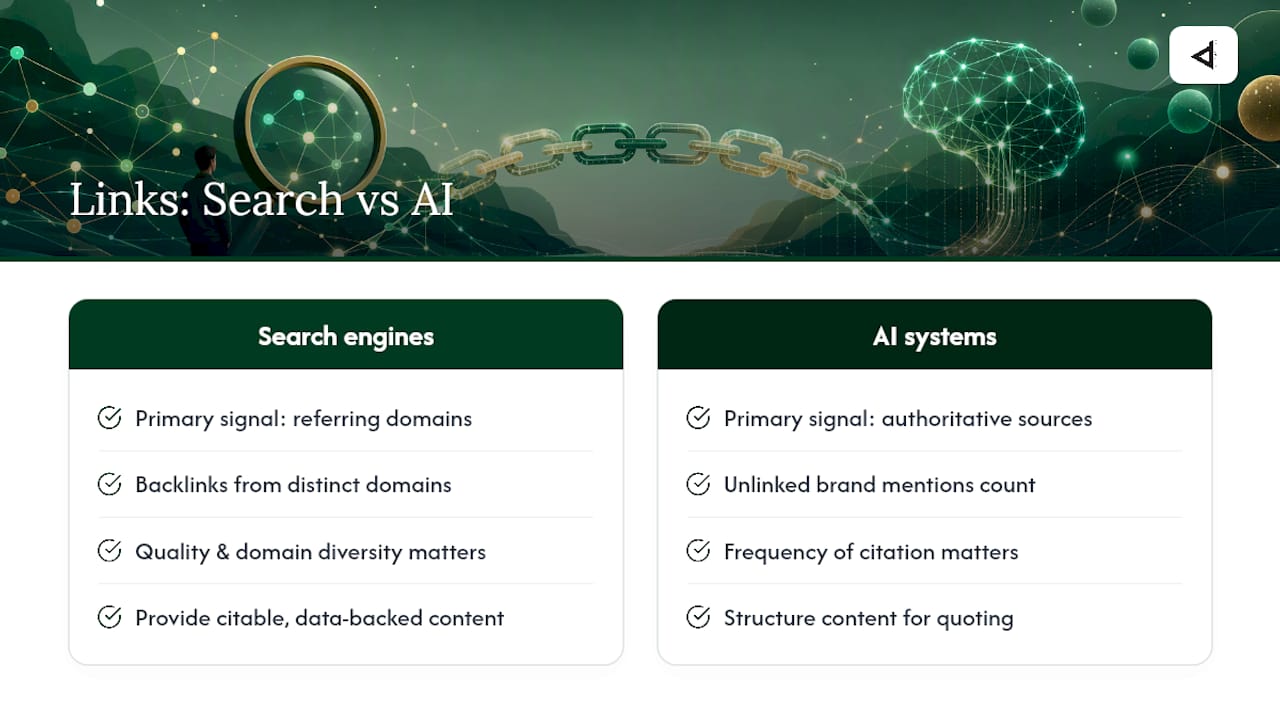
Search engines have used links as a core ranking signal since Google’s original PageRank algorithm, which treated each link as a vote. The logic was simple: if many credible sites link to a page, that page is probably worth ranking. The mechanics are more sophisticated now, but the underlying principle holds. Industry data consistently shows a strong correlation between referring domains and higher rankings, with top-ranking pages typically carrying significantly more backlinks than pages sitting below them.
The referring-domain signal: Pages with more backlinks from distinct, relevant domains tend to outrank pages with fewer, all else being equal. Quantity matters less than the quality and diversity of those domains.
What has shifted is the second audience for your links: AI systems. Platforms like ChatGPT, Perplexity, and Google’s AI Overviews pull from sources they consider authoritative and frequently cited. Backlinks remain a core ranking signal and should be paired with citable, data-backed content for AI visibility. But AI systems also weigh unlinked brand mentions, the frequency with which your name appears in credible contexts, and whether your content is structured to be quoted.
This means link building and brand PR are now one combined programme, not two separate tasks. Earning a link from a respected Australian trade publication does double duty: it passes authority to your site and it trains AI systems to associate your brand with that publication’s credibility. You can read more about this dynamic in CantyDigital’s guide to why backlinks still matter in the AI era.
The practical implication: pair every link-earning campaign with content that is genuinely citable. Original data, clear definitions, and specific claims give journalists, bloggers, and AI systems something concrete to reference. Generic content earns neither links nor citations.
Types of links and which ones to chase first
Not all links are equal, and knowing the categories helps you prioritise where to spend your time.
| Link type | How it’s earned | Authority passed | Best use |
|---|---|---|---|
| Editorial link | Cited naturally in an article or resource | Yes (dofollow) | Highest priority — hardest to earn, most valuable |
| Guest post link | Contributed article on another site | Usually yes | Strong when the site is relevant and editorial standards are high |
| Resource page link | Listed on a curated “useful links” page | Usually yes | Good for local and niche directories |
| Directory link | Submitted to a business or industry directory | Varies | Useful for local SEO; low value on generic directories |
| Nofollow / sponsored | Paid placements, press releases, some news sites | No (by attribute) | Brand awareness and referral traffic, not authority |
| UGC (user-generated) | Forum posts, blog comments | No | Minimal SEO value; useful for discovery |
| Social / noindex | Shared on social platforms | No | Referral traffic and brand signals only |
Chase editorial and resource page links first. They are harder to earn but they compound over time. Guest post links are worth pursuing on genuinely relevant, well-edited publications, not content farms. Directory links have a narrow use case: local SEO, where being listed on Google Business Profile, True Local, and industry-specific Australian directories does move the needle for local searches.
Nofollow links from high-traffic publications are not worthless. A mention in a major Australian news outlet with a nofollow link still drives real traffic and contributes to the brand-mention signals that AI systems read.
What makes a backlink genuinely valuable
Five factors determine whether a link is worth pursuing.
Domain authority and trust. A link from a site with a strong backlink profile of its own passes more equity than one from a brand-new blog. Tools like Ahrefs’ Domain Rating (DR) or Moz’s Domain Authority (DA) give you a proxy score, but treat them as rough guides, not gospel.
Topical relevance. A link from a plumbing directory to a plumbing business is more valuable than a link from a general lifestyle blog to that same business, even if the lifestyle blog has a higher DA. Search engines are increasingly good at understanding whether the linking site’s topic matches yours. Relevance often outweighs raw authority metrics.
Anchor text. Descriptive, natural anchor text (“local SEO tips for tradies”) tells search engines what your page is about. Over-optimised anchor text (“best cheap SEO services Australia buy now”) looks manipulative and can trigger a penalty. Aim for a natural mix: branded anchors, generic anchors (“click here”, “this guide”), and a smaller proportion of keyword-rich anchors.
Placement and context. As covered in the glossary section, a link in the body of an article outperforms one in a footer or sidebar. The surrounding text also matters. A link sitting next to a sentence that describes your expertise reinforces the relevance signal.
Editorial intent. Did someone choose to link to you because your content was genuinely useful? Or was the link placed as part of a transaction? Search engines are sophisticated enough to detect patterns of transactional linking. Quality editorial links from relevant sites are more valuable than many low-quality links, and that gap is widening as Google’s algorithms mature.
A single link from a respected Australian industry association or a well-read trade publication will do more for your rankings than fifty links from obscure directories. That is not a theory; it is the consistent finding from practitioners who track this at scale.
How to earn high-quality links: a practical checklist
Modern link building uses a mix of link-producer tactics and association-building digital PR, and both have a role. Here is a 90-day roadmap you can follow without an agency.
Step-by-step: your first 90 days
-
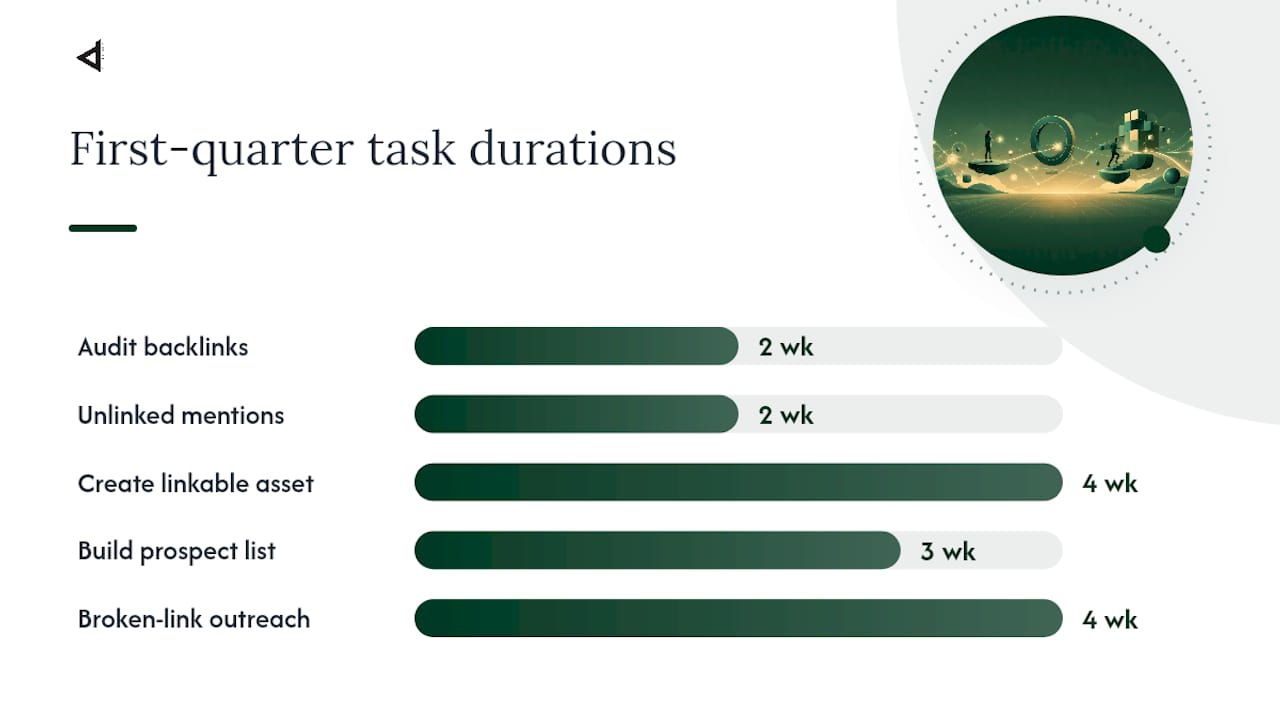
Audit your existing backlinks (Week 1–2). Pull your current backlink profile from Google Search Console and cross-reference it with Ahrefs or SEMrush. Note which pages attract links, which referring domains are relevant, and whether any toxic links need disavowing.
-
Find unlinked brand mentions (Week 2–3). Search for your business name in Google News and set up a Google Alert. When you find a mention without a link, email the author and politely ask them to add one. This is the fastest win in link building.
-
Create one linkable asset (Week 3–6). A linkable asset is content other sites want to cite: original research, a practical how-to guide, a local data report, a free tool, or a well-designed infographic. It does not need to be elaborate; it needs to be genuinely useful and specific.
-
Build a prospect list (Week 4–6). Identify 30–50 sites that link to similar content in your niche. Use Ahrefs’ “Link Intersect” or SEMrush’s backlink gap tool to find sites linking to competitors but not to you. Add Australian industry directories and local news outlets relevant to your sector.
-
Run broken-link outreach (Week 5–8). Find pages on relevant sites that link to dead URLs (use Ahrefs’ broken link checker or the Check My Links browser extension). Email the site owner, flag the broken link, and offer your content as a replacement. Conversion rates on this tactic are consistently higher than cold outreach because you are solving a problem for them.
-
Pitch guest contributions (Week 6–10). Identify two or three publications your audience reads. Pitch a specific, useful article idea, not a generic “I’d love to write for you” email. Keep the pitch to three sentences: who you are, what you want to write, and why their readers will care.
-
Follow up and track (Ongoing). Send one follow-up email five to seven days after your initial outreach. Log every contact, response, and outcome in a spreadsheet. Review your referring domain count monthly.
Pro Tip: Prioritise link reclamation and broken-link outreach in your first 30 days. Both tactics offer something of value to the other party, which is why they convert faster than cold guest-post pitches. You are not asking for a favour; you are solving a problem.
Tactics such as broken-link outreach, original research, and contextual guest contributions remain effective when executed to editorial standards. The key phrase is “editorial standards” — a guest post that reads like a press release will get rejected or, worse, published on a low-quality site that does nothing for your rankings.
For a deeper look at digital PR as a link-earning channel, CantyDigital’s guide on digital PR strategy covers the mechanics in detail. If you want to understand how your content’s structure affects whether AI systems will cite it, the Cromojo piece on building a site AI wants to cite is worth reading alongside this guide.
How to measure whether your link building is working
Tracking the right metrics separates a link-building programme that compounds from one that just keeps you busy.
| Metric | What it tells you | Where to track it |
|---|---|---|
| Referring domains | How many distinct sites link to you | Google Search Console, Ahrefs, SEMrush |
| Organic traffic to linked pages | Whether links are driving ranking improvements | Google Search Console |
| Keyword ranking movement | Which target keywords are climbing | SEMrush, Ahrefs, Moz |
| Referral sessions | Direct traffic arriving via backlinks | Google Analytics 4 |
| Domain authority proxy (DR/DA) | Rough measure of overall link profile strength | Ahrefs (DR), Moz (DA) |
| Editorial placements | Number of quality links earned this period | Outreach spreadsheet |
| Unlinked brand mentions | Opportunities to convert mentions into links | Google Alerts, Ahrefs Alerts |
A simple tracking stack for a small Australian business: Google Search Console for free backlink and traffic data, Ahrefs or SEMrush for deeper backlink analysis and competitor research, and a Google Sheet to log outreach contacts, dates, responses, and outcomes. Moz’s Link Explorer is another option for checking domain authority proxies.
Report monthly on referring domain growth and keyword movement. Report quarterly on whether the pages attracting links are also gaining organic traffic. The qualitative context matters too: a link from a respected Australian trade publication is worth noting in your report even if the raw domain count only moves by one.
Unlinked brand mentions deserve their own column in your tracking sheet. As covered earlier, AI systems weigh mention frequency alongside backlinks. CantyDigital’s article on why brand mentions matter for SEO explains how to find and act on these efficiently.
Realistic timelines and costs for Australian small businesses
Set honest expectations before you start, because link building is a long game.
On budget, Australian small businesses typically fall into three shapes:
- Small monthly retainer ($500–$1,500/month AUD): An agency or freelancer handles prospecting, outreach, and reporting. You get consistent activity without the time investment. CantyDigital’s link-building strategies for small business guide covers what to expect at different budget levels.
Prioritise spend in this order: audit first, then asset creation, then outreach. Paying for outreach before you have something worth linking to is the most common budget mistake beginners make.
Two mini case studies: what link building looks like in practice
Case study 1: Local service business, resource page outreach
A small Wollongong-based trades business had a solid website but almost no referring domains. They created a single practical resource: a free checklist for homeowners on what to check before calling a tradesperson. They emailed 40 local home improvement blogs and council resource pages, offering the checklist as a free addition to their “useful links” sections. Twelve sites added the link within six weeks. Within a few months, multiple target local keywords improved from lower to higher search positions. The lesson: one genuinely useful asset, targeted at the right sites, outperforms a hundred cold emails about nothing specific.
Case study 2: Niche blog, broken-link reclamation
A niche Australian gardening blog had lost significant organic traffic after a site migration broke dozens of internal URLs, which in turn caused external sites to link to dead pages. The owner used Ahrefs to identify every external link pointing to a 404 page, then emailed each linking site with the correct URL. Sixty percent of sites updated their links within a month. Traffic recovered to pre-migration levels within eight weeks. The lesson: fixing what you already have is almost always faster than building from scratch.
Key takeaways
Link building is the single most consistent lever for improving domain authority and organic rankings, and it now doubles as a trust signal for AI-driven search platforms.
| Point | Details |
|---|---|
| Start with what you have | Audit existing backlinks in Google Search Console before spending on outreach. |
| Quality beats quantity | One editorial link from a relevant, trusted site outperforms dozens of directory submissions. |
| AI visibility needs mentions too | Track unlinked brand mentions alongside backlinks; both feed AI citation signals. |
| Avoid black-hat shortcuts | Paid links, PBNs, and mass submissions risk penalties that can take months to recover from. |
| CantyDigital can run it for you | CantyDigital’s outreach automation and backlink services handle prospecting, outreach, and reporting for Australian small businesses. |
A frank view on where most beginners go wrong
The biggest mistake beginners make with link building is treating it as a numbers game. They chase domain authority scores, count links like trophies, and measure success by how many emails they sent. None of that is the point.
The question worth asking is simpler: would a real editor at a real publication choose to link to this page? If the honest answer is no, no amount of outreach volume will fix it. The content has to earn the link before the email gets sent.
There is also a tendency to separate link building from content strategy, as if they are two different departments. They are not. The sites that build authority fastest are the ones where every piece of content is designed with a specific linking audience in mind. Who would cite this? Why would they? What would they need to see to feel confident linking to it? Those questions should be asked before a word is written, not after the content is published and the outreach begins.
The AI visibility angle adds a layer that most guides still underplay. Unlinked mentions, citation frequency, and the credibility of the contexts in which your brand appears are all feeding into how AI systems decide what to surface. That means a press release picked up by ten Australian news outlets, even without a dofollow link on every one, is doing real work. Treat brand PR and link building as one programme, not two, and you will compound faster than competitors who are still counting raw link numbers.
CantyDigital’s link-building services for Australian businesses
If you have read this far and the honest conclusion is that you would rather have someone run this for you, that is a reasonable call. Link building done properly takes consistent time, a clear process, and access to the right tools.
CantyDigital is a Wollongong-based digital agency with 12 years of experience running link-building programmes for Australian small and mid-sized businesses, with no lock-in contracts. The approach combines outreach automation, press release distribution across Australian platforms, and editorial guest post placement to build a backlink profile that holds up under algorithm updates. As a 5-star Wix Partner, CantyDigital also builds the kind of technically sound, AI-compatible websites that give your links somewhere worth pointing.
Services relevant to link building include authority link building strategy and content, outreach automation, press release distribution, and full SEO growth plans from $170/month. If you want to start with a backlink audit and a clear picture of where you stand, check the backlinks and outreach automation FAQs or get in touch directly to discuss what a realistic programme looks like for your business.