

Brand mentions are defined as any reference to your business name across the web, whether linked or unlinked, and search engines treat them as direct signals of trust, authority, and topical relevance. Understanding why brand mentions matter for SEO has never been more urgent. A May 2026 Ahrefs study of 75,000 brands found that branded web mentions correlate at 0.664 with AI Overview visibility. That is three times stronger than backlinks, which scored just 0.218. For digital marketers and SEO professionals, this single finding reframes where effort should go.
Why brand mentions matter for SEO and AI search
The shift from backlink counting to brand mention analysis reflects a deeper change in how search engines evaluate authority. Traditional SEO rewarded sites that accumulated the most inbound links. Modern ranking systems, including Google’s AI Overviews and large language model (LLM) based search, evaluate whether a brand is consistently referenced as a credible source across diverse, trusted domains.
Google’s Quality Rater Guidelines treat unlinked brand mentions as trust signals that contribute directly to a brand’s expertise, authority, and trustworthiness, commonly called E-E-A-T. This means a mention in a respected industry publication carries ranking weight even when no hyperlink is attached. The implication for SEO professionals is significant: you no longer need a link to earn SEO credit from a mention.
AI models take this further. AI-driven search visibility depends more on being referenced as an answer source frequently and credibly than on generating referral clicks. A brand that appears in editorial articles, podcast transcripts, and social discussions builds a reputation profile that AI systems can extract and surface in generated responses.
“Backlinks still have SEO value, but AI models prioritise frequency, context, and consistency of brand mentions to build topical reputation. A brand mentioned once in a high-authority source is useful. A brand mentioned consistently across dozens of trusted sources becomes the answer.”
The mechanics behind this involve two key concepts:
- Entity association via co-occurrence: LLMs focus on brand co-occurrence with industry keywords across high-trust domains. A legal firm mentioned alongside “contract law,” “dispute resolution,” and “commercial litigation” across multiple authoritative sites becomes strongly associated with those topics in AI memory.
- Reciprocal Rank Fusion (RRF): Using RRF, AI ranking systems weigh brands that appear consistently across multiple related queries and diverse sources higher than brands with raw authority scores but narrow mention profiles.
The practical takeaway is that brand visibility and SEO are now inseparable. A brand that earns mentions across editorial media, social platforms, and third-party review sites builds the kind of multi-source consensus that AI systems use to decide whose name appears in a generated answer.
What types of brand mentions carry the most SEO weight?

Not all mentions are equal. The source, context, sentiment, and link status of a mention each affect how much SEO value it delivers.
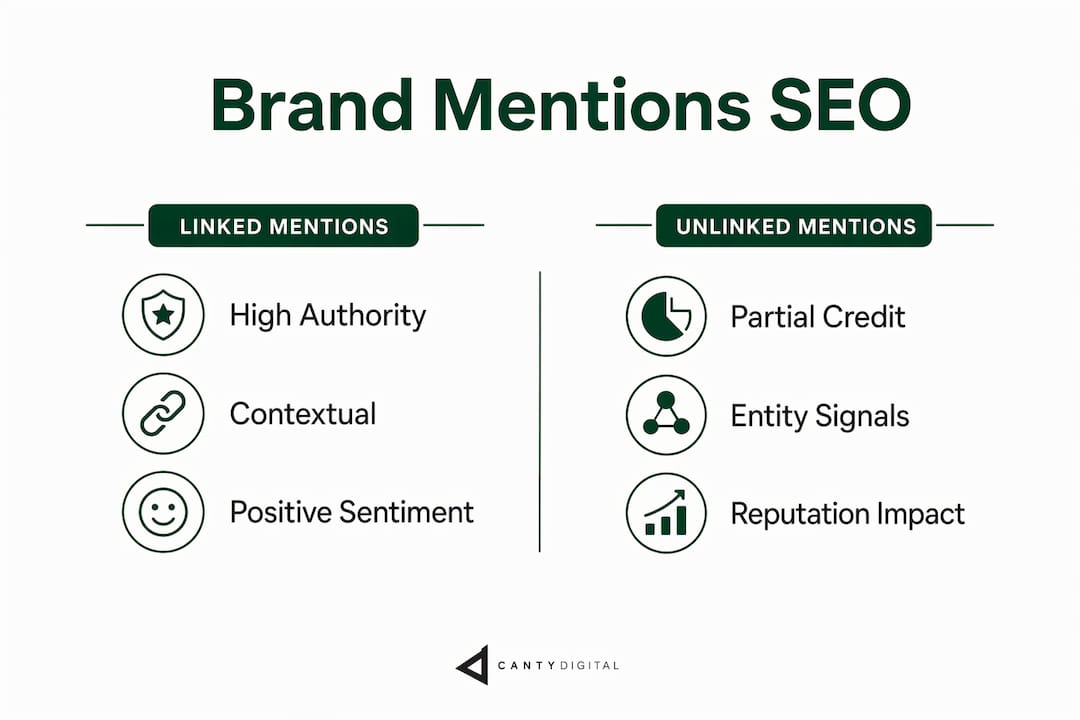
Over 75% of brand mentions in AI-generated responses come from editorial media and social conversations rather than brand-owned sites. This finding matters because many marketers invest heavily in owned content while neglecting the third-party mentions that AI systems actually draw from.
Prioritising mentions by value looks like this:
- Editorial mentions on authoritative domains. A mention in a national newspaper, industry journal, or well-regarded blog carries the highest weight. The domain authority of the source amplifies the trust signal.
- Unlinked mentions on high-authority sites. These still contribute to E-E-A-T and AI entity association. Converting unlinked mentions into backlinks is a high-return link building tactic that also strengthens referral traffic.
- Social media mentions with engagement. Brand mentions influence social media algorithms by signalling engagement and relevance beyond traditional metrics. A mention that generates replies, shares, or saves compounds its reach.
- Review platform mentions. Google Business Profile, Trustpilot, and industry-specific directories contribute to local and vertical SEO signals.
- Brand-owned content. Press releases, blog posts, and social profiles have value for indexation and keyword association, but they carry the least weight for AI trust signals.
Mention context matters as much as source authority. A mention that appears alongside your core service keywords reinforces topical relevance. A mention that simply names your brand without context contributes less to entity extraction by AI models. For this reason, keyword co-occurrence within the surrounding text of a mention is worth actively managing through your PR and outreach messaging.
Pro Tip: When pitching to journalists or guest post hosts, provide a brief context sentence that naturally pairs your brand name with two or three of your core service keywords. This shapes how the mention reads to both humans and AI systems.
How to track and measure brand mentions for SEO
Tracking brand mentions without a system produces noise, not insight. The goal is to turn raw mention data into decisions about content, outreach, and reputation management.
The recommended cadence is straightforward. SEO professionals should track mention velocity weekly to detect awareness spikes, then report monthly on share of voice, branded impressions, and link conversion rates. Weekly velocity tracking catches PR wins and reputation risks in real time. Monthly reporting connects mention growth to measurable SEO outcomes.
Key metrics to monitor:
- Mention velocity: The rate at which new mentions appear. A sudden spike often signals a viral moment, a press pickup, or a reputation issue.
- Share of voice: Your brand’s mention volume relative to the category. This benchmarks competitive position without requiring competitor traffic data.
- Link conversion rate: The percentage of unlinked mentions successfully converted to backlinks through outreach. Even a modest conversion rate compounds over time.
- Sentiment distribution: The ratio of positive, neutral, and negative mentions. Mention sentiment analysis acts as an early warning system for reputation issues, signalling shifts before a crisis reaches mainstream news.
- Source diversity: The spread of mentions across editorial, social, review, and forum sources. Narrow source diversity limits AI entity consensus.
| Metric | Tracking frequency | Primary use |
|---|---|---|
| Mention velocity | Weekly | Detect spikes and PR wins |
| Share of voice | Monthly | Competitive benchmarking |
| Link conversion rate | Monthly | Link building ROI |
| Sentiment distribution | Weekly | Reputation management |
| Source diversity | Monthly | AI visibility assessment |
Real-time alert tools, set up for your brand name, key personnel names, and core product terms, catch mentions the moment they are published. This speed matters for outreach: a journalist who mentions your brand today is far more receptive to a link request this week than in six weeks.
Pro Tip: Set up alerts for common misspellings of your brand name. Unlinked mentions with typos still carry partial entity association value, and correcting them through outreach improves both SEO and brand perception.
Practical strategies to earn and build brand mentions
Earning authoritative mentions requires deliberate effort across PR, content, and outreach channels. The following strategies produce the highest return for digital marketers focused on AI-driven search visibility.
- Build relationships with editorial media. Consistent media coverage from authoritative outlets is the single most effective driver of high-value mentions. Identify five to ten publications in your industry and pitch original data, expert commentary, or case studies that give journalists a reason to name your brand.
- Create content that earns organic discussion. Original research, industry surveys, and data-driven reports get cited by other writers. A single well-distributed study can generate dozens of editorial mentions across months.
- Run a systematic unlinked mention outreach programme. Use alert tools to find unlinked mentions weekly. Contact the site owner with a polite, specific request to add a link. This tactic converts existing brand visibility into linkless link building value and direct SEO authority.
- Align your messaging with target keywords. Every press release, media pitch, and guest post should include your brand name alongside two or three core service keywords. This shapes AI co-occurrence associations over time.
- Integrate mention goals into PR campaigns. Treat mention volume and source diversity as campaign KPIs alongside reach and impressions. A PR campaign that generates 50 editorial mentions across 20 domains delivers more AI visibility than one that reaches a large audience through a single channel.
Across all of these tactics, consistency beats intensity. A brand that earns ten editorial mentions per month across diverse sources for twelve months builds a stronger AI entity profile than one that earns 200 mentions in a single campaign and then goes quiet.
- Prioritise sources with genuine editorial standards over low-quality directories.
- Track which content formats generate the most third-party citations and produce more of them.
- Coordinate PR and SEO teams so mention data informs both content strategy and link building.
Key takeaways
Brand mentions are now a primary SEO signal, with their correlation to AI visibility running three times stronger than backlinks, making multi-source mention growth the most direct path to search prominence in 2026.
| Point | Details |
|---|---|
| Mentions outperform backlinks for AI | Branded mentions correlate at 0.664 with AI Overview visibility versus 0.218 for backlinks. |
| Editorial sources dominate AI responses | Over 75% of AI-cited mentions come from editorial media and social conversations, not brand-owned sites. |
| Unlinked mentions still carry SEO weight | Google’s E-E-A-T framework treats unlinked mentions as trust signals; convert them to links for compounded value. |
| Track velocity and sentiment weekly | Weekly monitoring catches reputation risks and PR wins before they escalate or fade. |
| Context shapes AI entity extraction | Mentions paired with core service keywords build stronger topical associations in AI ranking systems. |
The part most SEO strategies still get wrong
After working in digital marketing for over a decade, the pattern I see most often is this: SEO teams obsess over backlink counts while their brand’s mention profile quietly determines whether they appear in AI-generated answers at all.
The uncomfortable truth is that a brand with 500 high-quality backlinks but a thin, inconsistent mention profile across editorial and social sources will lose AI visibility to a brand with 200 backlinks and a rich, diverse mention footprint. The RRF mechanism does not reward raw authority. It rewards consistency across multiple query contexts and source types.
What I have found actually works is treating brand mentions as a separate discipline within SEO, not a byproduct of link building. That means dedicated tracking, monthly reporting on source diversity, and a PR strategy explicitly designed to place your brand name alongside your target keywords in third-party editorial content. The brands that do this well are not necessarily the biggest spenders. They are the most deliberate.
The other thing worth saying plainly: sentiment matters more than most SEO professionals acknowledge. A cluster of negative mentions on high-authority sites does not just damage reputation. It actively suppresses AI visibility by introducing conflicting signals about your brand’s trustworthiness. Monitoring and responding to negative mentions is not a PR task. It is an SEO task.
— Matthew
How CantyDigital can strengthen your brand mention strategy
CantyDigital is a Wollongong-based digital agency with 12 years of experience in signal-based SEO and AI search optimisation. If your brand is not appearing in AI Overviews or ranking for competitive terms, a weak mention profile is often the cause.
CantyDigital’s SEO and AISEO services are built around the signals that modern search engines and LLMs actually use, including brand mention growth, entity association, and multi-source consistency. The team also offers press release distribution across Australian platforms and outreach automation to convert unlinked mentions into high-quality backlinks. No lock-in contracts. Real, measurable results. If you want a brand mention strategy that moves rankings, CantyDigital is the place to start.
FAQ
What is a brand mention in SEO?
A brand mention is any reference to your business name across the web, whether or not it includes a hyperlink. Search engines and AI models use these references as trust and authority signals when evaluating your site’s ranking potential.
Do unlinked mentions help SEO?
Yes. Google’s Quality Rater Guidelines treat unlinked mentions as E-E-A-T signals, and AI systems use them for entity association. Converting unlinked mentions to backlinks adds further SEO value on top of the existing signal.
How often should I monitor brand mentions?
Track mention velocity weekly to catch spikes and reputation shifts early. Report monthly on share of voice, source diversity, and link conversion rates to connect mention growth to measurable SEO outcomes.
Why do brand mentions matter more for AI search than backlinks?
A May 2026 Ahrefs study found branded mentions correlate at 0.664 with AI Overview visibility compared to 0.218 for backlinks. AI systems use Reciprocal Rank Fusion to prioritise brands that appear consistently across multiple trusted sources and query contexts.
What sources produce the most valuable brand mentions?
Editorial media and social conversations generate over 75% of the brand mentions that appear in AI-generated responses. Mentions from authoritative third-party publications carry significantly more weight than brand-owned content for both traditional SEO and AI visibility.