


Local SEO ROI is defined as the measurable financial return your business earns from investment in local search visibility, calculated using real lead data, conversion rates, and revenue figures. To measure ROI from a local SEO campaign accurately, you need three things working together: Google Business Profile (GBP) insights, Google Analytics 4 (GA4) conversion tracking, and a sound attribution model. Without all three, you are either over-crediting SEO or flying blind. This guide gives Australian business owners and marketing professionals a practical, step-by-step framework for calculating and monitoring local SEO returns.
What key metrics and tools are essential to measure local SEO ROI?
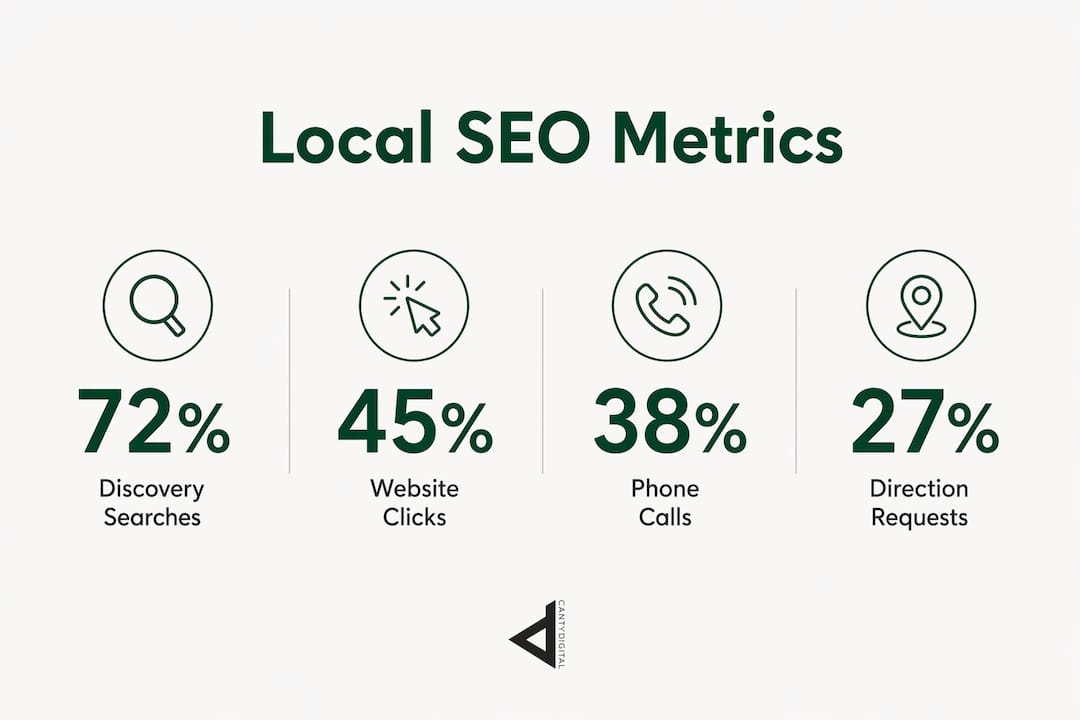
The foundation of any local SEO ROI measurement is your Google Business Profile data. GBP tracks discovery searches (how many people found you through a category or keyword search), direct searches (people who already knew your name), calls, direction requests, and website clicks. These are not vanity metrics. Each one represents a potential customer taking a real action toward your business.
GA4 sits alongside GBP as the second pillar. It tells you what happens after someone clicks through to your website. The critical step is adding UTM parameters to your GBP website URL. This separates local SEO traffic cleanly inside GA4, so you can track goal completions, form submissions, and phone click events that originated from local search. Without UTM tagging, that traffic blends into “organic” and attribution becomes guesswork.

The third tool most business owners overlook is geo-grid rank tracking. A 5×5 or 7×7 geo-grid maps your keyword rankings at multiple geographic points across your service area. A single keyword ranking tells you how you appear at one location. A geo-grid shows you the full picture, including the suburbs where you are invisible. That distinction matters enormously for service-area businesses.
| Metric | Source | Business relevance |
|---|---|---|
| Discovery searches | Google Business Profile | Shows how many new customers found you |
| GBP calls | Google Business Profile | Direct lead volume from local search |
| Direction requests | Google Business Profile | Signals foot traffic intent |
| Website clicks (UTM) | GA4 | Tracks on-site conversions from local traffic |
| Geo-grid rank coverage | Rank tracking tools | Reveals visibility gaps across your service area |
| Goal completions | GA4 | Measures actual conversions from local SEO visits |
Pro Tip: Set up a dedicated GA4 goal for GBP-sourced phone clicks and form submissions. Tag your GBP website URL with UTM source “google,” medium “organic,” and campaign “local-seo” so every conversion is cleanly attributed.
How can business owners calculate and attribute revenue from local SEO leads?
The standard formula for attributing local SEO revenue is straightforward. Take your incremental GBP calls (current monthly calls minus your pre-campaign baseline), multiply by your close rate, then multiply by your average job or sale value. The result is your attributed revenue.
Here is a worked example using realistic figures for an Australian trade business:
- Establish your baseline. Record your average monthly GBP call volume from the three months before the campaign started. Say that figure is 15 calls per month.
- Measure current call volume. After six months of local SEO activity, your GBP shows 40 calls per month.
- Calculate incremental calls. 40 minus 15 equals 25 incremental calls attributable to the campaign period.
- Apply an attribution discount. Not every incremental call came purely from SEO. Conservative attribution assigns 70–80% of incremental calls to SEO impact. At 75%, that gives you 18.75 calls, rounded to 19 SEO-attributed calls.
- Multiply by close rate and job value. If your close rate is 65% and your average job value is $850, the calculation is: 19 × 0.65 × $850 = $10,497.50 attributed revenue.
- Calculate ROI. Subtract your monthly SEO investment from attributed revenue, divide by the investment, and multiply by 100. If your investment is $1,200 per month: ($10,497.50 minus $1,200) / $1,200 × 100 = 774% ROI.
This approach underpins most standard ROI models used in local search marketing. The attribution discount is the part most business owners skip, and skipping it inflates your numbers in a way that will eventually embarrass you in a client meeting or board review.
Pro Tip: Track your baseline call volume before you start any campaign. If you have already started, pull your GBP historical data for the three months prior to your first optimisation activity. That baseline is the anchor for every ROI calculation you will ever run.
What is the recommended process for monitoring local SEO performance?
Monthly review is the right cadence for tracking local SEO metrics. Daily checks create noise. Weekly checks are too reactive. A monthly rhythm gives you enough data to spot genuine trends and make decisions based on patterns rather than one-off fluctuations.
Your monthly review should cover these items:
- GBP discovery searches: up, down, or flat compared to last month and the same month last year
- GBP calls, direction requests, and website clicks: trend direction over three months
- GA4 goal completions from UTM-tagged local SEO traffic
- Geo-grid rank coverage: which suburbs improved, which declined
- Review count and average star rating: both affect local ranking signals
- Business information consistency across Google, your website, and any directory citations
The last point is underestimated. Fewer than half of local businesses maintain consistent name, address, and phone number data across all platforms. Google explicitly rewards consistency, and inconsistency actively suppresses your visibility. A monthly check of your core citations takes less than 20 minutes and protects the ranking gains you have already earned.
After each monthly review, choose one specific area to improve. Trying to fix everything at once produces no measurable signal. If your geo-grid shows weak coverage in a particular suburb, focus your next month’s content and citation activity on that area. If your call volume is flat but direction requests are rising, your GBP photos and business description may need attention to convert more profile visitors into callers.
Pro Tip: Calls, direction requests, website visits, and review trend lines together give you a health score for your local SEO campaign. If three of the four are rising, your campaign is working even if one metric dips temporarily.
What common challenges arise when measuring local SEO ROI?
The most common mistake is abandoning a campaign too early. SEO campaigns typically require 3–6 months before meaningful returns appear. The first two months often show near-zero ROI as Google processes new signals and your profile gains authority. Business owners who pull the plug at month three miss the compounding gains that arrive from month four onwards.
The second challenge is over-attribution. If you are also running Google Ads, posting on social media, or getting word-of-mouth referrals, some of those GBP calls came from those channels. Skipping the attribution discount and claiming 100% of incremental calls as SEO wins destroys your credibility with stakeholders and gives you a false picture of what is actually working.
Here are the four most common measurement mistakes and how to fix them:
- No baseline recorded. Fix: Pull historical GBP data immediately and document it before making any changes.
- UTM parameters missing from GBP URL. Fix: Update your GBP website link with UTM tags today. It takes two minutes.
- Reacting to daily or weekly data swings. Fix: Commit to monthly reviews only. Short-term fluctuations are noise, not signal.
- Ignoring qualitative signals. Fix: Read your Google reviews each month. Customers often mention how they found you, which validates or challenges your attribution model.
Pro Tip: Use a simple spreadsheet to log your monthly GBP metrics, GA4 conversions, and geo-grid scores in one place. A three-month rolling average smooths out anomalies and makes your trend lines far more reliable than point-in-time snapshots.
Key takeaways
Accurate local SEO ROI measurement requires a baseline, an attribution discount, and a monthly review process built on GBP insights and GA4 conversion data.
| Point | Details |
|---|---|
| Set a baseline first | Record pre-campaign GBP call volume before any optimisation activity begins. |
| Use the attribution discount | Apply 70–80% attribution to incremental calls to avoid over-crediting SEO. |
| Review monthly, not daily | Monthly cadence reveals real trends; daily data creates misleading noise. |
| Tag your GBP URL with UTMs | UTM parameters separate local SEO traffic cleanly inside GA4 for accurate conversion tracking. |
| Fix one thing per month | Focused monthly improvements produce measurable signals; fixing everything at once produces none. |
What I have learned from tracking local SEO ROI over the years
The number that surprises most business owners is not the ROI percentage. It is how long the ramp-up takes. I have seen well-executed local SEO campaigns show almost nothing in month one and month two, then deliver a consistent stream of qualified leads from month five onwards. The businesses that stayed the course were the ones that had clear tracking in place from day one. Seeing the geo-grid coverage expand, even before calls increased, gave them the confidence to keep going.
The other thing I have come to believe strongly is that qualitative data belongs in your ROI report alongside the numbers. When a customer mentions in a Google review that they “found you on Google Maps,” that is attribution data. It confirms your model. When reviews mention a competitor by name and explain why they chose you instead, that is competitive intelligence you cannot get from GA4.
The businesses I see struggle most with local SEO performance are the ones chasing quick wins rather than building a measurement habit. A solid monthly reporting process, even a simple one, is worth more than any single tactic. It tells you what to do next, and it tells you when to stop doing something that is not working. That clarity is the real return on your investment.
— Matthew
How CantyDigital supports your local SEO measurement
Knowing what to measure is one thing. Having a team that builds the tracking infrastructure and interprets the data for you is another.

CantyDigital is a Wollongong-based digital agency with 12 years of experience in signal-based SEO and local search strategy. The team sets up proper GBP tracking, UTM-tagged URLs, and monthly reporting frameworks so you always know what your local SEO investment is returning. For businesses ready to move from guessing to knowing, the SEO FAQs page is a practical starting point, and the SEO growth plans from $170 per month are built for businesses that want measurable results without lock-in contracts.
FAQ
What is the formula to calculate local SEO ROI?
Local SEO ROI is calculated as: (attributed revenue minus SEO investment) / SEO investment × 100. Attributed revenue comes from incremental GBP calls multiplied by your close rate and average job value, with a 70–80% attribution discount applied.
How long before a local SEO campaign shows a positive ROI?
Most local SEO campaigns require 3–6 months before meaningful returns appear. Early months build authority and ranking signals; revenue gains typically compound from month four or five onwards.
What is a geo-grid and why does it matter for ROI tracking?
A geo-grid maps your keyword rankings across multiple geographic points in your service area. It reveals which suburbs you rank well in and which you do not, giving you a far more complete picture of local visibility than a single keyword ranking.
How do UTM parameters help with local SEO attribution?
UTM parameters added to your GBP website URL separate local SEO traffic from other organic traffic inside GA4. This lets you track conversions, form fills, and phone clicks that came specifically from your Google Business Profile.
How often should I review my local SEO metrics?
Monthly reviews are the recommended cadence for local SEO metrics. Monthly data gives you enough volume to identify genuine trends without the noise that comes from reacting to daily or weekly fluctuations.


