


UX design is defined as the discipline of creating products and services that deliver meaningful, relevant experiences by focusing on user needs, behaviours, and goals. The field draws on psychology, human-computer interaction, and design thinking to solve real problems, not just create attractive interfaces. Strong UX design produces 200–400% conversion improvements and doubles revenue growth, with 88% of users never returning after a poor experience. Those numbers explain why UX design has moved from a specialist function into a core business priority. Whether you are exploring the field for the first time or looking to sharpen your practice, understanding what UX design actually is, and what it is not, is the clearest place to start.
What is UX design and why does it matter?
UX design is the practice of shaping every touchpoint a person has with a product, from the first click to the final confirmation screen. The standard industry term is “user experience design,” often shortened to UX design, and it covers research, strategy, prototyping, and testing, not just visual layout. UX design is distinct from art; it is objective problem-solving using structured frameworks rather than self-expression. A UX designer asks “does this work for the person using it?” before asking “does this look good?”
The field sits at the intersection of psychology, business strategy, and technology. A UX designer must understand how people think, what they need, and how digital systems behave. This cross-disciplinary nature is what makes UX design both challenging and valuable. Good digital design effectiveness depends heavily on how well UX principles are applied from the start.

What are the core UX design principles and processes?
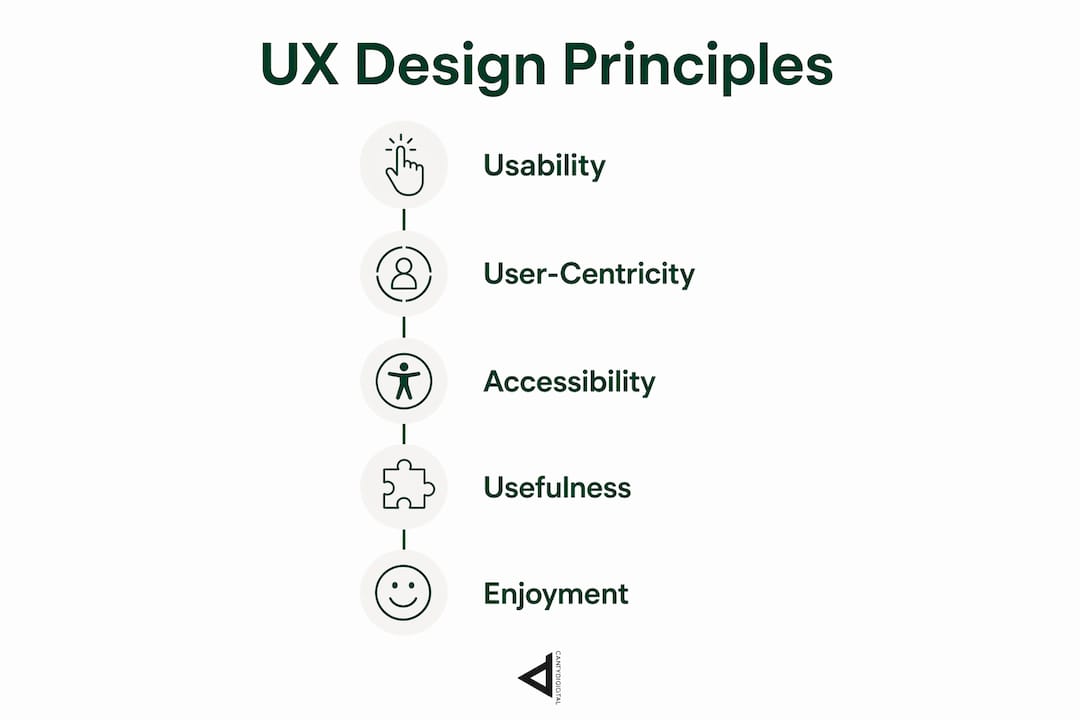
UX design focuses on five core principles: usability, user-centricity, accessibility, usefulness, and enjoyment. Each principle serves a specific purpose. Usability means the product works without confusion. User-centricity means decisions are grounded in real user research, not assumptions. Accessibility means the product works for people with disabilities, not just the majority. Usefulness means it solves a genuine problem. Enjoyment means the experience feels satisfying, not frustrating.
These principles come to life through a structured process. The 5-step Design Thinking framework, Empathise, Define, Ideate, Prototype, and Test, is the most widely used approach in the field. Each stage builds on the last. Empathising means conducting user interviews and observations. Defining means synthesising findings into a clear problem statement. Ideating means generating solutions without filtering. Prototyping means building low-fidelity versions to test assumptions. Testing means putting prototypes in front of real users and measuring what happens.
How UX design differs from UI design
UX design and UI design are related but separate disciplines. UX covers the full experience, including research, information architecture, and interaction flow. UI design focuses specifically on the visual layer, typography, colour, and component styling. A product can have a beautiful UI and still fail on UX if the navigation is confusing or the task flow is broken. The two disciplines work best together, but conflating them leads to under-investment in the research and testing that UX requires.
Measuring UX with frameworks
UX design is a data-driven discipline that prioritises metrics like task success rates and System Usability Scale (SUS) scores over subjective aesthetics. The HEART framework, developed by Google, measures Happiness, Engagement, Adoption, Retention, and Task success. SUS provides a standardised score out of 100 that benchmarks usability across products. Experienced UX designers use these tools to make the case for design decisions in business language, not just design language.
Pro Tip: Run a SUS survey with just five to ten users after each usability test. A score below 68 signals significant usability problems that need addressing before launch.
How does UX design impact business outcomes?
Design-led companies deliver 228% higher shareholder returns and see $100 returned for every $1 invested in UX. That is not a coincidence. When users can complete tasks without friction, they convert, return, and refer others. When they cannot, they leave and rarely come back.
“Every extra second of friction in UX costs business money, impacting revenue, support, and retention. The hidden cost of poor UX extends well beyond lost clicks to increased operational expenses like support tickets and refunds.”
— Smashing Magazine
UX design reduces operational costs by cutting support tickets, lowering churn, and reducing refund rates. A checkout flow that confuses users does not just lose the sale. It generates a support call, a refund request, and a negative review. Fixing that flow before launch costs a fraction of what it costs to fix after thousands of users have experienced it. This is why proactive UX investment consistently outperforms reactive fixes.
| Business metric | UX design impact |
|---|---|
| Conversion rate | 200–400% improvement with strong UX |
| Shareholder returns | 228% higher for design-led companies |
| ROI on UX investment | $100 returned per $1 spent |
| User retention | Reduced churn through friction removal |
| Support costs | Fewer tickets when tasks are intuitive |
72% of Fortune 500 companies have UX teams, but only 14% have mature, optimised UX practices. That gap represents a significant competitive opportunity. Companies that move UX from a cultural aspiration to a strategic function, tied to revenue and retention metrics, consistently outperform those that treat it as a finishing step. Good UX builds emotional connections and drives brand loyalty far more effectively than logos alone. Understanding web design elements that hurt conversions is a practical starting point for any business assessing its current UX maturity.
How to learn UX design: skills and pathways
Beginners should focus on user research, prototyping, usability testing, and building a problem-solving mindset to learn UX effectively. These four competencies form the foundation of every UX role, from junior designer to senior strategist. The good news is that most of these skills are learnable through structured courses and hands-on projects.
A practical learning pathway looks like this:
- Build foundational knowledge. Start with a structured course such as the Google UX Design Certificate on Coursera. It covers research methods, wireframing, prototyping in Figma, and usability testing in a logical sequence.
- Learn user research methods. Study how to conduct interviews, surveys, and contextual observation. Research is the most underrated skill in UX and the one that separates good designers from great ones.
- Practise prototyping. Use tools like Figma or Adobe XD to build low-fidelity and high-fidelity prototypes. Prototyping is how you test ideas cheaply before committing to development.
- Run usability tests. Recruit five to eight participants and observe them completing tasks on your prototype. Note where they hesitate, make errors, or express confusion.
- Study analytics. Learn to read data from tools like Google Analytics or Hotjar. Quantitative data tells you what is happening; qualitative research tells you why.
- Build a portfolio. Document two to three case studies that show your process from research to final design. Employers hire on process evidence, not just polished visuals.
- Seek real-world projects. Volunteer to redesign a local business website, contribute to open-source projects, or take on freelance work. Applied experience accelerates learning faster than any course alone.
Pro Tip: Frame every portfolio case study around a business problem, not a design challenge. Show how your UX decisions affected a measurable outcome, such as task completion rate or conversion. This is the language that gets you hired.
Specialisations within UX include interaction design, information architecture, UX writing, and UX research. Each requires a different skill emphasis. Interaction designers focus on motion and micro-interactions. UX researchers focus on qualitative and quantitative methods. UX writers shape the language that guides users through a product. Career growth in UX is strong, with demand increasing across technology, finance, healthcare, and e-commerce sectors.
What are the emerging UX design trends in 2026?
AI-powered adaptive interfaces, accessibility improvements, and conversational UIs are the major forces reshaping UX design right now. Each trend reflects a shift in how users interact with digital products and what they expect from those interactions.
The key trends defining UX design in 2026:
- AI-driven personalisation. Interfaces now adapt in real time to individual user behaviour, surfacing relevant content and adjusting layouts based on context. This raises the bar for UX designers, who must design for dynamic states, not just static screens.
- Accessibility as a standard. Accessibility design benefits all users and aligns with SEO and legal requirements. Designing for screen readers, keyboard navigation, and colour contrast is no longer optional. It is a baseline expectation and, in many jurisdictions, a legal requirement.
- Conversational UIs. Chatbots, voice interfaces, and AI assistants are becoming primary interaction channels. UX designers must now consider dialogue flows and error recovery in addition to visual layouts.
- Purposeful microinteractions. The trend away from visual complexity toward subtle, meaningful animations and feedback signals. A button that responds to a tap with a brief animation confirms the action without adding noise.
- UX as business strategy. Design is moving out of the product team and into the boardroom. UX metrics now appear in executive dashboards alongside revenue and retention figures. This shift demands that UX practitioners translate design improvements into business language to gain stakeholder buy-in.
The connection between UX and SEO is also tightening. Search engines reward pages that users engage with, return to, and share. Understanding why SEO and web design connect is increasingly part of a UX designer’s remit, not just a developer’s concern.
Key takeaways
UX design is a data-driven discipline that directly connects user experience quality to business revenue, retention, and competitive advantage.
| Point | Details |
|---|---|
| UX design definition | UX design creates meaningful, usable experiences by solving real user problems through research and testing. |
| Business ROI | Design-led companies see 228% higher shareholder returns and $100 back per $1 invested in UX. |
| Core process | The 5-step Design Thinking framework guides UX from research through to validated, tested solutions. |
| Learning pathway | Start with user research, prototyping, and usability testing, then build a portfolio with measurable outcomes. |
| Emerging trends | AI personalisation, accessibility standards, and conversational UIs are reshaping UX expectations in 2026. |
UX design is a business lever, not a finishing touch
I have watched businesses treat UX design as something you bolt on at the end, after the development is done and the budget is spent. That approach is expensive. The data is clear: fixing a usability problem post-launch costs significantly more than catching it in a prototype test with five users. Yet the “design it pretty at the end” mindset persists, especially in organisations where design does not have a seat at the strategy table.
The most common misconception I encounter is that UX is about making things look nice. It is not. UX is about making things work for the person using them, and then measuring whether they do. The moment you start measuring task completion rates and SUS scores instead of debating button colours, your design decisions become defensible in any boardroom conversation.
The other thing worth saying plainly: empathy is a skill, not a personality trait. You can learn to conduct user interviews, synthesise findings, and translate them into design decisions. The practitioners who grow fastest are the ones who treat every usability test as a learning opportunity, not a validation exercise. If your prototype survives testing unchanged, you probably did not test it hard enough.
For businesses, the implication is straightforward. UX is not a cost centre. It is a revenue function. The companies that treat it as one, and measure it accordingly, are the ones pulling ahead.
— Matthew
CantyDigital builds websites with UX at the core
CantyDigital is a Wollongong-based digital agency with 12 years of experience building high-performance websites that put user experience first. Every site we build starts with UX principles baked in, not added later. That means faster load times, clearer navigation, and conversion-focused layouts that work for your visitors from the first click.
We work with businesses across the Illawarra and beyond, including Kiama, Shellharbour, and Warilla, to deliver websites that rank, convert, and retain customers. If you want to understand exactly what goes into a well-designed site, our website design FAQs cover the most common questions in plain language. No lock-in contracts. Real, measurable results.
FAQ
What is the UX design definition in simple terms?
UX design is the practice of creating products and services that are easy to use, useful, and enjoyable for the people who interact with them. It combines user research, prototyping, and testing to solve real problems.
How does UX design differ from UI design?
UX design covers the full user experience, including research, flow, and interaction logic. UI design focuses on the visual layer, such as colour, typography, and component styling. Both disciplines work together but serve different purposes.
What are the main benefits of UX design for businesses?
Strong UX design increases conversion rates by 200–400%, reduces support costs, lowers churn, and builds brand loyalty. Design-led companies also deliver 228% higher shareholder returns compared to industry peers.
How long does it take to learn UX design?
Most beginners can build foundational UX skills within six to twelve months through structured courses, self-directed projects, and usability testing practice. Building a strong portfolio typically takes an additional three to six months of applied work.
Is UX design relevant to SEO?
Yes. Search engines reward pages with strong engagement signals, low bounce rates, and fast load times, all of which are direct outcomes of good UX design. UX and SEO are increasingly interdependent disciplines.


