Most Australian businesses pay somewhere between $1,200 and $5,000 a month for professional SEO, with entry-level campaigns starting around $800 to $1,500 and enterprise or multi-location work running past $10,000. If you’re budgeting for real results rather than a token effort, treat $1,800 a month as your practical floor. Anything below that rarely covers enough content, technical work and outreach to move rankings. Get a scoped proposal before committing to any number.
TL;DR:
- Most Australian SEO campaigns range from $1,200 to $5,000 per month, with entry-level options starting around $800 to $1,500.
- The scope of work and pricing vary widely based on industry competition, website complexity, and targeted goals, influencing the total cost.
- Agencies typically offer four main billing models: monthly retainers, project fees, hourly consulting, and performance-based pricing, each suited for different needs.
- Higher-tier SEO services include custom content, backlinks, technical work, and dedicated account management, costing $5,000 or more monthly.
- Comparing proposals requires detailed questions about deliverables, scope, team expertise, tools, and exact metrics to avoid misleading or underfunded offers.
Table of Contents
- Understanding SEO cost in Australia: what the ranges actually mean
- Monthly SEO retainers: entry, growth and authority pricing tiers
- Which SEO pricing model suits your business?
- What you actually get for your SEO budget
- Why do SEO quotes vary so much between businesses?
- How do you choose the right SEO provider?
- Who’s behind this pricing guide?
- The pricing conversation everyone’s having wrong
- Get a proposal that actually matches your budget
- Where to verify these numbers yourself
- Sources
Understanding SEO cost in Australia: what the ranges actually mean
Ask five agencies for a quote and you’ll get five different numbers, and that’s not because someone’s overcharging. It’s because “SEO” covers wildly different scopes of work depending on your industry, competition and what state your website is already in.
Australian pricing guides generally split the market into three bands. Low-end campaigns tend to sit under $1,500 a month and usually cover basic on-page fixes and a handful of content pieces. Mid-range work, where most small-to-medium businesses land, runs roughly $1,200 to $5,000 monthly depending on how competitive the keywords are. High-end or enterprise campaigns push past $5,000 and can climb into five figures for national or multi-location brands.
Billing structure matters as much as the number itself. You’ll typically encounter:
- Monthly retainers — an ongoing fee for continuous work, the most common model for SEO because rankings build over months, not days
- Project fees — a fixed price for a defined scope like a technical audit or website migration
- Hourly consulting — paid by the hour, usually for advisory work or one-off fixes rather than full campaigns
- Performance-based fees — payment tied to results, less common and worth scrutinising closely
Most Australian agency quotes are stated ex-GST, so add 10% when comparing against your actual budget. Contract terms vary too. Some agencies lock you into 12-month terms; others, including CantyDigital, operate without lock-in contracts specifically because SEO results should earn ongoing business, not be trapped by a contract clause.
Monthly SEO retainers: entry, growth and authority pricing tiers
Once you know your budget band, the real question is what you actually get for it. Here’s how the three common tiers typically break down for Australian businesses.
-
Entry tier ($800 to $1,500 per month). This suits a local business with light competition, maybe a tradie or a single-location retailer wanting to fix obvious technical issues and start building a handful of blog posts. Expect a basic technical audit, on-page optimisation across key pages, one to two content pieces monthly, and light Google Business Profile upkeep. Don’t expect aggressive link building or deep competitor analysis at this level. It’s a reasonable starting point if your website has never had any SEO attention and you’re testing the waters.
-
Growth tier ($1,500 to $5,000 per month). This is where most established small-to-medium businesses sit, and it’s also where agencies report the bulk of new campaign starts. At this level you should see regular content production (three to six pieces a month), structured outreach for backlinks, monthly reporting with actual commentary rather than a dashboard screenshot, and ongoing technical maintenance. Businesses in moderately competitive industries like trades, healthcare or professional services generally need to sit in this band to see meaningful movement within six months.
-
Authority/enterprise tier ($5,000 to $10,000+ per month). National brands, e-commerce sites with thousands of SKUs, or businesses in cutthroat verticals like finance and legal typically land here. This tier usually includes a dedicated account team rather than one generalist, custom content strategy, aggressive digital PR and outreach campaigns, technical work across large or complex site architectures, and bespoke reporting tied to revenue rather than rankings alone. Google Business Profile management alone can run from $400 per location per month once you’re managing multiple sites, which adds up fast for multi-location brands.
The jump between tiers isn’t just about doing “more” of the same thing. Growth-tier work adds strategic layers, like structured link acquisition and conversion-focused landing pages, that entry-tier budgets simply can’t fund.
Which SEO pricing model suits your business?
The billing structure you choose affects both your cash flow and how much control you have over scope. Each model has a genuine use case, and picking the wrong one is a common reason businesses feel let down by SEO.
Monthly retainers work best when you want consistent, compounding effort over time. SEO is rarely a “set and forget” job. It needs ongoing content, technical monitoring and outreach, so a retainer gives the agency room to plan multi-month campaigns instead of scrambling to deliver isolated tasks. The trade-off is you’re committing to an ongoing spend, so scope clarity matters. Ask exactly what’s included each month before signing anything.

Hourly consulting suits short, specific problems. Australian consultants typically charge $150 to $300+ per hour for specialised work like a technical audit, a penalty recovery, or advice on a site migration. It’s the wrong model if you need sustained content and link-building effort, because the meter runs regardless of outcome.
Project-based fees fit well-defined, one-off work: a full technical audit, a website rebuild with SEO baked in, or a content overhaul. The keys here are clear milestones and a documented change-control process, because scope creep on fixed-fee projects is where relationships sour fastest.
Performance-based pricing sounds appealing but deserves scrutiny. Watch for vague ranking guarantees, unclear definitions of “success,” or contracts that only pay out on vanity metrics like traffic rather than leads or revenue.
Pro Tip: Ask any agency proposing performance pricing to define the exact metric they’re paid against, in writing, before you sign. If they can’t give you a precise definition, that’s your answer.
What you actually get for your SEO budget
Price bands only mean something once you know which activities they buy. Every legitimate campaign, regardless of tier, should cover four core workstreams: technical SEO (site speed, indexing, structured data), on-page content optimisation, some form of link acquisition, and local search management if you rely on local customers. Analytics and reporting should be included at every level too, though the depth of that reporting scales with price.
Higher budgets don’t just mean “more of the same.” They typically unlock activities that lower tiers can’t fund:
- Landing page builds designed specifically for conversion, not just ranking
- Conversion-focused copywriting rather than generic blog content
- Structured digital PR and outreach campaigns for higher-authority backlinks
- Dedicated account management instead of a shared generalist
- Custom technical work for large or complex site architectures
This is also where readers get caught out by proposals that look cheap but exclude critical extras. Development hours, content production and third-party tool licences are commonly billed separately from the core retainer, so a $1,200 quote that excludes content writing might actually cost you $2,000+ once you add it in. Press release distribution and structured outreach for backlinks are two other line items agencies frequently quote separately rather than folding into a base retainer.
Before comparing two proposals side by side, ask each agency to itemise exactly what’s bundled and what’s billed as an add-on. CantyDigital’s SEO service page breaks down inclusions like technical maintenance and content production explicitly for this reason, because vague bundling is where most quote confusion starts.
Why do SEO quotes vary so much between businesses?
Two businesses in the same city, same industry, can get quotes $3,000 apart, and it’s rarely because one agency is ripping someone off. Several genuine variables drive the difference.
Competition and keyword difficulty matter more than almost anything else. Ranking a plumber in a regional town for “emergency plumber [suburb]” takes a fraction of the effort needed to rank a Sydney law firm for “personal injury lawyer.” Competitive verticals demand more content, more backlinks and more time, which pushes cost up proportionally.
Website health and technical debt decide how much of the budget goes to fixing problems versus building new value. A site riddled with broken redirects, duplicate content and slow load times needs weeks of remediation before growth work even starts.
E-commerce complexity adds cost fast. Optimising 40 product pages is a different job to optimising 4,000, and each product category often needs its own keyword strategy.
Scope breadth shifts pricing directly:
- Single-location local SEO is the cheapest scope to execute
- Multi-location campaigns multiply Google Business Profile and local content work
- National SEO demands broader keyword coverage and stronger domain authority
Content needs and internal capacity also swing quotes. A business that can supply its own drafts for editing pays less than one needing full-service content production from scratch.
AI tooling is genuinely changing the labour equation. Agencies using AI-assisted research and drafting can move faster on technical audits and content briefs, which is starting to compress prices at the entry tier while authority-tier work, which demands strategic judgement AI can’t replicate, holds its price.
How do you choose the right SEO provider?
Comparing quotes is hard when every agency structures its proposal differently. Normalise them by asking the same set of questions across the board.
- Ask for exact deliverables per month. Not “content strategy” but “four 1,200-word articles plus two landing page optimisations.” Vague scope is the single biggest driver of disappointment.
- Ask who actually does the work. A one-person operation quoting enterprise-tier pricing for a national e-commerce brand is a red flag. Ask about team size and specialisation.
- Ask what tools they use for tracking and reporting. Legitimate agencies can name their stack and show sample reports on request.
- Ask about reporting cadence and what’s measured. Monthly reporting should track rankings, traffic and, ideally, leads or revenue, not just impressions.
- Ask about contract length and exit terms. Twelve-month lock-ins with no early exit are common in the industry, but they’re not the only option.
Watch for guarantees of “page one rankings” or specific position numbers. No legitimate agency controls Google’s algorithm closely enough to promise that. Also watch for pricing that seems too low to fund real work. Meaningful outcomes generally require enough monthly investment to fund original content, consistent outreach and dedicated management, and campaigns priced well below that threshold often can’t deliver much beyond basic housekeeping.
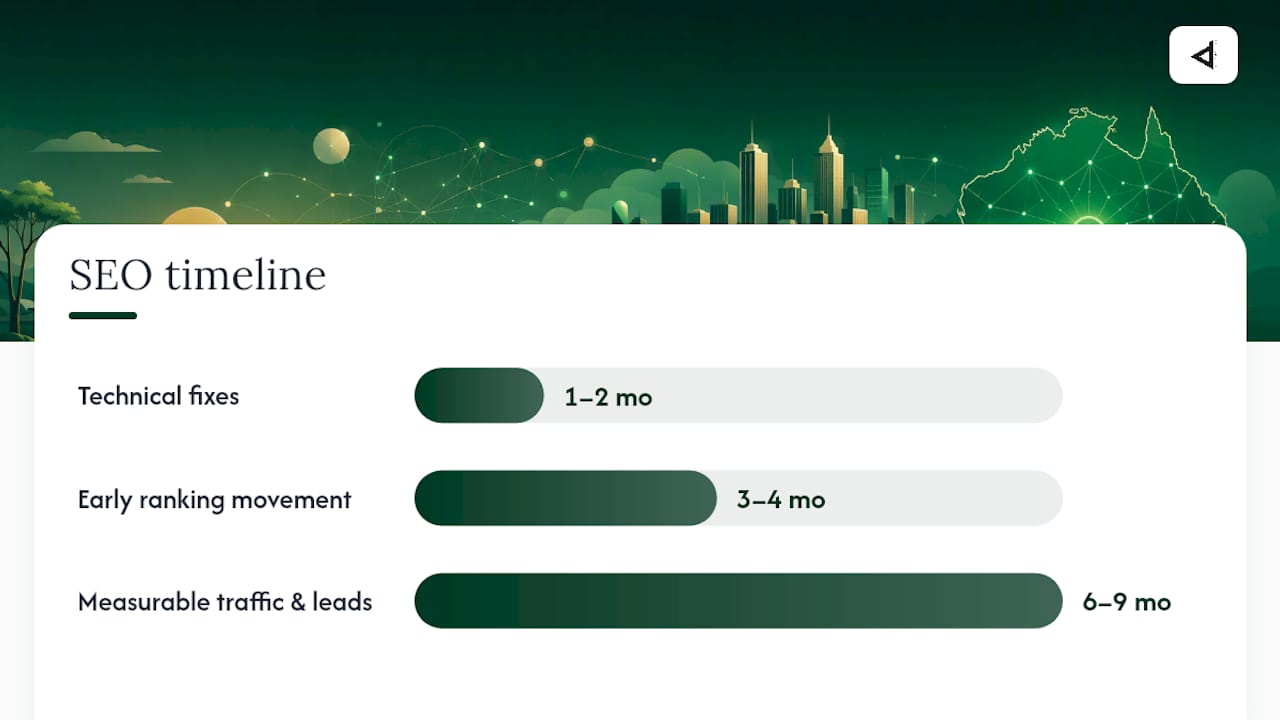
Realistic timelines matter too. Expect technical fixes and quick wins in the first one to two months, early ranking movement by month three to four, and measurable traffic and lead growth by month six to nine. Anyone promising faster is either overselling or working in a low-competition niche.
Pro Tip: Ask every agency to quote cost-per-deliverable, not just a monthly total. Dividing the retainer by the number of content pieces, audits and outreach efforts included makes wildly different proposals genuinely comparable.
Who’s behind this pricing guide?
This guide draws on 12 years of hands-on agency experience at CantyDigital, a Wollongong-based digital agency working across web design and signal-based SEO for Australian businesses. That on-the-ground perspective, pricing real campaigns for real clients across trades, retail and professional services, shapes every figure in this guide, cross-checked against market-wide pricing surveys rather than a single agency’s rate card.
CantyDigital’s own tiers map closely to what’s outlined above: an entry-level plan from $170 a month for businesses just starting out, scaling through growth-tier work into full-service campaigns with content, outreach and technical management bundled in. Readers can see exact inclusions on the SEO service page rather than relying on a generic price list.
The pricing conversation everyone’s having wrong
Most SEO pricing content obsesses over finding the “right” number, as if there’s a universal correct monthly fee. There isn’t, and chasing one wastes energy that should go into scoping deliverables properly.
The bigger blind spot is how AI is reshaping the labour that sits behind these prices. Cheap, templated content and basic technical fixes are getting faster and cheaper to produce, which means agencies still charging premium rates for commodity work in 2026 deserve harder questions. Meanwhile, the judgement calls, knowing which keywords are worth chasing, how to structure a site for both Google and AI answer engines, and when to walk away from a low-value tactic, are getting more valuable, not less.
My honest read: businesses should stop asking “what should SEO cost” and start asking “what does this specific proposal actually buy me, and would I pay that for the deliverables alone if SEO were not the label on it.” That reframe exposes weak proposals fast. Prioritise agencies that can explain their reasoning over ones that just quote a number.
— Matthew
Get a proposal that actually matches your budget
If you’ve read this far, you already know the vague $99-a-month SEO ad is a trap and a $10,000 enterprise retainer is overkill for a single-location business. CantyDigital is the practical middle ground for Wollongong and Australia-wide businesses: no lock-in contracts, transparent tier structures, and pricing that scales from a $170-a-month starter plan up to full-service campaigns with content, outreach and technical work bundled in.
Whether you need a technical audit, a content-led growth campaign, or help deciding which tier actually fits your competition level, the fastest way to find out is to ask directly. Check the SEO Growth Plans starting at $170/mo to see where your budget lands, or request a scoped proposal so you know exactly what deliverables you’re paying for before you commit to anything.
Where to verify these numbers yourself
For deeper reading beyond this guide, Eurisko’s Australian SEO cost breakdown, Paramark’s 2026 pricing analysis, and Firewire Digital’s cost guide all offer independent market surveys. The Semrush Awards Australia winners page is worth a look too, though award recognition should never replace checking an agency’s actual proposed deliverables.