Complete your Google Business Profile, make your phone number impossible to miss, publish one solid service page and one honest suburb page, then start asking every customer for a review the day the job finishes. Those four moves drive most of the map-pack visibility and exclusive lead flow tradies chase. Expect map-pack movement within weeks and real ranking gains for competitive keywords in 3 to 6 months.
TL;DR:
- Completing and consistently updating your Google Business Profile with accurate info, photos, and reviews can generate visible rankings within weeks and lead to more calls.
- Ensuring your business name, address, and phone number match across all directories and your website is crucial for local SEO and avoids dilution of relevance.
- Creating dedicated service and location pages optimized for specific keywords and suburbs improves search visibility and customer trust.
- Speed-loading your website on mobile and making your contact info tappable significantly increases conversion rates from local and voice searches.
- Running paid ads alongside organic efforts provides immediate leads while SEO builds long-term visibility, with cost-per-won-job being the key metric for ROI.
Table of Contents
- Quick checklist: priority local SEO actions for tradies
- Google Business Profile: claim, complete and use it as your primary lead engine
- Reviews and citations: build a system that turns every finished job into ranking signals
- Service pages and location pages: structure that matches how customers search
- Technical and conversion basics: speed, mobile, click-to-call and on-page must-haves
- Paid ads and a dual-track approach: short-term paid leads while SEO compounds
- Timeline and typical costs: what to expect and how to judge ROI
- Measure and improve: tracking enquiries, conversion rates and cost-per-job
- Why Canty Digital: proof points, case studies and what we deliver for tradies
- Voice search and mobile: why “near me” searches decide who gets the call
- Practical perspective from a Wollongong-based agency: quick operational fixes and hiring advice
- How CantyDigital can help: starter packages and how to get a free audit
- Sources
Quick checklist: priority local SEO actions for tradies
You don’t need a marketing degree to get the basics right. You need a list, a bit of discipline, and about 90 days.
Here’s the order that gets results fastest, based on what actually moves the needle for trades businesses:
- Week 1: Claim your Google Business Profile (GBP) if you haven’t, or take full ownership if someone else set it up years ago.
- Week 1 to 2: Fill out every field: categories, services, service areas, hours, photos. Nothing left blank.
- Week 2 to 3: Audit your business name, address and phone number (NAP) across your website, GBP, and any directory you’re already listed on.
- Week 3 to 4: Fix mismatches. “St” versus “Street”, old phone numbers, wrong suburb spelling. All of it.
- Week 4 to 6: Write one genuinely useful service page (your top-earning service) and one suburb page for your busiest local area.
- Ongoing from day one: Start texting a review link to every customer within an hour of finishing the job.
Delegate the directory listing and NAP data entry to an apprentice or office admin. It’s tedious, not skilled. Keep the GBP category selection, the service page writing, and the review outreach with you or whoever runs customer relationships. That’s where local knowledge and tone matter.
For tools, you don’t need anything fancy. A spreadsheet tracks your citations. Google’s own Business Profile dashboard shows your calls and direction requests. A free rank checker tells you where you sit for “your trade + your suburb.”
Pro Tip: Do the NAP audit before you do anything else. Fixing your service pages while your address is wrong on five directories is like painting a wall you’re about to knock down.
Google Business Profile: claim, complete and use it as your primary lead engine
Your Google Business Profile is the single highest-leverage asset in tradie SEO for tradies, full stop. It’s free, it shows up before your website in most local searches, and Google treats a complete, active profile as a trust signal that a half-finished one simply doesn’t earn.

Trades that see the fastest local gains prioritise a fully completed profile, consistent citations, a steady flow of reviews, and honest location pages working together, not in isolation.
Fields that matter most, and why:
- Primary category: choose the most specific one available (Electrician, not “Contractor”). This is the single biggest driver of which searches you show up for.
- Services list: add every service you offer with a short description. Google matches these against search terms.
- Service area: list every suburb you genuinely work in. Don’t add fifty suburbs you never visit; it dilutes relevance.
- Website and phone: link your actual site, and use a real, answered number, not a call-tracking number that changes constantly.
- Hours: keep them accurate, especially public holidays. Wrong hours generate wasted calls and bad reviews.
- Photos: upload real job photos weekly. Vans, finished work, your crew on-site. Stock photos hurt more than help.
Verification usually happens by postcard or phone, depending on your business category. If you cover multiple suburbs from one workshop, list your primary address accurately and use the service area feature rather than creating fake secondary locations. Google has cracked down hard on that trick.
Once it’s live, treat it like a living page. Post a short update weekly, answer every review within 48 hours, and check the Q&A section for questions you should be answering yourself before a stranger does it wrong.
Reviews and citations: build a system that turns every finished job into ranking signals
Every finished job is a ranking opportunity if you treat it that way. The trades that pull ahead run a simple, repeatable loop: finish the job, send a text with the review link, get the review, grab a photo, note the suburb. Rinse and repeat.

Timing is everything here. Asking for a review immediately after finishing a job, by sending the direct link via SMS or WhatsApp, gets the highest response rate of any method. Waiting a week and the moment’s gone; the customer’s already moved on mentally.
A few things worth building into the system:
- Text the review link before you’ve even left the driveway, while the job’s fresh in the customer’s mind.
- Use a tool like Quotewren to fold review requests into your quoting and invoicing process, so it happens automatically rather than relying on memory.
- Reply to every review, good or bad, with a specific detail about the job. Generic “thanks!” replies waste the opportunity.
- List your business on 4 to 5 key Australian directories with identical formatting every time.
On citations: NAP consistency, the exact same business name, address and phone number everywhere, is a non-obvious but critical pillar of local SEO. A quick audit trick: export every listing you can find into a spreadsheet and normalise the fields (same abbreviations, same phone format) before updating each one.
Pro Tip: Set a recurring quarterly reminder to Google your own business name and check every result. Old directory listings from a previous address have a way of resurfacing years later.
Service pages and location pages: structure that matches how customers search
One focused page per service beats one page trying to cover everything. If you’re a plumber offering hot water repairs, blocked drains and gas fitting, that’s three pages, not one page with three headings crammed in. Each page should target the exact phrase a customer types, and Google rewards that specificity.
The same logic applies to suburbs. Write one honest page per town you genuinely service rather than swapping the town name into a templated page twelve times. A location page needs to feel local, mentioning actual suburbs, landmarks or recent jobs; templated town swap pages get penalised by Google and convert poorly with real customers anyway.
Each page you build should contain:
- A clear H1 stating the service and location together (e.g. “Emergency Plumber in Wollongong”).
- A short explainer covering what the service involves and why it matters.
- Scope details so customers know what’s included and what’s not.
- Rough price guidance even as a range; vague “contact for quote” pages convert worse.
- A visible call-to-action with your phone number repeated near the top and bottom.
- Real photos from jobs you’ve actually done in that area.
- Local proof such as a review specific to that suburb or job type.
Link your service pages and area pages to each other. A Wollongong plumbing page should link to your blocked drains page, which should link back to your Wollongong page. This internal structure helps Google understand your coverage and helps customers find the exact service they need.
Add one to two new pages a month rather than dumping twenty at once. A steady cadence looks natural and gives you time to write each one properly. SEO for plumbers is a good reference point if you want to see this structure applied to a specific trade.
Technical and conversion basics: speed, mobile, click-to-call and on-page must-haves
None of the above matters if your site takes eight seconds to load on a tradie’s ute-mounted phone with two bars of reception. Most local searches for trades happen on mobile, often from someone standing in a flooded laundry wanting an answer now.
Aim for load times under three seconds. Google’s PageSpeed Insights and GTmetrix both give you a free readout and tell you exactly what’s slowing things down, usually oversized images or bloated page builders.
Mobile essentials worth checking today:
- Your phone number should be tappable, not just visible; a customer shouldn’t have to copy and retype it.
- Keep the number visible in a sticky header or footer, not buried three scrolls down.
- Contact forms should ask for name, number and job type. Nothing more. Every extra field loses enquiries.
- Test your own site on your phone, on mobile data, standing in your backyard where the signal’s average.
A well-structured website and active GBP form the foundation not just for Google but for Generative Engine Optimisation too; the same fundamentals that help Google also help AI tools like ChatGPT and Google’s AI Overviews recommend your business when someone asks for a “reliable electrician near me.”
Basic schema markup (LocalBusiness schema, listing your services and area) helps search engines and AI systems parse your page correctly without needing a developer to build anything custom.
Paid ads and a dual-track approach: short-term paid leads while SEO compounds
SEO takes months. Paid ads take hours. If you need jobs this week, running Google Ads alongside your SEO build is the sensible move, not a contradiction.
A dual-track strategy, running targeted Google Ads for immediate jobs while building organic visibility underneath it, balances short-term cash flow with a long-term asset that eventually costs you nothing per lead.
To test this properly:
- Run a $500 to $1,000 test campaign for two weeks on your highest-value service.
- Track every call and form fill back to that campaign specifically.
- Calculate cost-per-won-job, not cost-per-lead; a cheap lead that never books is worthless.
- Keep total acquisition costs, ads, subscriptions and platform fees combined, within roughly 20% of your average job value.
Be wary of lead marketplaces that sell the same enquiry to four other tradies simultaneously. They often create a race-to-the-bottom on price, and owned channels tend to produce better-qualified, exclusive leads over time.
Timeline and typical costs: what to expect and how to judge ROI
Anyone promising first-page rankings in a week is either lying or talking about a keyword nobody searches for. Real timelines: map-pack improvements can show up within weeks once your GBP is active and complete, but competitive organic rankings for your main service keywords generally take 3 to 6 months of consistent work.
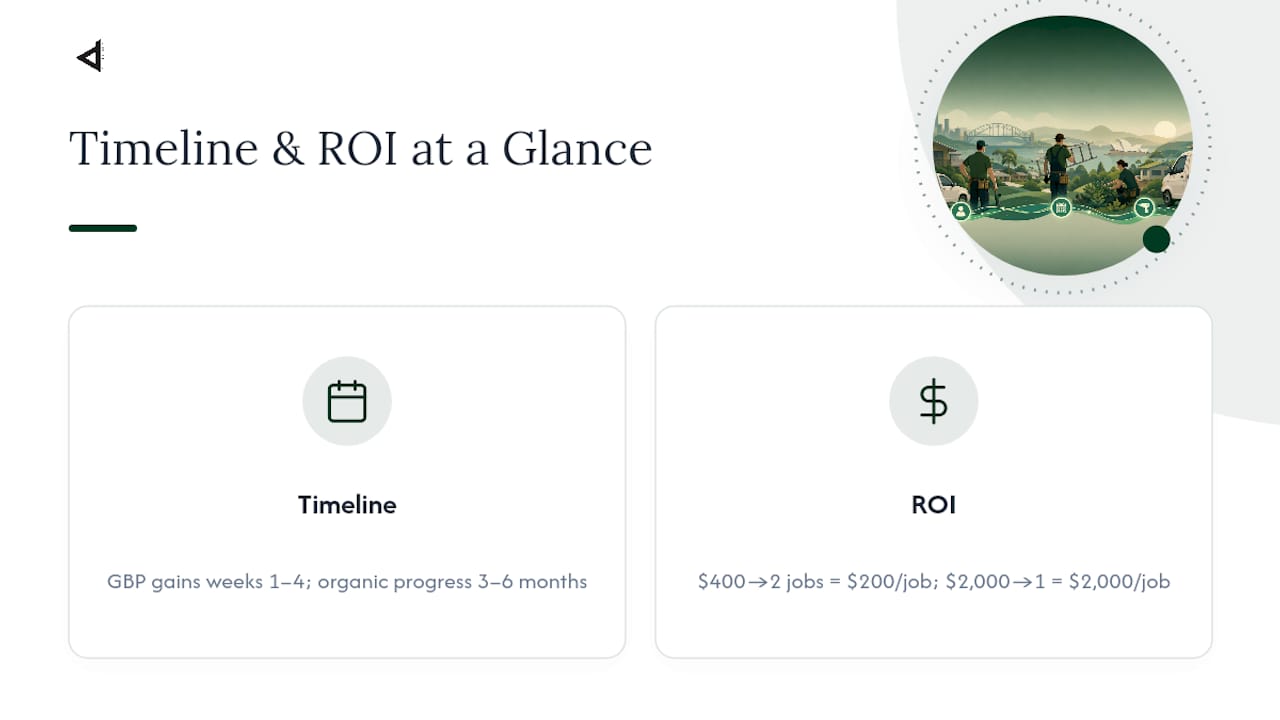
Cost bands vary depending on how much you do yourself versus hand off:
Whichever band you sit in, judge it the same way: calculate cost-per-won-job by dividing total monthly spend by the number of jobs you can trace back to that channel. If SEO is costing you $400 a month and delivering two jobs worth $1,200 each, that’s a sustainable ratio. If it’s costing $2,000 for one job, something’s broken, either the targeting, the pages, or the follow-up process.
Compare that figure against your paid channels and lead marketplaces using the same 20% rule mentioned earlier. Whichever channel produces the lowest cost-per-won-job deserves more of your budget, not whichever one feels busiest.
Measure and improve: tracking enquiries, conversion rates and cost-per-job
You can’t manage what you don’t track. Set up call tracking (even a simple second number forwarded to your mobile works), Google Analytics 4 on your website, and a basic spreadsheet or CRM logging every enquiry’s source.
A workable measurement plan runs like this:
- Tag every enquiry with its source: GBP call, website form, Facebook, referral, paid ad.
- Record whether each enquiry turned into a booked job and what it was worth.
- Calculate cost-per-won-job by channel at the end of each month.
- Run this for 90 days minimum before judging any channel; trades work has natural weekly and seasonal noise that skews shorter windows.
- Shift budget toward whichever channel’s cost-per-won-job sits comfortably under your 20% threshold.
For small tradies, a good benchmark is a handful of quality enquiries a week from organic and GBP combined once the fundamentals are in place, with conversion from enquiry to booked job sitting well above what paid leads typically achieve, since organic and GBP enquiries tend to be higher intent.
Why Canty Digital: proof points, case studies and what we deliver for tradies
CantyDigital has spent 12 years building websites and SEO campaigns for local Australian businesses out of Wollongong, with a specific focus on trades and services businesses that live or die by local search. We’re a 5-star Wix Partner, and our SEO for plumbers guide walks through exactly this playbook applied to a real trade.
Our starter package for tradies typically covers a full GBP setup and audit, two properly written pages (one service, one suburb), a complete NAP audit across existing directories, and a review request workflow you can hand to your team. We measure results the same way this article recommends: calls, form leads, and cost-per-won-job, not vanity ranking screenshots.
Voice search and mobile: why “near me” searches decide who gets the call
Most people don’t type “electrician Wollongong” into Google anymore. They say “hey Google, find an electrician near me” while standing next to a sparking switchboard, or they thumb-type a shorter, more conversational version on their phone while driving.
Voice and mobile search both favour the same things: clear, direct answers and strong local signals. When someone asks a voice assistant for a tradie nearby, it’s pulling almost entirely from Google Business Profile data, proximity, and review signals, not from a keyword-stuffed webpage. This is another reason GBP completeness matters more than almost anything else in this article.
Write your service page content in plain, conversational language that matches how people actually talk: “How much does it cost to fix a burst pipe?” rather than “Burst Pipe Repair Pricing Structures.” Voice queries are longer and more question-based than typed ones, and pages that answer a specific question directly, in the first sentence or two, tend to get pulled into both voice answers and Google’s AI-generated overviews.
Since almost all of this traffic arrives on a phone, the mobile basics from earlier in this article aren’t optional extras, they’re the entire game. A fast-loading page with a tappable phone number is what turns a voice search into an actual booked job.
Practical perspective from a Wollongong-based agency: quick operational fixes and hiring advice
The mistakes we see most often aren’t complicated: a GBP with three services listed when the business offers fifteen, suburb pages that are the same paragraph with the town name swapped, and a phone number that’s different on the website than on three separate directories.
Fixing those three things alone often moves the needle faster than any amount of content writing. The habits that actually compound are boring: ask for the review before you drive away, put a call button where a thumb naturally lands, reply to every review within a couple of days.
If you’ve got an hour a week and enjoy this kind of work, DIY is genuinely viable for the first six months. If you don’t, or you’d rather be on the tools, hiring a local agency that’ll show you the numbers behind the work is the better trade.
— Matthew
How CantyDigital can help: starter packages and how to get a free audit
CantyDigital is the practical alternative to a traditional agency retainer for tradies in New South Wales and beyond: no lock-in contracts, transparent pricing, and a starter package built specifically around the actions covered in this article, not a generic marketing bundle.
Our starter package includes a full Google Business Profile setup and optimisation, two properly researched pages (one service, one suburb), a NAP audit across your existing directory listings, and a review request workflow your team can run without thinking twice. Pricing starts from $170 a month for ongoing SEO, with clear scopes at every tier so you know exactly what you’re paying for and what it delivers. For businesses wanting the full build, from strategy through technical work, our complete SEO service covers content, citations, and reporting month to month.
Get in touch for a free audit of your current Google Business Profile and website, and we’ll tell you plainly which three things to fix first, no obligation attached.
Sources
- SEO for Tradies | Made 4 Tradies
- Local SEO for tradespeople — guidance and checklist
- Local SEO for tradies: the 2026 guide to winning more jobs | TradieLink