
The best approach to B2B lead generation in Australia blends conversation-led outreach (phone and personalised email) with targeted paid search and Performance Max campaigns, backed by a website built to convert. Neither channel alone moves fast enough on its own. Outbound builds the relationships Australian buyers still expect, while paid and organic search catch the demand already searching for a fix.
The immediate next step isn’t a big-budget campaign. It’s a focused six-week pilot.
- Map your ideal customer profile (ICP): industry, company size, decision-maker titles, buying triggers
- Pick two channels to test, not five (LinkedIn plus phone, or Performance Max plus email)
- Set one clear conversion goal (booked meeting, not just form fill)
- Run it for six weeks before judging results
CantyDigital works with Australian businesses on exactly this kind of pilot, pairing outbound with signal-based SEO and paid campaigns so leads keep arriving after the first sprint ends.
Key Takeaways
The most effective B2B lead generation in Australia combines conversation-led outreach with targeted paid search, run as a six-week pilot before scaling.
| Point | Details |
|---|---|
| Run a short pilot first | Test two channels for six weeks before committing budget to a full campaign. |
| Match channel to deal size | Use LinkedIn and phone outreach for high-value deals, Performance Max for search-ready demand. |
| Give Performance Max time | Allow at least six weeks and diverse assets before judging campaign performance. |
| Track lead-to-opportunity, not lead count | Measure pipeline value and conversion rate in your CRM, not just leads generated. |
| CantyDigital blends outreach with SEO and paid | A 30/60/90-day pilot combining web design, AISEO and outreach builds pipeline that outlasts any single campaign. |
Table of Contents
- What works in Australia: the channels that generate qualified B2B leads
- How a typical B2B lead campaign runs: brief to handover
- How to choose a lead-generation partner without getting burnt
- Pricing and timelines: what a realistic proposal looks like
- Measurement and optimisation: proving lead quality, not just lead count
- Expert view: using AI-driven campaigns without losing control
- CantyDigital’s approach: how we deliver measurable B2B pipeline in Australia
- How to get started with CantyDigital
- Why most B2B lead campaigns in Australia fail before they start
- Sources
What works in Australia: the channels that generate qualified B2B leads
Australian B2B buyers behave differently from their US or UK counterparts. The market is smaller, relationships carry more weight, and a cold LinkedIn message from someone who clearly hasn’t done their homework gets ignored fast. Four channels consistently produce results, but each does a different job.
- LinkedIn works best for reaching decision-makers directly, especially in professional services, tech and B2B manufacturing. Organic posting builds recognition over months; paid LinkedIn ads work when you can target by job title and company size with real precision.
- Conversation-led outreach (phone calls backed by targeted email) still outperforms pure digital plays for high-value, considered purchases. Australian buyers respond better to a genuine conversation than a drip sequence, particularly once the deal size climbs past a few thousand dollars.
- Performance Max and paid search catch buyers who are already searching. Google’s own guidance recommends running new Performance Max campaigns for at least six weeks, feeding the system strong audience signals and a genuinely diverse set of assets before judging performance. Cut a campaign at week two and you’re judging it before it’s learned anything.
- Content and SEO build the pipeline that doesn’t dry up when the ad budget pauses. A page that ranks for “commercial fitout Wollongong” keeps producing leads for years, and it makes every paid dollar work harder because prospects who’ve already read your content convert faster.
Pro Tip: Don’t run all four channels from day one. Pick the two that match how your buyers actually make decisions, prove them out, then layer in the rest.
Account-based marketing, industry events and channel partnerships earn their place once you know your average deal size and sales cycle. They’re expensive relative to leads generated, but for enterprise deals with six-figure contract values, a targeted ABM push aimed at twenty named accounts often beats a thousand LinkedIn impressions. Gartner’s research on the B2B buying journey makes the case clearly: these deals involve multiple stakeholders and touchpoints, so a single-channel campaign rarely reaches everyone who needs to say yes.

How a typical B2B lead campaign runs: brief to handover
A lead campaign that actually produces meetings follows a consistent shape, whether you run it in-house or brief an agency. Skip a step and the whole thing stalls somewhere between “leads generated” and “deals closed.”
- Define the ICP and buying triggers in measurable terms. Not “mid-sized companies” but “manufacturers with 50 to 200 staff who’ve recently expanded floor space or hired a new operations manager.”
- Build the list and clean the data. Any Australian campaign touching personal information needs to respect the Privacy Act and the Spam Act’s consent rules for commercial electronic messages. Buying a scraped list and blasting it is the fastest way to get flagged or blocked.
- Create outreach assets that reference the prospect’s actual situation. A generic “quick question” email gets deleted. One that mentions a specific expansion or hire gets read.
- Run the outreach cadence. Typically five to seven touches across email and phone over two to three weeks, with LinkedIn engagement running alongside.
- Qualify and hand over. Every lead needs a clear standard (budget confirmed, decision timeframe known, right person on the call) before it lands in the CRM, with a service level agreement specifying how fast sales follows up.
Pro Tip: Set your handover SLA before the campaign starts, not after the first batch of leads arrives. “Sales contacts within 24 hours” only works if sales agrees to it in writing first.
The B2B marketing sales funnel framework helps here, giving you a shared language for where a lead sits between “interested” and “ready to buy.”
How to choose a lead-generation partner without getting burnt
Most bad agency experiences trace back to one thing: nobody asked the right questions before signing. Four criteria separate the operators who deliver from the ones who talk a good game.
- Vertical experience. An agency that’s run campaigns for trades, professional services or manufacturing in Australia knows the buying patterns already. One that’s only worked with US SaaS startups is starting from zero.
- Measurement and CRM fluency. They should talk fluently about conversion tracking and CRM handover, not just “we’ll send you a spreadsheet of leads.”
- Data compliance. Any partner sourcing contact lists needs a defensible answer on where the data comes from and how it complies with Australian privacy rules.
- Local proof points. Case examples from Australian clients, not screenshots from a US case study with the logo swapped out.
Before signing anything, ask these questions directly:
- Can you show me a campaign snapshot from a client in my industry, including meetings booked and pipeline value generated?
- How do you track lead-to-opportunity conversion once a lead leaves your hands?
- Where does your contact data come from, and how is consent handled?
- What does reporting look like week to week, not just at the end of the campaign?
Red flags show up fast once you’re asking these questions. Vague answers about “proprietary databases,” no willingness to show real numbers, and no mention of CRM integration at all are the three biggest warning signs. A partner worth hiring will have campaign steps, measurement dashboards and CRM sync ready to walk you through, not just a pitch deck full of stock photos.
Pricing and timelines: what a realistic proposal looks like
Three pricing models dominate the Australian market, and each suits a different stage of growth.
- Retainer. A fixed monthly fee covering strategy, execution and reporting. Suits businesses wanting a consistent, ongoing pipeline rather than a one-off spike.
- Cost-per-lead or cost-per-meeting. You pay for outcomes, which sounds safer but often pushes agencies toward volume over quality unless the lead definition is airtight.
- Blended. A smaller base retainer plus a performance component tied to booked meetings or qualified opportunities. This tends to align incentives best.
Setup typically takes one to two weeks: ICP confirmation, asset creation, list building and campaign configuration. From there, run the pilot for six weeks minimum. That figure isn’t arbitrary. It matches Google’s own recommendation for how long a Performance Max campaign needs to exit its learning phase, and outbound cadences need roughly the same runway to show a real response pattern.
Cost varies mainly on four factors: how senior your target buyer is, how hard the list is to build, how many channels you’re running, and whether you’re optimising for volume or quality. When comparing proposals, ignore the headline lead count and ask what percentage of those leads historically convert to a genuine sales opportunity. That number tells you more than the price per lead ever will.
Measurement and optimisation: proving lead quality, not just lead count
Lead count is a vanity metric if nobody’s tracking what happens after the handover. Four numbers actually matter:
- Qualified meetings booked, not just form submissions
- Pipeline value generated, tracked in your CRM against each campaign source
- Conversion rate from lead to sales opportunity
- Close rate on opportunities, sourced back to the original channel
Google Ads’ lead generation guidance recommends setting conversion actions around the outcomes that actually matter (Contact, Submit lead form, Book appointment) and using enhanced conversions or dynamic values wherever the platform supports it, rather than treating every click as equal.
CRM integration closes the loop. Whether you’re on HubSpot or another platform, leads need to sync automatically with source data attached, and your SLA with sales needs teeth: a lead untouched after 48 hours should trigger an alert, not just sit in a queue.
Pro Tip: Review conversion data monthly, not weekly. Weekly numbers in B2B are too small a sample to act on and you’ll end up chasing noise instead of trends.
The types of lead capture elements that actually convert matter here too. A campaign driving traffic to a page with no clear next step wastes half its budget before the CRM even gets involved.
Expert view: using AI-driven campaigns without losing control
Performance Max and similar AI-optimised campaigns reward patience and good inputs, and punish anyone who treats them as a set-and-forget tool.
Google’s own data shows that campaigns given a proper six-week learning period, strong audience signals and a genuinely diverse set of assets — multiple headlines, several image ratios, at least one video — consistently produce better lead quality than campaigns judged and adjusted within the first two weeks.
Feed Performance Max your best data. Customer Match and remarketing lists work well as audience signals, provided the underlying data was collected with proper consent under Australian privacy expectations. Don’t rely on AI alone for high-value targets. A six-figure enterprise deal still needs a human picking up the phone, even while Performance Max handles broader, lower-touch demand.
Audit the campaign regularly. Check which landing pages the system has expanded into, since automated URL expansion sometimes sends traffic to irrelevant pages, and review auto-generated creative for anything off-brand before it runs at scale.
CantyDigital’s approach: how we deliver measurable B2B pipeline in Australia
CantyDigital combines high-performance web design, signal-based SEO and outreach automation into one pipeline rather than treating them as separate projects. A campaign only works if the website converts, the SEO keeps compounding after the ad spend stops, and outreach fills the gap while organic momentum builds.
A typical pilot runs on a 30/60/90 structure: the first 30 days cover ICP mapping, asset build and campaign launch; days 30 to 60 focus on optimisation once real data starts arriving; days 60 to 90 assess whether to scale, adjust, or hand the pipeline fully to your sales team.
With 12 years operating out of Wollongong, a five-star Wix Partner track record, and press release distribution capability across Australian platforms for building authority alongside the campaigns themselves, CantyDigital brings the full stack rather than one channel in isolation.
How to get started with CantyDigital
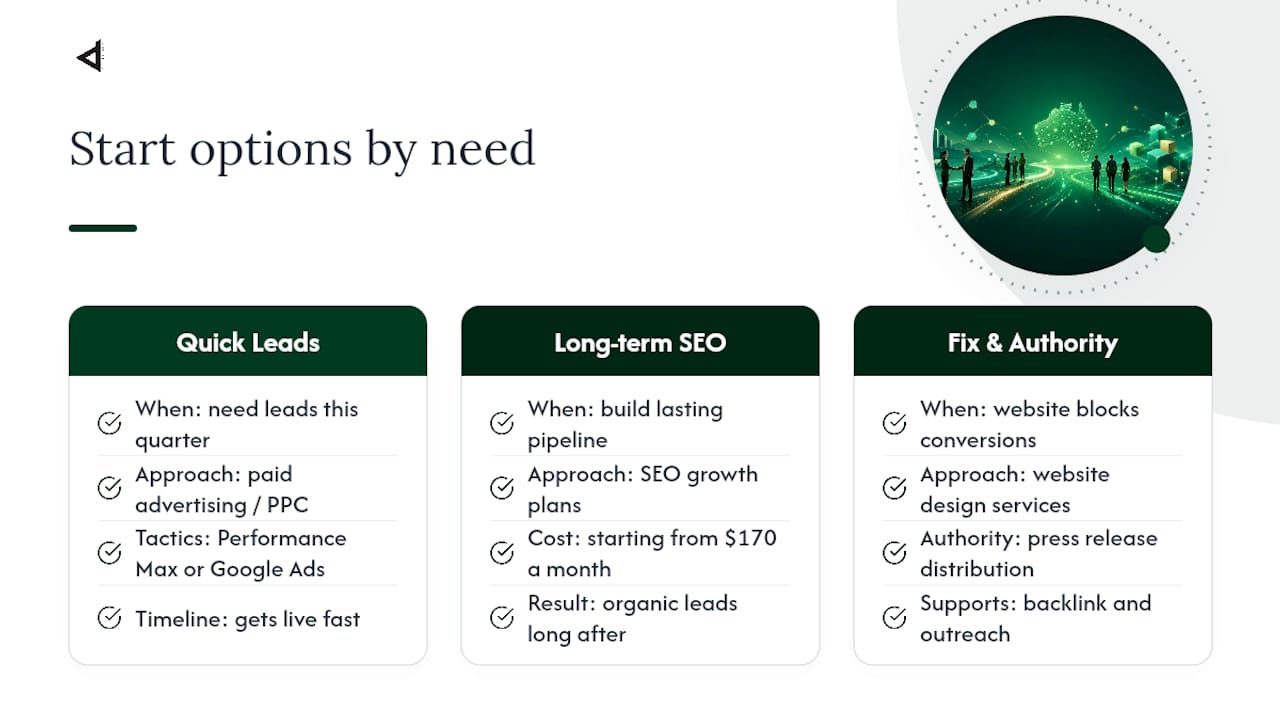
Different needs point to different starting points. If you need leads landing this quarter, paid advertising and PPC gets a Performance Max or Google Ads campaign live fast, targeting the buyers already searching for what you sell. If you’re building pipeline that lasts beyond any single campaign, the SEO growth plans starting from $170 a month build the organic foundation that keeps producing leads long after a paid campaign winds down.
Businesses wanting authority alongside direct leads often start with press release distribution to build credibility while the lead campaigns ramp up, and pair it with backlink and outreach services to strengthen search rankings in the background.
If your website itself is the bottleneck, holding leads back rather than converting them, website design services fix that before you spend another dollar on traffic.
Every engagement runs without lock-in contracts, so a six-week pilot stays a six-week pilot unless the results earn a longer partnership. Book a strategy call with CantyDigital to map your ICP and scope a pilot suited to your budget and timeline.
Why most B2B lead campaigns in Australia fail before they start
The conventional wisdom says more channels and bigger budgets fix a slow pipeline. They don’t. Most failed campaigns I’ve seen weren’t underfunded, they were unfocused, running five channels at once with no clear definition of what a qualified lead even looked like.
The uncomfortable truth is that most Australian businesses could get better results from doing less, more deliberately. Two channels run properly for six weeks beat five channels run carelessly for two. The businesses that get this right treat the pilot as a genuine test, not a box to tick before the “real” campaign starts.
The other gap I keep seeing: businesses obsess over lead volume and ignore the handover. A hundred leads with no CRM process and no sales SLA produces worse results than twenty leads that get called back within a day. Fix the handover before you fix the top of the funnel. That’s the part conventional advice skips entirely, and it’s the part that actually determines whether the pipeline turns into revenue.
— Matthew
Sources
- Google Ads Help — Performance Max optimisation tips
- Gartner — B2B buying journey
- Abmatic AI — B2B marketing for Australian companies