


SEO and web design are two disciplines that share one goal: getting the right people to your site and keeping them there. Understanding why SEO and web design connect means recognising that every design decision, from your URL structure to your image file sizes, either helps or hurts your search rankings. Successful website creation merges SEO and design into a single process, not two separate projects handed off between teams. Sites that treat them as one discipline rank better, load faster, and convert more visitors into customers.
Why does web design influence SEO outcomes?
Web design shapes SEO outcomes at every level of a site, from the broadest structural decisions down to individual image files. Most designers focus on how a site looks. Search engines focus on how a site works. When those two priorities clash, rankings suffer.
Site structure and crawlability
Your URL structure, internal linking, and page hierarchy tell search engines what your site is about and which pages matter most. A flat, logical structure lets crawlers index your content efficiently. A tangled hierarchy with orphaned pages and inconsistent URLs creates dead ends that crawlers abandon. Early SEO integration shapes URL structure, mobile responsiveness, and content planning from day one, which means fixing these issues after launch costs far more than building them correctly upfront.
Visual elements and load performance
Images and videos are the most common cause of slow load times. Uncompressed visual assets drag down performance scores, and high-res images and videos affect both site load speed and search rankings directly. A hero image that looks stunning at full resolution can add two seconds to your load time. Two seconds is enough to lose a significant portion of your visitors before they read a single word.

Mobile responsiveness
Mobile usability is a confirmed Google ranking factor, and mobile responsiveness should be tested with SEO tools, not visual inspection alone. A site can look perfect on a designer’s monitor and still fail Google’s mobile usability tests due to tap target sizing, font scaling, or viewport configuration issues. Visual inspection catches aesthetic problems. SEO tools catch ranking problems.
Here is what design decisions directly affect in SEO terms:
- URL structure: Clean, keyword-informed URLs improve crawlability and click-through rates from search results.
- Navigation depth: Pages buried more than three clicks from the homepage receive less crawl priority.
- Image alt text: Descriptive alt attributes help search engines index visual content and improve accessibility.
- Font and contrast: Poor readability increases bounce rates, which signals low quality to search algorithms.
- Code cleanliness: Bloated CSS and JavaScript slow render times and obscure content from crawlers.
Pro Tip: Run Google’s PageSpeed Insights and Search Console’s mobile usability report on every new design before launch. Fix technical failures before you fix aesthetic ones.
What SEO strategies should web designers integrate during site development?
The most effective approach is to treat SEO as a design constraint, not an afterthought. Post-launch structural changes can break user flows and disrupt search indexing, which means the cost of ignoring SEO during design is paid twice: once in lost rankings and again in expensive remediation work.
Here are the core SEO strategies to build into a site from the start:
Keyword-informed navigation. Map your primary keywords to your top-level navigation pages before you design a single layout. Your navigation structure should reflect how your audience searches, not just how your business is organised internally.
Page hierarchy and content structure. Use H1, H2, and H3 headings to create a clear content hierarchy on every page. Search engines use heading structure to understand page topics. Designers who treat headings as purely visual elements break this signal.
Metadata from day one. Every page needs a unique title tag and meta description written before the site goes live. Leaving these as placeholders and filling them in later is one of the most common and costly oversights in web development.
Schema markup. Structured data tells search engines exactly what your content represents, whether that is a product, a service, an article, or a local business. Adding schema during development is straightforward. Retrofitting it after launch is tedious and error-prone.
Mobile-first design. Google indexes the mobile version of your site first. Designing for desktop and scaling down produces a worse mobile experience than designing for mobile and scaling up.
Content visibility. Avoid hiding important text inside JavaScript-rendered elements, accordions, or tabs unless you have confirmed that Google can index that content. Text that users cannot see without interaction is often text that search engines cannot index reliably.
Internal linking plan. Map out your internal links before you build. Every important page should receive links from at least two or three other pages on the site. This distributes authority and helps crawlers find your content. For a deeper look at how small structural decisions affect rankings, the guide on site changes and SEO shifts is worth reading.
Why is site performance critical to both SEO and user experience?
Site performance is where SEO and design synergy becomes measurable. Websites loading within 1 second have conversion rates 2.5 times higher than those loading in 5 seconds. That single statistic explains why performance is not a technical nicety. It is a revenue variable.
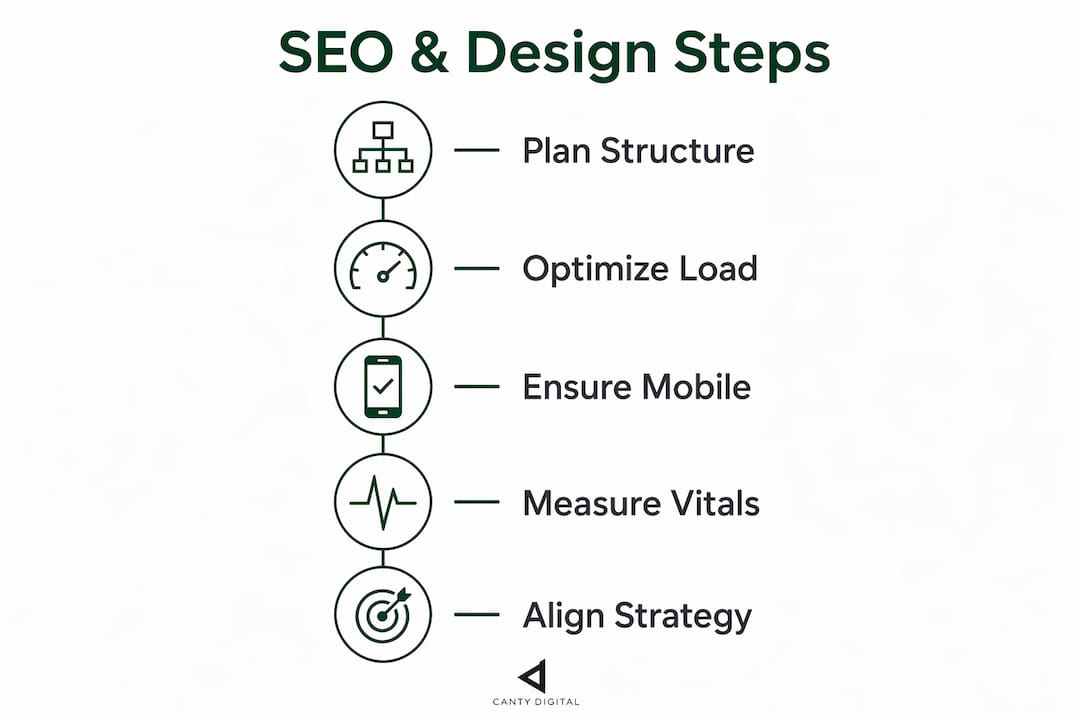
Google’s Core Web Vitals measure three specific performance signals: Largest Contentful Paint (how fast the main content loads), Interaction to Next Paint (how quickly the page responds to user input), and Cumulative Layout Shift (how stable the layout is as it loads). Poor scores on any of these metrics directly affect your position in search results.
| Performance factor | SEO impact | User experience impact |
|---|---|---|
| Page load time | Ranking signal in Core Web Vitals | Directly affects bounce rate and conversions |
| Uncompressed images | Slows LCP score | Delays visible content, frustrates visitors |
| Layout shift | Penalised by CLS metric | Causes accidental clicks and disorientation |
| Mobile load speed | Affects mobile-first indexing | Determines whether mobile visitors stay or leave |
Google’s ranking algorithm uses over 200 factors, with user experience metrics like bounce rate, time on site, and mobile usability carrying significant weight. A beautifully designed site that loads slowly will consistently underperform a plainer site that loads fast.
Pro Tip: Compress every image to WebP format before uploading. WebP files are typically 25–35% smaller than JPEG at the same visual quality, and the difference shows up immediately in your Core Web Vitals scores.
For a practical breakdown of improving these scores, CantyDigital’s guide on page speed and Core Web Vitals covers the technical steps in detail.
How does aligning SEO and design improve digital marketing results?
Aligning SEO with web design from the start produces compounding benefits that separate high-performing sites from average ones. Over 76% of consumers prefer website layouts that make information easy to find. That preference directly correlates with lower bounce rates, longer sessions, and higher conversion rates. These are the same signals that search algorithms use to assess quality.
The practical benefits of SEO and design working together include:
- Higher organic traffic. Sites built with keyword-informed architecture rank for more terms without requiring additional content investment.
- Lower bounce rates. Intuitive navigation keeps visitors on the site longer, which strengthens engagement signals sent to search engines.
- Fewer post-launch fixes. Teams that integrate SEO during design avoid the expensive cycle of redesigning pages that fail to rank.
- Stronger conversion paths. When design guides users toward clear calls to action and SEO brings in qualified traffic, conversion rates improve at both ends of the funnel.
- Better brand trust. A fast, well-structured, visually consistent site signals professionalism. Visitors trust professional sites more and are more likely to enquire or purchase.
The efficiency argument alone justifies integration. Redesigning a site’s information architecture after launch to fix SEO problems is one of the most expensive and disruptive projects a business can undertake. Building it correctly the first time costs a fraction of that. For anyone starting out with the fundamentals, CantyDigital’s SEO tips for beginners provides a solid grounding in the principles that underpin this approach.
Key takeaways
SEO and web design must be planned together from day one because structural, performance, and content decisions made during design directly determine how well a site ranks and converts.
| Point | Details |
|---|---|
| Design decisions affect rankings | URL structure, navigation depth, and code quality all send direct signals to search engines. |
| Performance is a revenue factor | Sites loading in 1 second convert at 2.5 times the rate of sites loading in 5 seconds. |
| Mobile testing requires SEO tools | Visual inspection alone misses the usability failures that hurt mobile rankings. |
| Early integration prevents costly fixes | Post-launch structural changes disrupt indexing and break user flows. |
| User experience signals feed algorithms | Bounce rate, time on site, and mobile usability are confirmed ranking factors. |
The uncomfortable truth about SEO and design working in silos
Most agencies still treat SEO and web design as separate services delivered by separate teams. I have seen this play out hundreds of times, and the result is almost always the same: a beautiful site that ranks on page three and a client who wonders why their investment is not working.
The real problem is not skill. Designers are talented. SEO specialists know their craft. The problem is timing. When an SEO specialist reviews a finished design, the structural decisions are already locked in. Changing URL patterns, flattening navigation, or restructuring content hierarchies at that stage means unpicking months of work.
What actually works is a shared brief at the start of every project. The SEO specialist maps keyword intent to page structure before the designer touches a wireframe. The designer builds visual hierarchy around heading structures that serve both readability and search relevance. Neither discipline compromises. Both win.
The teams I have seen get this right treat the site architecture document as a joint deliverable, not a handoff. They review it together, challenge each other’s assumptions, and sign off on a structure that serves both goals. That single change in process produces better outcomes than any individual tactic either team could apply in isolation.
If your current workflow has SEO coming in after design, that is the first thing worth changing.
— Matthew
CantyDigital builds websites where SEO and design work as one
CantyDigital has spent 12 years building websites where search performance and visual quality are planned together, not bolted together after the fact.
Every site CantyDigital delivers starts with a keyword-informed architecture, clean technical foundations, and design decisions that support both user experience and search visibility. As a 5-star Wix Partner based in Wollongong, the team works with businesses across Australia that need a site built to rank from day one. You can explore the full approach on the web design services page, or review common questions on the website design FAQs page. For businesses that need ongoing SEO support alongside their design, CantyDigital’s monthly SEO plans start from $170 per month with no lock-in contracts.
FAQ
Why do SEO and web design need to work together?
SEO and web design share the same performance variables: site structure, load speed, mobile usability, and content hierarchy. Separating them during development creates conflicts that are expensive to fix after launch.
How does site speed affect SEO rankings?
Page load time is a direct Google ranking factor through Core Web Vitals. Sites loading within 1 second convert at 2.5 times the rate of sites loading in 5 seconds, making speed both an SEO and a revenue issue.
What is the most common SEO mistake in web design?
Building navigation and URL structures based on internal business logic rather than keyword intent. This forces expensive post-launch restructuring and delays organic ranking results.
Does mobile design affect search rankings?
Google uses mobile-first indexing, meaning it ranks your site based on its mobile version. Mobile responsiveness must be verified with SEO tools, not visual inspection, to catch the technical failures that affect rankings.
When should SEO be integrated into a web design project?
SEO should be integrated at the brief stage, before wireframes are created. Keyword mapping, URL structure, and content hierarchy decisions made early prevent the costly redesigns that result from treating SEO as a post-launch task.


