
A digital PR strategy is a structured, measurable plan to build brand visibility and authority through targeted online media coverage, backlinks, and content distribution. Unlike traditional PR, which focuses on print, TV, and radio, digital public relations generates lasting online footprints that drive referral traffic long after a campaign ends. It integrates SEO benefits directly, including high-quality backlinks and E-E-A-T signals, making it a core tool for any marketing professional serious about online reputation. The discipline sits at the intersection of content marketing, media relations, and search visibility, and it requires the same rigour as any other channel in your marketing mix.
What is a digital PR strategy and what does it include?
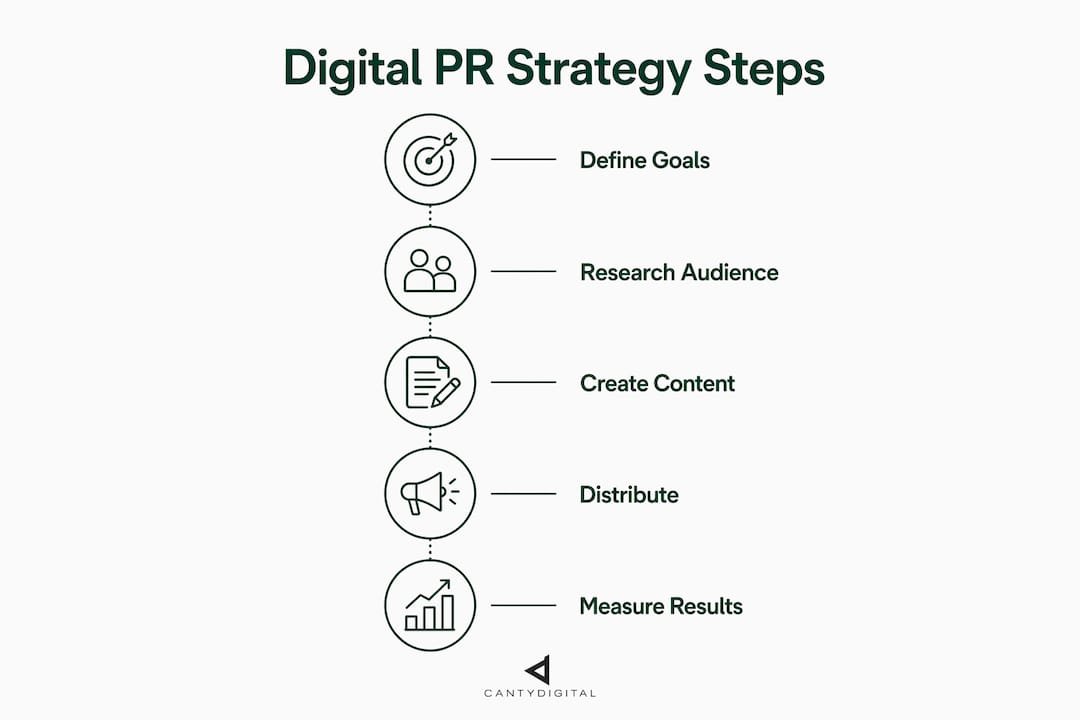
A digital PR strategy is a planned roadmap covering goal-setting, audience research, content creation, media outreach, and performance evaluation. Each component connects to the others. Without clear goals, your content has no direction. Without audience research, your outreach misses the mark.
The foundation is the SMART objective framework. SMART objectives require specific, measurable, achievable, relevant, and time-bound goals. A vague goal like “get more coverage” is useless. A SMART version reads: “Secure 15 backlinks from Australian news sites within six months.”

Audience research goes deeper than demographics. Combining demographic and psychographic data uncovers perception gaps between how your audience currently views your brand and how you want them to view it. That gap is where your messaging strategy lives.
The five core components of a digital PR strategy are:
- Goal definition: Set SMART objectives tied to business outcomes.
- Audience research: Map demographics, psychographics, and current brand perception.
- Messaging and content: Develop narratives that close perception gaps and appeal to journalists.
- Outreach and distribution: Pitch earned media, publish owned media, and engage influencers.
- Evaluation: Track metrics against your SMART goals and adjust.
| SMART criterion | What it means | PR example |
|---|---|---|
| Specific | Clear, defined outcome | Secure coverage in three industry publications |
| Measurable | Quantifiable result | Increase referral traffic by 20% |
| Achievable | Realistic given resources | One press release per month |
| Relevant | Tied to business goals | Support a product launch campaign |
| Time-bound | Has a deadline | Within a 90-day campaign window |
Pro Tip: Write your SMART objectives before you brief your content team. Objectives shape the angle of every piece you create, not the other way around.
How do you create and distribute newsworthy content?
Digital PR tactics centre on one principle: journalists and editors publish content that serves their audience, not yours. Your job is to make your brand’s story genuinely useful or interesting to their readers.
Original research is the most reliable content type for earning media coverage. A survey of 500 Australian consumers, a data analysis of industry trends, or a proprietary study gives journalists a reason to link back to you. Data-driven stories are harder to ignore than opinion pieces. They also earn backlinks naturally because other writers cite your findings.
Content marketing protects and promotes brand reputation through diverse formats and multi-channel distribution. This means combining owned media, such as your blog and social channels, with earned media placements in publications, podcasts, and industry newsletters.
Common digital PR tactics include:
- Online press releases distributed to wire services and directly to journalists.
- Media pitching with personalised angles tailored to each publication’s audience.
- Influencer outreach targeting creators whose followers match your audience profile.
- Guest articles placed on authoritative industry sites to build credibility and earn quality backlinks.
- Data-led content such as original research, surveys, and industry reports.
- Podcast appearances and expert commentary for broadcast-style earned media.
When pitching journalists, lead with the story angle, not your brand. A pitch that opens with “We surveyed 500 small business owners and found that 60% have no crisis communication plan” is far more compelling than one that opens with your company name.
Pro Tip: Repurpose every major content asset across formats. A research report becomes a press release, a blog post, a social media series, and a podcast talking point. One piece of original work can generate coverage across multiple channels.
How do you measure the effectiveness of a digital PR strategy?
Measurement is where most digital PR efforts fall apart. Marketers track vanity metrics like impressions and forget the signals that actually move the needle.
The metrics that matter are referral traffic, backlink quality and quantity, brand mentions, share of voice, and sentiment analysis. Each tells a different story. Referral traffic shows whether coverage drives real visitors. Backlink quality, assessed through tools like Google Analytics and Ahrefs, shows whether your outreach is landing on authoritative sites.
Tracking brand mentions is critical for building E-E-A-T, the Experience, Expertise, Authoritativeness, and Trustworthiness framework that search engines use to assess credibility. Brand authority built through consistent mentions supports long-term SEO impact well beyond any single campaign.
A practical evaluation process follows these steps:
- Set baseline metrics before the campaign launches. Record current referral traffic, backlink count, and brand mention volume.
- Monitor in real time using Google Analytics for traffic and a mention-tracking tool for coverage.
- Assess backlink quality monthly. Check domain authority and relevance of linking sites.
- Review sentiment across media coverage and social mentions to catch reputation issues early.
- Compare results against SMART goals at the campaign midpoint and end. Adjust tactics based on what the data shows.
- Document learnings for the next campaign cycle. Patterns across campaigns are more valuable than single-campaign results.
Pro Tip: Set up Google Alerts for your brand name and key executives from day one. Free, instant, and the fastest way to catch coverage you did not pitch for, which often signals organic authority growth.
What are the common mistakes in digital PR strategy implementation?
The most persistent misconception is that digital PR is just link building with a press release attached. Digital PR differs from link building in scope. It builds brand awareness, media relationships, and community engagement in addition to generating backlinks. Treating it as a purely technical SEO exercise produces thin results.
A second common mistake is treating the strategy as a fixed document. A digital PR strategy must adapt to new data, market changes, and competitive shifts. A roadmap written in january and never revisited is a liability, not an asset.
A third mistake is ignoring internal communications and crisis readiness. Digital PR extends beyond external media relations. It covers internal communication, community involvement, and crisis management as well. A brand that handles a public issue poorly online can undo months of positive coverage in days.
Common pitfalls and how to avoid them:
- Pitfall: Measuring only traffic. Fix: Track backlinks, brand mentions, and sentiment alongside traffic.
- Pitfall: Generic media pitches. Fix: Research each journalist’s recent work and tailor every pitch to their beat.
- Pitfall: No crisis protocol. Fix: Build a basic response framework before you need it, not during an incident.
- Pitfall: Siloing PR from SEO. Fix: Share keyword data with your PR team so content targets terms with real search demand.
- Pitfall: Inconsistent publishing. Fix: Build a content calendar with committed deadlines and stick to it.
Pro Tip: Treat your digital PR strategy as a living document. Schedule a monthly 30-minute review to assess what is working, what has changed in your market, and what needs updating.
How do you align digital PR with your broader marketing goals?
Digital PR produces its best results when it connects directly to your overall marketing objectives. A campaign that earns coverage but does not support a product launch, a brand repositioning, or a lead generation target is wasted effort.
The alignment starts with understanding your audience at a level that goes beyond basic demographics. Psychographic data, including values, lifestyle, and motivations, shapes the narrative your PR content needs to carry. That narrative must be consistent across your PR outreach, your content marketing, and your paid channels.
SEO and digital PR are natural partners. PR earns backlinks and brand mentions. SEO turns those signals into rankings and visibility. When your content team and PR team share keyword data and editorial calendars, every piece of coverage compounds in value.
| PR goal | Aligned marketing objective |
|---|---|
| Earn backlinks from industry publications | Improve domain authority and organic rankings |
| Secure podcast appearances | Build brand awareness in a new audience segment |
| Generate original research coverage | Support a product launch with third-party credibility |
| Increase brand mentions | Strengthen E-E-A-T for AI search visibility |
| Manage a public issue | Protect brand reputation and customer trust |
Coordination between PR, SEO, and content marketing is not optional. It is the difference between a campaign that earns a few placements and one that builds compounding authority over time. Brands that treat these disciplines as separate functions consistently underperform those that run them as a unified effort.
Key takeaways
A digital PR strategy delivers lasting brand authority when it combines SMART objectives, deep audience research, newsworthy content, and continuous measurement across backlinks, mentions, and sentiment.
| Point | Details |
|---|---|
| Define SMART objectives first | Set specific, time-bound PR goals before briefing your content or outreach team. |
| Research audience perception gaps | Use demographic and psychographic data to shape messaging that shifts how your brand is seen. |
| Create genuinely newsworthy content | Original research and data-led stories earn the most media coverage and backlinks. |
| Measure beyond traffic | Track backlinks, brand mentions, and sentiment to build E-E-A-T and long-term SEO authority. |
| Align PR with SEO and content | Share keyword data and editorial calendars across teams to compound the value of every placement. |
What I have learned from watching digital PR done well and done badly
The brands that get digital PR right share one habit: they treat it as a long-term reputation investment, not a short-term traffic play. The ones that struggle are usually chasing placements for their own sake, without connecting coverage back to a business outcome.
The most common mistake I see is skipping the audience research phase. Teams jump straight to content ideation and wonder why their pitches get ignored. Journalists are not interested in your brand. They are interested in stories their readers care about. If you have not done the work to understand what your audience values, your pitch will miss every time.
The second thing I have noticed is that measurement gets deprioritised the moment a campaign gets busy. Tracking brand mentions feels less urgent than writing the next press release. But building brand citations is now directly tied to how AI-driven search platforms assess your authority. Skipping measurement is not just a reporting problem. It is a competitive disadvantage.
The best digital PR campaigns I have seen balance creative instinct with disciplined data review. They start with a clear objective, build content around a genuine insight, and then iterate based on what the numbers show. That cycle, repeated consistently, is what separates brands that build real authority from those that just generate noise.
— Matthew
CantyDigital’s approach to digital PR and SEO
CantyDigital works with Australian businesses to build the kind of online authority that digital PR is designed to create. From press release distribution across Australian platforms to outreach automation that secures high-quality backlinks, the team connects PR tactics directly to measurable SEO outcomes.
If you want to understand how digital PR fits into your broader SEO picture, the SEO FAQs page covers the questions most business owners ask when they start connecting these two disciplines. CantyDigital offers no-lock-in contracts, so you can test what works without committing to a long-term arrangement before you see results.
FAQ
What is a digital PR strategy in simple terms?
A digital PR strategy is a planned approach to earning online media coverage, backlinks, and brand mentions that build your reputation and improve your search rankings. It combines content creation, media outreach, and performance measurement into a single, goal-driven programme.
How does digital PR differ from traditional PR?
Traditional PR targets print, TV, and radio. Digital PR focuses on online publications, podcasts, blogs, and social media, generating lasting backlinks and referral traffic that traditional coverage cannot produce.
What are the most important metrics for digital PR?
The most important metrics are referral traffic, backlink quality, brand mention volume, and sentiment. Tracking these alongside SMART goals shows whether your campaign is building real authority or just generating impressions.
How do SMART objectives apply to a digital PR strategy?
SMART objectives give your PR campaign a measurable target and a deadline. An example is securing 20 backlinks from Australian industry sites within 90 days, which makes performance easy to assess and report.
How does digital PR support SEO?
Digital PR earns high-quality backlinks and brand mentions, both of which are direct signals used by search engines to assess authority. Consistent coverage also builds E-E-A-T, which is increasingly important for visibility in AI-driven search results.