


Consistent branding is defined as the unified presentation of your visual identity, messaging, tone, and values across every digital channel your business occupies. 81% of consumers require trust in a brand before making a purchase, and consistent branding is the primary method to communicate that trust. When your website, social media profiles, email newsletters, and search listings all look and sound like the same business, customers recognise you faster, doubt you less, and buy from you sooner. Understanding why consistent branding matters online is not a design preference. It is a commercial decision with measurable consequences.
How does consistent branding build trust and influence customer behaviour online?
Consistent branding builds trust by reducing the mental effort customers spend evaluating whether your business is legitimate. This works through a well-documented psychological principle called the mere exposure effect. Repeated brand exposures lower cognitive barriers, making customers more comfortable engaging with and buying from a brand they recognise. The more familiar your brand feels, the less resistance a customer experiences before converting.
“Inconsistent branding creates micro-friction points that raise subconscious doubts, harming conversion rates. A customer who sees a mismatched logo on your Facebook page versus your website will hesitate, even if they cannot explain why.”
That hesitation is costly. Micro-friction points reduce conversions by planting doubt in prospects at the exact moment they are closest to buying. Eliminating those friction points does not require a bigger advertising budget. It requires alignment.
Consistent branding also signals legitimacy. A business that presents the same colours, fonts, and tone across Google, Instagram, and its own website reads as established and professional. A business that looks different on every platform reads as disorganised, regardless of the quality of its actual product or service. Over time, that consistent presence builds preference. Customers choose familiar brands over unfamiliar ones, all else being equal.

What are the core components of a consistent online branding strategy?
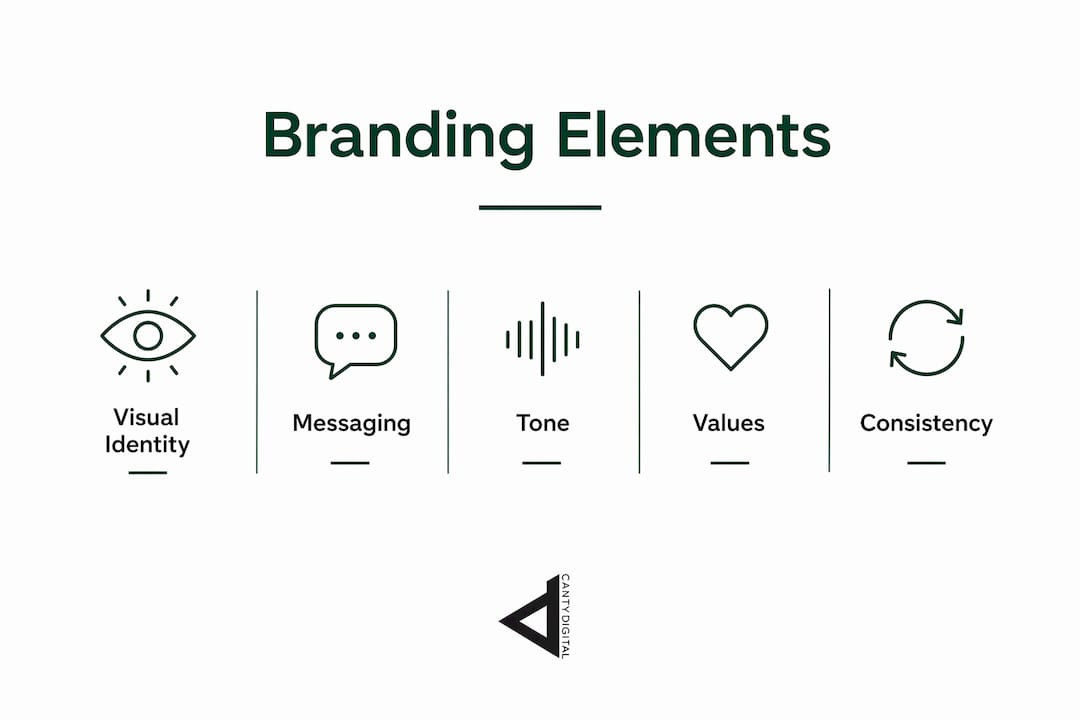
A consistent branding strategy rests on five interconnected elements. Miss one and the others weaken.
- Unified naming conventions. Consistent naming across domains and social handles is the foundation of brand cohesion. If your website is but your Instagram is @yourbiz_official and your Facebook is “Your Business Pty Ltd,” you are already fragmenting your identity.
- Visual identity. Your logo, colour palette, and typography must appear identically across every channel. This means the same hex codes, the same logo file versions, and the same font pairings. Understanding the core elements of modern branding helps you lock these down before inconsistency creeps in.
- Voice and tone. Tone and messaging consistency boosts brand recognition and trust. Whether you write formally or conversationally, that register must stay the same across your website copy, social captions, email subject lines, and customer service replies.
- Content strategy. On-brand, consistent content improves search rankings and brand perception simultaneously. Every article, video, or post you publish should reinforce the same positioning and values.
- Reputation management. How you respond to reviews, handle complaints, and engage with your community is part of your brand. Inconsistent quality in customer interactions undermines every dollar spent on visual identity.
| Branding element | What inconsistency looks like | What consistency delivers |
|---|---|---|
| Visual identity | Different logos across platforms | Instant recognition at every touchpoint |
| Naming conventions | Mismatched handles and domain names | Unified, searchable brand presence |
| Voice and tone | Formal website, casual social posts | Coherent personality customers trust |
| Content strategy | Off-topic posts and mixed messaging | Topical authority and SEO strength |
| Reputation management | Inconsistent response quality | Reliable customer experience |
What common challenges cause branding inconsistency online?
Most branding inconsistency is not caused by carelessness. It is caused by structure. Businesses grow, teams expand, and different people manage different channels without a shared reference point. The result is message dissonance that customers feel even when they cannot name it.
The most common causes include:
- Siloed teams. Fragmented teams managing different digital channels create cognitive dissonance in customers during the buying process. Your social media manager, your web developer, and your email marketer may all have different ideas about what your brand sounds and looks like.
- Designer and agency turnover. Every time a new designer or agency touches your brand without a clear brief, brand asset drift occurs. Colours shift slightly. Fonts get substituted. Tone changes.
- No single source of truth. Continuous brand asset management prevents brand fragmentation. Without a central repository containing approved logos, colour codes, font files, and copy guidelines, each team member improvises.
- Treating branding as a one-off project. Branding is not something you set up at launch and leave alone. It requires ongoing maintenance as your business evolves, new platforms emerge, and your audience’s expectations shift.
Pro Tip: Appoint a brand steward. This is the person responsible for auditing your digital touchpoints quarterly, updating your brand guidelines, and approving new assets before they go live. One person with clear ownership prevents the slow drift that erodes brand equity over years.
A dedicated brand steward improves consistency and brand integrity over time. This role does not need to be full-time. It needs to be deliberate. Pair the steward with a shared brand asset folder, a documented style guide, and a quarterly review calendar, and most inconsistency problems disappear.
How does consistent branding contribute to business growth and marketing ROI?
Brand consistency is a growth engine, not a cosmetic exercise. Companies with consistent branding report up to 23% revenue increase. That figure reflects what happens when customers trust you faster, convert more readily, and return more often.
“Brand consistency is a strategic growth engine, not a vanity metric. It removes friction and increases conversion without added marketing spend. Every dollar you invest in alignment pays back through lower acquisition costs and higher lifetime value.”
The mechanism is straightforward. When micro-friction points disappear, conversion rates improve without any increase in ad spend. A customer who arrives at your website from a social ad and immediately recognises the same visual identity, the same tone, and the same promise they saw in the ad is far more likely to complete a purchase. A customer who arrives and feels like they have landed on a different business will leave.
| Business outcome | How consistent branding drives it |
|---|---|
| Revenue growth | Up to 23% increase reported by consistently branded companies |
| Conversion rate | Reduced micro-friction lowers abandonment at decision points |
| Marketing efficiency | Aligned campaigns cost less to produce and perform better |
| SEO and topical authority | Consistent content signals expertise to search engines |
| Competitive differentiation | Unique brand voice stands out amid generic AI-generated content |
The competitive differentiation point deserves attention. A unique and consistent brand voice is a key differentiator in an era of ubiquitous AI-generated content. When every industry is flooded with generic articles and templated social posts, a brand that sounds distinctly human and consistently itself becomes memorable by default. This is not a future concern. It is the current reality of digital marketing in 2026. A well-executed branding strategy online now directly influences whether AI platforms cite and recommend your business.
Key takeaways
Consistent branding is the single most cost-effective way to build trust, reduce conversion friction, and grow revenue without increasing marketing spend.
| Point | Details |
|---|---|
| Trust drives purchase decisions | 81% of consumers require brand trust before buying, making consistency a commercial priority. |
| Micro-friction kills conversions | Mismatched branding across channels plants doubt that stops customers from completing a purchase. |
| Five elements must align | Naming, visual identity, tone, content strategy, and reputation management all need to work together. |
| Appoint a brand steward | One person with quarterly audit responsibility prevents the slow drift that erodes brand equity. |
| Consistency grows revenue | Consistently branded companies report up to 23% higher revenue, without additional ad spend. |
Branding is a discipline, not a deliverable
Most businesses treat branding as a project with a finish line. You hire a designer, get a logo, set up your social profiles, and consider it done. That is the most expensive mistake I see business owners make, and it rarely shows up on a balance sheet until years later when a rebrand costs ten times what ongoing maintenance would have.
The businesses I have seen maintain the strongest brand presence online are not the ones with the biggest budgets. They are the ones with the clearest internal systems. A shared Google Drive folder with approved assets. A one-page style guide that every contractor receives before they touch the brand. A quarterly check where someone actually visits every digital touchpoint and asks, “Does this still look and sound like us?”
What surprises most business owners is how quickly brand drift happens without those systems. A new social media manager uses a slightly different font. A freelance copywriter adopts a more casual tone. A web developer updates a page without checking the colour codes. None of these changes are dramatic in isolation. Together, over 18 months, they produce a brand that feels incoherent to customers who cannot explain why they trust you less than they used to.
The other thing I would push back on is the idea that branding consistency is only relevant for large businesses. A sole trader with a consistent visual identity and a clear, reliable voice will outperform a mid-sized competitor with a fragmented digital presence every time, because trust is not proportional to size. It is proportional to familiarity. Brands that show up consistently across platforms in 2026 will dominate their categories. That is not a prediction. It is already happening.
— Matthew
How CantyDigital helps you build a consistent brand online
A strong brand presence starts with a website that reflects your identity accurately and consistently. CantyDigital builds high-performance websites from the ground up with visual consistency, SEO, and AI-platform compatibility built in from day one.
The team at CantyDigital also delivers signal-based SEO that keeps your brand messaging aligned across search results, AI platforms, and digital directories. If your business is ready to audit its brand consistency and close the gaps that are costing you conversions, the website design FAQs page is a good starting point. For businesses in the Illawarra region, CantyDigital’s Kiama web design services offer localised expertise with the same commitment to brand alignment and measurable results.
FAQ
What is consistent branding?
Consistent branding is the unified presentation of your visual identity, messaging, tone, and values across every digital channel. It ensures customers recognise and trust your business regardless of where they encounter it online.
Why does branding consistency matter for online businesses?
Consistent branding builds trust, reduces micro-friction in the buying process, and directly improves conversion rates. Research shows companies with consistent branding report up to 23% higher revenue.
How often should I audit my brand consistency?
A quarterly brand audit is considered best practice. A dedicated brand steward reviewing all digital touchpoints every three months prevents the gradual drift that erodes customer trust over time.
What is the most common cause of branding inconsistency?
Siloed teams managing different digital channels without shared brand guidelines is the leading cause. Each team member improvises without a central source of approved assets, creating visible inconsistency across platforms.
Does consistent branding help with SEO?
A consistent content strategy aligned with your brand positioning aids SEO and builds topical authority. Search engines reward brands that publish coherent, on-topic content consistently over time.


